Wednesday, February 28, 2018

Thief In The Night


Day 138: One of the drawbacks to having multiple bird feeders (or any bird feeders at all) is that they tend to draw other types of unwelcome wildlife to the yard. Last year, I relocated well over a dozen squirrels and disposed of two Bushy-Tailed Woodrats, but the largest of the thieves won't fit in my only Havahart trap. Over the years, I've seen several families of raccoons as well as frequent solos. Sometimes one will sit just outside the kitchen's sliding glass door to engage in a hissing/yowling match with Skunk, who takes considerable offense at their presence. Tip just runs back and forth from the door to the living room window, trying to get the best view. Between cats protesting the invaders and Rocky shoving my garbage can and recycling bin around as he tried to figure out a way to get inside, I didn't get much sleep last night. That said, this is the first time I've managed to get a decent picture of one of the varmints, and as I stood there with the kitchen door open just far enough to stick the camera outside, it advanced toward the house until only a few yards away. I slammed the door shut with a bang, but even that only startled the 'coon momentarily. It moved as far as the fence, checked out the ground below the crow board, and then shambled off toward Clyde's house. Raccoons are just one of many reasons my cats are not allowed outdoors. A raccoon can easily kill a full-grown cat.

Tuesday, February 27, 2018

Parrot Tree


Day 137: First, they sent the scouting party and then, after having ascertained that the food source was reliable and replenished daily, the flock booked the Inn of the Contorted Filbert for an indeterminate stay. Guests who return every year, the Porch Parrots...Evening Grosbeaks...are, to put it simply, the most enjoyable gluttons at my feeders. They favour black-oil sunflower seed, and should I happen to let the supply run down, they'll perch on the shepherd's hooks closest to the window and let me know about it with impatient "CHURP!" demands. I've given up keeping a tally of the hundreds of pounds of seed they consume every year, but it's more than 10 fifty-pound bags between April and August, never mind the shoulder seasons. I've been meeting their nutritional requirements for over forty years, first at my home on a SW Washington prairie and now here. The flock I left behind when I moved from the prairie took up with another neighbour who has continued the tradition. My winter flock usually numbers 10-50 (15 in the tree as I write this), but in the summertime, the census more than doubles and adds in the Black-Headed Grosbeaks as well. My yard is always a chorus of happy bird voices, and what better thanks could there be?

Monday, February 26, 2018

Mr. Redwing


Day 136: Although winter isn't generally considered the best time of year for birding, you'd have no problem checking off a dozen or more species on any given day from the comfort of my living room. The Red-winged Blackbirds always stop through on their way to Mineral Lake, although they seem to have arrived a bit earlier than usual this year, and in greater numbers. In a few weeks, I should see their cousins, the Brewers, whose yellow eyes invariably send me scampering for the field guide before I remember who they are. Nesting Red-wings can be extremely territorial even toward humans, to the extent that a few years ago, a sign by a small pond in an industrial park warned visitors to "Beware Aggressive Black Bird." Air strikes were apparently fairly common in the parking lot.

Sunday, February 25, 2018

Stranded Knitting


Day 135: This is what happens when Crow is housebound: pink knitting. I'm going slightly stir-crazy, and I have to get rid of the leftovers from the pussy hats...I have to! I don't want to see them when I dive into the stash. Even so, this has been good practice in the technique of stranded knitting which, when all is said and done, is almost as pretty on the back as it is on the front. However, there's only so much pink I can take at a time. Even though I wasn't looking at my reflection in a mirror when I head-tested the hat on the left for fit, I could feel my gorge rising at the very thought. Seriously, I charge $2 more per pair of socks if somebody wants pink. I need green, people. I need trees and lichens and the smell of the forest and my boots pounding a trail. Lemme out of here before I go totally nuts!

Saturday, February 24, 2018

A Little Confused


Day 134: Although Varied Thrush (Ixoreus naevius) is said to be a year-'round resident here, they generally appear here in April or May. Consequently, I was surprised to see this guy at the feeder, munching down seeds instead of the usual diet of insects and fruit. Like the Black-Capped Chickadee, he seems to be a solo, as was the single American Robin who cropped up a few days ago. This tells me I'd better keep my eyes open for other isolated occurrences as the seasons progress. I may have a "big year" in my own back yard!

The call of the Varied Thrush is a long whistle, followed a few seconds later by another whistle on a different pitch, and accounts for one of the questions I'm most frequently asked by visitors to the Park: "Do you know what bird makes this sound?" Some of the human imitations are quite good, but even a poor rendition is easily identifiable as Varied Thrush. Once you have heard it and have had the bird identified, you'll never forget those haunting, paired notes. These birds prefer cool, moist evergreen forests such as those found in Mount Rainier National Park, and although the species is still listed as "common" in the Pacific Northwest, its habitat is shrinking due to logging outside of protected areas.

Friday, February 23, 2018

The Undarling Starling


Day 133: Despite his cute coat of neat "knit stitches" (the non-breeding phase colouration), the European Starling is no one's darling. Sturnus vulgaris was introduced to North America some time in the late 1800s and now outcompetes other birds ranging from swallows and bluebirds to larger species such as woodpeckers as well, taking over their nesting cavities and forcing them out of their territories. Starlings generally congregate in flocks which may consist of hundreds or thousands. Nest-building is begun by the males but is completed by the female. Nesting material may include bits of greenery and flowers placed by the male as an attractant; upon accepting him as a mate, the female removes the fresh bits, leaving only grasses, twigs and other pieces of dry material in the nest cup. Prolific, Starlings can raise up to three broods of 4-5 chicks per year. Oddly, the advance of agriculture has led to a decline in the number of Starlings present in Europe, although they are still a long way from being listed as a "species of concern" in their homeland.

Thursday, February 22, 2018

Currier And Ives Morning


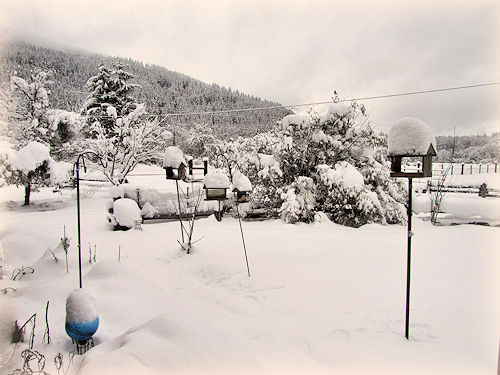
Day 132: For those of my readers who are unfamiliar with Currier and Ives, they were partners in a printmaking firm which specialized in hand-tinted lithographs, many of which were of snow scenes similar to that which appears out my kitchen door this morning. In addition to being hung as wall art, their designs have been used on Christmas cards, china and assorted other media and are familiar to many even though the names of the artists are not. Unspoiled snow always puts me in mind of them, and with eight inches of new snow...new, I said...having fallen overnight, I'm going to need to put on my tallest boots to cut a swath out to the bird feeders. I try to avoid leaving paths through the larger part of the yard, and since I have nowhere to go (I laid in groceries yesterday), I will decline my neighbour's offer of a plowed driveway.