365Caws is now in its 16th year of publication. If I am unable to post daily, I hope readers who love the natural world and fiberarts will seize those days to read the older material. Remember that this has been my journey as well, so you may find errors in my identifications of plants. I have tried to correct them as I discover them. Likewise, I have refined fiberarts techniques and have adjusted recipes, so search by tags to find the most current information. And thank you for following me!
Monday, August 31, 2020
Back To The Corner
Day 323: I was marginally beyond the halfway point in the hand-stitching of this piece when Mousie's grandmother's vintage quilt top arrived, with a somewhat greater sense of immediacy attached to it. I removed it from the stretcher frame I had been given by a thoughtful friend, tucked it in a stout plastic bag and put it away for the duration. The pattern is called "Patience Corner." Each block consists of four smaller blocks, each of which is made up of a rectangle and two squares, one of which is a solid colour. In this iteration, the position of the rectangles is rotated within each as well as in the larger blocks. The prints also occur in rotation; what is a rectangle in one large block becomes a square in the adjacent block, and each large block is themed blue, aqua, purple or green. The overall effect is rather kaleidoscopic. The pieces are shadow-quilted with a star at the centers of the small squares and intersecting diagonals in the rectangles. As with most quilts, the hand-quilting is best observed by flipping the work over. At the rate of one block per day and time off for good behaviour, I should have it done within six weeks.
Sunday, August 30, 2020
Definitely Anna's
Day 322: There was still some lingering doubt in my mind regarding my identification of what appeared to be an Anna's...no, a swarm of Anna's Hummingbirds visiting my yard. I'd never confirmed the presence of Anna's here before, although there was that one incident with the funny-coloured "Rufous" female at the feeder about ten years ago, captured only on video as a darting blur which may or may not have had a grey belly and a flash of red under the chin. But yesterday while I was riding my exercise bike, camera at my side just in case, half a dozen that-can't-be-Rufouses showed up, popcorning between the Sitka Mountain-ash and the feeder in the fuchsias. Then one perched on the preferred branch of the mountain-ash, remaining in place for several minutes as I stopped pedalling and picked up the camera. Then I got off the bike and edged closer...and closer...and closer...and..."Oh, look at those freckles!" I said in observation of the breast, "And you have a dark patch...was that a wink of red?...under your little chin!" The light had to be just right to catch it, and the camera did not, but it was enough to confirm that yes, the Ash Group is definitely comprised of Anna's, juveniles and females, and very possibly at least one subadult male. It's been an exciting summer at the feeders!
Labels:
Anna's Hummingbird,
birding,
Calypte anna,
female,
Sitka Mountain-ash,
yard
Saturday, August 29, 2020
A Quilt And A Crow
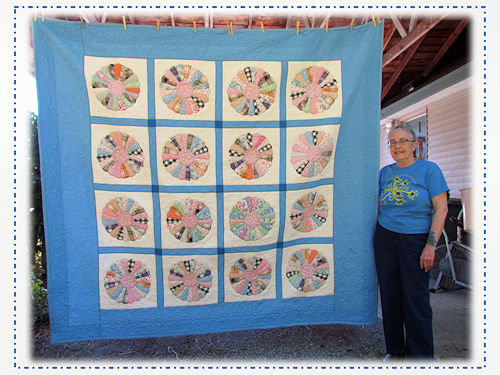
Day 321: For the historical record, here is Mousie's grandma's heirloom quilt, complete. When it arrived at my house, it consisted of sixteen hand-pieced Dresden plates mounted on a sheet of unbleached muslin. The plates were not aligned evenly, having as much four inches difference in their spacing, so after conferring with Mousie, I cut them into 16" blocks and put them back together using a blue cotton broadcloth to try to change the colour scheme from pink to blue. Darker centers were placed at each intersection of the "streets" between the blocks, and each of these was quilted with a shamrock to reflect Mousie's Irish origins. The streets were quilted from a commercial template I referred to as "DNA," a double-helix. I also used commercial stencils for the "hibiscus" flowers and leaves in the top and bottom borders, but the sides were my own designs. There are two repeats of four patterns on each side: a crow for me, a mouse for Mousie, a goldfinch for our other sister-of-the-heart and a hummingbird for Mousie's husband. They are set among oak leaves, acorns, butterflies, dragonflies and bees. As is the case with most detailed quilting, you don't see the design until you flip the quilt over, but I could not get a good image of the back side. It goes in the mail today, and after 11 months of work, I'm going to miss it. That said, I had taken another quilt off the frame before it was completed in order to work on Mousie's. That quilt is back on, and I should be able to finish it in about six weeks.
Friday, August 28, 2020
Red-Breasted Nuthatch
Day 320: Determined to capture a "field-guide" shot of my little Nutty friend, I settled into a lawn chair in the shade of the contorted filbert yesterday, camera on my raised knee and my finger on the shutter button. I knew I'd have to be quick. Nutty seldom remained on the feeder more than five seconds, and even then was in motion. I took lots of pictures of an empty platform, digital response even slower than my own, but eventually made this capture. I believe this is a male based on the richer "red" of its breast and underparts. That said, I may actually have a pair. Something which seemed to fly like a Nuthatch in my peripheral vision landed on the far side of the feeder while my attention was on this bird.
Now for a few cool facts about Nuthatches. First of all, look at the size of those feet! No wonder the little bugger is so good at hanging upside-down to feed. I'm sure the stubby tail gives him better balance in that position as well. Nuthatches are bark foragers, feeding primarily on insects. Perhaps they were drawn to my yard by the ash-borers which would devastate my Sitka Mountain-ash if it wasn't for the sapsuckers' diligence. Nuthatches are cavity-nesters, with a preference for holes in dead trees or dead branches. They line their nests with grass, pine needles and bark, and use finer material like feathers and fur to insulate them. They also apply a ring of resin to the edges of their entryways, the male "painting" outside while the female does the interior and, interestingly, they frequently use bits of bark to transport gobs of pitch to the nesting site, and as a tool to apply it. At the feeder, their preferred diet is black-oil seed (no shortage of that at this establishment!), and will also take mealworms and suet. They cache food for consumption later, and usually take the bigger, heavier bits first. If the items are too large to swallow, they anchor them in a crack and hammer them into smaller pieces. They are also known to associate with chickadees, another reason they may have appeared for the first time in my yard this year.
Thursday, August 27, 2020
Convolvulus Arvensis, Field Bindweed
Day 319: If you've ever walked through a field or even a patch of grass where this rhizomatous perennial weed grows, you will understand why it's called "Bindweed." Convolvulus arvensis is related to Morning Glories and as such, is a twining, tough vine which is resistant to breakage when one is trying to free one's ankle from its snare. Although it has a flower smaller than that of Morning Glory, it is similar in shape and may or may not be striped with pink. It is quite difficult to eradicate once established as I can testify; it still crops up occasionally in my yard and in the Barren Wasteland where I believe it was introduced in a package of commercially-marketed "wildflowers for Pacific Northwest gardens." It is certainly not the only weed I've found in those packets. California poppies are a popular addition, and they are becoming an issue in some areas of Washington where they are crowding out native species. As for the Bindweed, it has an extensive root system and is impossible to dig out. The best means of attack is to pull it regularly and often to prevent the plant from being able to photosynthesize.
Wednesday, August 26, 2020
Red-Breasted Nuthatch, Sitta Canadensis
Day 318: Although not a Life List bird for me, today marks the first appearance of a Red-Breasted Nuthatch (Sitta canadensis) at my present location. We had a rather startling introduction, little Nutty and I, meeting first as my hand entered a bird feeder from one side just as he entered from the other. We both jumped, but not very far. After pouring a cupful of black-oil seed in the tray, I proceeded to the enclosed feeder shown in this photo. Nutty sat atop the shepherd's hook as I loaded it up, less than six inches from my face. By that point, I'd recovered from our first encounter and met him eye to eye. "Oh! You're a Nuthatch!" I said, after noting his identification points (not that there's much chance of misidentifying one of these cheeky little birds). "I don't s'pose you'd let me go get the camera, would you?" Predictably, he was gone when I got back. I settled in to do some sewing in the kitchen, thought at one point that I might have seen him in the Philadelphus, and when I migrated back out to the living room and sat down at the computer, he made another split-second appearance at the feeder. Now thoroughly motivated, I moved the quilting frame to a spot where I had a clear view of both of the feeders he'd visited, set the camera on a stool beside me and waited. He returned several times, and I took half a dozen photos of an empty feeder, an equal number of shots of red-breasted blurs, and then at last he settled in long enough for me to focus the lens through the kitty-nose-printed double pane window and bingo, I got my documentation shot. Hopefully, he will allow me a field-guide photo session once he becomes accustomed to my presence...if, of course, he's not just passing through.
Labels:
feeder,
first occurrence,
Red-Breasted Nuthatch,
Sitta canadensis,
yard
Tuesday, August 25, 2020
Mystery Sparrow Solved
Day 317: It's been a year for hard-to-identify birds at my house. I finally confirmed that the swarm of female hummingbirds were indeed Anna's after a female Rufous came to visit the feeder only a few minutes after a distinctly grey-bellied guest left it, allowing me to note the differences almost as easily as if they had been side-by-side. However, a bunch of ground-foraging sparrows settled in to cause a great deal of consternation as I pulled bird book after bird book down from the shelf in an effort to sort them out. The fact that they were feeding on the ground, behaving like Spotted Towhees with a cute little jump backwards to raise seeds from the grass, was the first clue that they weren't any of my regular sparrows. My first thought had been that they were young White-Crowned whose "racing stripes" hadn't fully brightened up, but their streaky undersides and behaviour took that out of consideration. The same reasoning ruled out Golden-Crowned, which appear here more infrequently. Song Sparrow was ruled out by the presence of faint white wing bars on many of them, as did the lack of a "tie-tack" on the breast. Their call was something I don't hear regularly as well. Standing at the window trying to get a clear view and/or photos as they scrabbled about in the weeds which pass as my lawn, I hadn't been able to observe the dark line through the eye. Once I saw it, all the puzzle pieces fell into place: ground forager, streaky underparts, faint wing bars, weak "moustache"...I had a flock of young Chipping Sparrows (Spizella passerina), another infrequent visitor to my yard. Now the "pip!" calls made sense, as did pinkish-yellow beaks beginning to turn black at the tips. LBJ or LGB (Little Brown Job or Little Grey Bird) identifications can be tricky, especially when the bird hasn't matured into its adult colouration.
Subscribe to:
Posts (Atom)