365Caws is now in its 16th year of publication. If I am unable to post daily, I hope readers who love the natural world and fiberarts will seize those days to read the older material. Remember that this has been my journey as well, so you may find errors in my identifications of plants. I have tried to correct them as I discover them. Likewise, I have refined fiberarts techniques and have adjusted recipes, so search by tags to find the most current information. And thank you for following me!
Showing posts with label Baltic-style inkle band. Show all posts
Sunday, December 1, 2024
Nine Pattern Threads
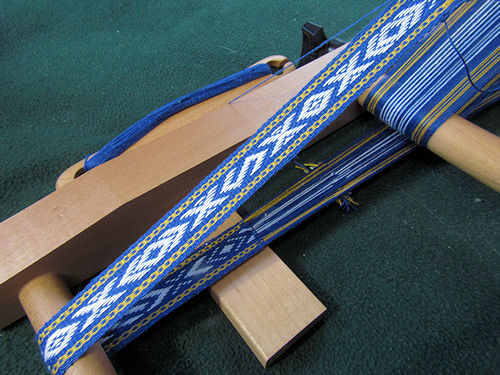
Day 49: In Baltic-style pickup on an inkle loom, warping is done in the usual manner with alternating threads being either heddled or unheddled, regardless of their colour. The pattern threads (white, in this case) are separated from one another by two ground threads (blue). For the sake of explanation, let's say that the first pattern thread is heddled. The two ground threads immediately following it will be unheddled and heddled respectively, and then the next pattern thread will be unheddled (i.e., opposite the first pattern thread). The warping continues across the pattern area in sequence (heddled, unheddled), meaning that because we began with pattern thread #1 being heddled, odd numbers will all be heddled, and evens will be unheddled. Since there are two possible sheds in inkle weaving, odds will be on the surface in one shed, evens in the other. Designs are created by either lifting pattern threads to the surface of their non-native shed, or pushing them down so that the weft thread passes above them, preventing them from appearing on the surface of the cloth. In this nine-thread pattern, there are a few passes where I have to do both in a single shed, i.e., lift some and suppress others. It is important to be sure that two ground threads remain between the pattern threads. If one happens to get picked up out of sequence, the result will be a twist which conceals part of the pattern thread, throwing the design out of kilter. When the weft is beaten into place, check to be sure that two ground threads appear between each pair of pattern threads, which here would appear as one white, two blues across the design area, ending with one white.
Wednesday, November 20, 2024
A Simple Wide Band
Day 38: Inky-Dinky Inkle is just about maxed out insofar as how wide a band he can hold. At this point, I have vinyl bolt covers and/or rubber bands around the tips of almost every dowel to prevent losing threads off the ends. But for all of how complex this wide band is, it's actually a very simple pattern. The checkerboard effect is all done with the threading. Only the seven green pattern threads need to be manipulated in the Baltic style. What does that mean, exactly? Since all threads are either heddled or unheddled, one shed raises three pattern threads and the other one raises four. That means that in order to create a design, some pattern threads will need to be lifted out of the lower shed and brought into the upper shed, or some in the upper shed will need to be pushed down so they don't appear on the surface. Sometimes it's necessary to do both on a given throw. For example, if I have four pattern threads in the natural shed (that would be numbers 1, 3, 5 and 7) and my pattern calls for only the three middle pattern threads to appear on the surface, I have to suppress 1 and 7 to get them out of my way, and I need to raise 4 so that it floats on top. Numbers 2 and 6 are already in the lower shed, so I don't need to do anything with them. The green diamonds are formed in eight passes, with a final pass to close the last one made. Balltic-style inkle weaving is really quite simple, although the notation for it can be very confusing to the beginner. Sometimes it's better to think about which threads need to be on top, and just make it happen.
Saturday, August 28, 2021
Baltic Inkling
Day 319: Long-time followers might possibly recall Crow's Project Rule which states that I may not have more than one project piece of any specific type of fiber art in construction simultaneously. There is some flexibility in the Rule when it comes to weaving because there are so many different techniques by which a cloth can be manufactured. At the moment, I have a lap throw on the floor loom, a scarf on a rigid heddle, and this Baltic-style band on the inkle. The floor loom is operated by my feet. The rigid heddle requires much arm/shoulder motion, and the threads on the inkle are largely manipulated by my hands. I prefer to have this variety so that I can change up the physical stressors as well as the mental focus necessary for each style of weaving. To me, they qualify as "different," if not perhaps as different as knitting is from crochet, even though they all fall within the category of "weaving." Baltic patterns such as this one demand a heavier single or a doubled thread for the design floats. These pattern threads are raised from below or pushed down from the upper warp layer as needed. The back side (visible in the lower background in the image on the left) is often as attractive as the charted design.
Labels:
Baltic-style inkle band,
band weaving,
inkle weaving,
weaving
Subscribe to:
Posts (Atom)


