365Caws is now in its 16th year of publication. If I am unable to post daily, I hope readers who love the natural world and fiberarts will seize those days to read the older material. Remember that this has been my journey as well, so you may find errors in my identifications of plants. I have tried to correct them as I discover them. Likewise, I have refined fiberarts techniques and have adjusted recipes, so search by tags to find the most current information. And thank you for following me!
Sunday, July 7, 2013
Talk To The Hat
Day 278: There's a story among those of us who have spent a good portion of our lives alone, and I first heard it related about a fence-rider in the Australian Outback. A new-chum happened upon him one day while he was holding forth an animated argument with his hat where it was jammed down on a post, and reported back to his mates at the bunkhouse that the poor old sod was going a bit barmy and might be due for a spell back among human companions. "Nah, 'e's orright," the new-chum was told. "Not to worry, so long as the 'at don't answer 'im back."
I haven't reached the point at which the hat responds in kind, although I do discuss the price of tea in China with various rocks, trees and small wildlife, and have been known to reproach a piece of barbed wire with an epithet and a demand to "Gimme back my sleeve, willya? I don't have all day to stand here waitin' for you to let go of me. I've got work to do." Brambles are often accosted in much the same manner, as are puncheon bridges which grab the point of a walking stick, refusing to give it up to allow me a normal walking pace. It sometimes seems that objects have minds of their own, particularly when met in Nature, but so far, none has expressed itself within my hearing.
Saturday, July 6, 2013
Mount Rainier
Day 277: You cannot live at the base of such grandeur and say that you take it for granted, not unless you are totally blind to the beauty of the natural world, but it occurs to me that in this blog, I have posted very few photos of Mount Rainier, giving short shrift to one of the most compelling forces in my life. It was having this mountain in my back yard, so to speak, which fostered in me a strong adventurous spirit. Even at a very young age, I felt the Mountain's pull. I wanted to explore the meadows, to hike, to climb, to learn the names of the wildflowers and to become a forest ranger. I would not say that Mountain set my path; rather, it became the path on which my every footstep fell, existing simultaneously as the route and the destination.
Once upon a whim, I left the state for a period and, too inexperienced in emotional attachment, did not recognize for some time the source of an incredible homesickness. It was not friends or family I missed. It was my Mountain on the horizon. When I discovered the shape of the hole in my heart, I beat-feeted it home for good.
When I walk out behind the Longmire housing compound during my lunch break nowadays, I Mountain-watch. A cloud on the shoulder of Gibraltar Rock, a cap on the summit, the debris of a rockfall darkening a glacier each give me a glimpse of the seasonal mood. No more than I could take this peak for granted could I refrain from imbuing it with a personality. This is the Mountain, regent of the Pacific Northwest, and I'll thank you to spell that with a capital M, please.
Friday, July 5, 2013
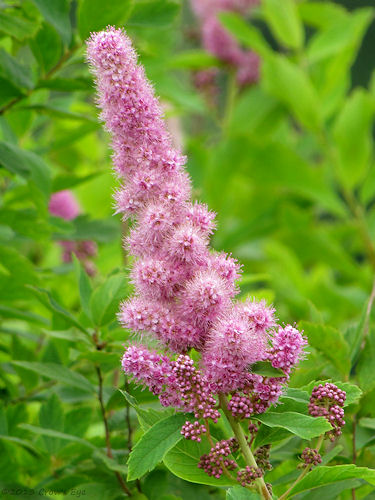
Hardhack, Spiraea Douglasii
Day 276: Hardhack is a member of the family of Spiraeas, but instead of bearing its flowers in a flat cluster, it sends up tall spikes. Technically a shrub, it is a rather weedy plant, often forming thick cover for wildlife where it fills in wetlands. It is the most common Spiraea in western Washington and a cousin, Spiraea menziesii, is found more often on the east side of the mountains. The two may be distinguished by the presence or absence of fine, matted hairs on the back side of the leaves.
Thursday, July 4, 2013
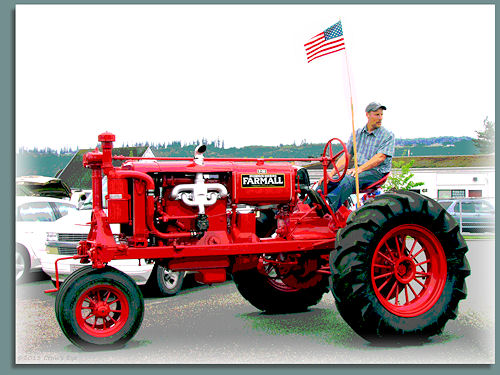
A Farmall Fourth
Day 275: As much as I love watching parades, I enjoy actively participating in them even more. Today, it was my privilege to be one of almost two dozen uniformed representatives of Mount Rainier National Park who swept through Eatonville, handing out candy and high-fives to the kids, waving acknowledgement to the community residents and smiling in general goodwill. It was perhaps our best Park turnout ever, and the small-town populace lined both sides of the streets elbow to elbow, ranked three to five deep in places, over a one-mile route. The high-school band followed directly behind us, marking a lively tempo which inspired some -ahem!- to "boogie" joyously. Our group was fairly near the front of the parade, so when we had completed the circuit, we stood on the sidelines and watched as other groups passed by. As in many other rural areas, tractors come naturally to a parade. I was delighted to see two Farmalls bringing up the rear and managed to catch this shiny red beauty before she headed back to the barn.
Labels:
Eatonville,
Farmall,
Fourth of July,
MORA,
parade,
tractor
Wednesday, July 3, 2013
Remembering George
Day 274: We called her George. It started when I was about 10 years old, on the occasion of a brutal self-inflicted haircut which left her with a one-inch pigtail in the back. "Mama, you look just like George Washington," I said, and "George" stuck. She was George to my friends, George to her own. Not too many people have a mother named George.
George's favorite flower was Skunk Cabbage, but running a very close second were "Turk's Caps," miscalled because that was how her father referred to them because they looked like the Turk's Caps he knew from the midwest. I grew up calling them "Turk's Caps," and only in adulthood became aware of the error. Even now have to remind myself that they are really Columbia Lilies, the Pacific Northwestern cousin. What the heck, if your mother's name is George, surely a tiger lily by any other name is still a tiger lily.
Labels:
"Turk's Caps",
Columbia Lily,
George,
Lilium columbianum
Tuesday, July 2, 2013
Menzies' Larkspur, Delphinium Menziesii
Day 273: No matter how many wildflower pictures I may bring home from a hike or bike ride, Larkspur is almost guaranteed to trump anything else. The intense blue stops you in your tracks.
I bicycled thirty-five miles on the Yelm-Tenino and Chehalis-Western Trails today as part of a patrol for invasive plants, and fortunately, Larkspur isn't on the list. That said, I found a massive infestation of English Ivy and two small patches of Yellow Archangel which will be duly reported.
It was a lovely day for a ride. After rescheduling work because I expected today to be in the 90s again, the forecast changed overnight. I awoke to sunny skies and the promise of somewhat cooler temperatures, so I threw the bike in the car and headed for Flatland. As is so often the case, I drove down into overcast by the time I reached Eatonville. The clouds persisted until after noon and a fresh breeze kept the sweat from rising. On the way home, I rewarded myself with an iced mocha from my favorite espresso wagon.
Monday, July 1, 2013
Crow's Crows
Day 272: "Where did you get your nickname? Is it a Native American name?" If I only had a nickel for every time I've been asked those questions, I'd be a rich Crow. The answer to the second is that no, it is not a Native American name, although it could be said that it was derived in much the same way that many cultures name their children at birth and then another appellation is given or chosen at adulthood as the person's "real" name. This leads into the answer for the first question: I have been associated with crows since I was very young.
My dad started it. He was a fan of the "Dick Tracy" comic strip, in which a little girl who was called Wings appeared occasionally. She had long, black hair which was worn swept back from her temples in a somewhat more flamboyant manner than the way I wore my own long, black hair. Daddy started calling me "Wings," and when we were working out in our house vegetable garden, he would recite poems to me which often contained crows. "One for the worm, one for the crow, one to die and one to grow," he would say as he placed four corn kernels in each hill, and would then tell me that the corn had an even greater chance of survival since it was covered on two accounts: one to grow, and another to grow for the crow, i.e. for his Wings.
With this initial association, a love of Edgar Allan Poe's "Raven" was a natural outgrowth. I began looking for crows in other venues and never failed to speak with them when I saw them in the wild. Their intelligence appealed to me, as did the fact that they were social pariahs for the most part, as was I. The more I observed them, the more fascinated I became with the species overall, seeing perhaps more of myself in them (both good and bad) as I came to know them better. I learned to speak a few words of their language (ever so much more complex than any human speech) and took to feeding them in my yard. They grew to accept me, many times coming down to the "crow board" before I'd walked five feet away. My studies of them deepened and then widened to include the other corvids, but by that time, I was already known as one of the flock, a Crow.
In the Native American fashion, Crow could be said to be my "spirit guide"; in the Australian Aboriginal culture, my Dreaming. Crows and I are inseparable. Raven, that much-revered benevolent trickster of the Pacific Northwest's First People, is a friend by extension, as are the family of Jays. Crow watches out for me, alerting me to unusual things in the forest, sometimes guiding me to discoveries and adventures. Crow teaches me as I observe his relationship with the natural world, and his interactions with members of his own kind and with other species. Crow is ever present in my life, and I have only to give a quick caw from the back porch to find his ready companionship. Caw! And that's how I got my name.
Subscribe to:
Posts (Atom)