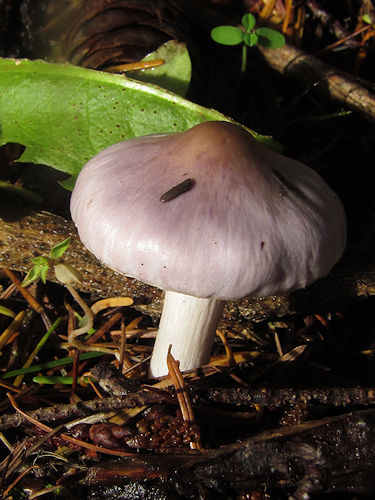
Day 46: A more detailed analysis of its spores under the microscope has caused me to revise my original identification of this mushroom as Cortinarius salor to C. iodeoides, a species known to occur in the area just south of me by a few miles. That it was a Cortinarius was never in doubt. Observe the spiderwebby cortina (veil) which in this young specimen is still attached to both cap and stipe. This characteristic is what gives Cortinarius its genus epithet. That said, the genus is one of the largest in Fungi with well over a thousand species. Some can be identified by sight, but others require microscopic examination or chemical testing (I also did a chem test to separate two possible candidates, C. iodes and C. iodeoides).
My first attempt to obtain a spore print flopped miserably. I am always hesitant to murder a mushroom, so picked up a previously detached cap from the ground where it was lying upside down. I didn't take into account the rain which had occurred only a few hours earlier until I thought about it retrospectively. Oh, yeah, okay...all the spores washed out. Nobody home. Since I had a fairly good colony of cute little lilac Cortinarius, I figured I could sacrifice one in the name of science. After a day, a nice collection of brown spores had accumulated in the paper-lined petri dish. Then it was time to transfer them to the microscope. If my kitchen sprouts Cortinarius at some point in the future, no one should be surprised. Under magnification, the spores revealed themselves to be oval to almond-shaped, which immediately ruled out C. salor. Its spores are round. Spores 7μ in length distinguished it from C. iodes at 10μ.
You may have noticed that the spores in the above photo appear on a black background. This is because I use a darkfield microscope to make them more visible. In fact, other than the stereoscope I use to more closely observe macro characteristics of lichens, the darkfield is my most commonly used 'scope. It lives on my dining table, hence the comment about culturing Cortinarius in the kitchen. Generations of naturalists before me had to do with much less optimal working conditions, and most of them survived.