Showing posts with label Turdus migratorius. Show all posts

Thursday, September 28, 2023

Gate Crashers


Day 350: You know the profile. There's always the group who arrive at the party half an hour early, and start in on the food as soon as it's put on the buffet. Robins...American Robins...Turdus migratorius...are rude. A flock of at least two dozen showed up this morning to start in on the Sitka mountain-ash berries. I can only hope the Cedar Waxwings arrive while there are still some left. Okay, I appreciate the cleaning service, because a driveway full of mountain-ash berries leaves your shoes rather sticky after you've gone out to get the mail, but I did not put out this banquet for gluttons. It was meant to nourish the Waxwings as they begin their long journey southward. Robins migrate, yes, but not as far. Still, I suspect a flare has gone up, and it won't be long before the Waxwings notice the increased activity in my yard. They'll be here, and I'll be watching for them.

Wednesday, October 26, 2022

In The Absence Of Waxwings


Day 13: Not a single Cedar Waxwing has come to my yard this fall, nor have they shown up in Cornell's Birdcast migration data for my county. They passed through in the spring, so I can only assume that the recent abundance of wildfire smoke has directed them to another route. That said, my Sitka Mountain-ash trees were laden with berries, and some had begun to drop onto my gravel driveway. Raking leaves out of gravel is one thing, messy berries quite another. I wondered what I was going to do without my clean-up crew. I needn't have worried. A flock of American Robins (Turdus migratorius) cleaned one tree in a matter of days and are now working diligently on the second. They are even foraging deep in the junipers for the ripest berries. Boozy birdies, some of them seem a little shaky on their pins for having overindulged on those which have begun to ferment.

Sunday, April 10, 2022

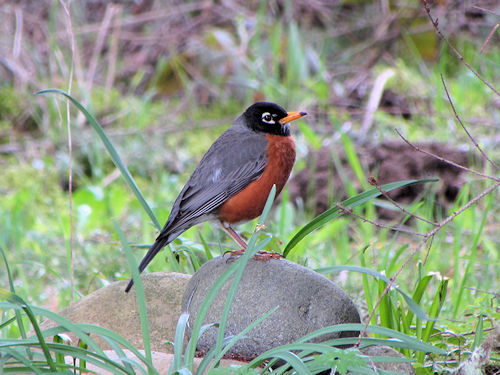
American Robin, Turdus Migratorius


Day 179: There is always some amount of confusion when I say "robin" to any of my English/Australian/New Zealander friends because the bird they call by the same name is a different breed of cat...er, of feathered friend. The European Robin (Erithacus rubecula) is significantly smaller and cuter, and belongs to the family Muscicapidae which was split taxonomically with Turdidae in 1998, thanks to DNA research done by Charles Sibley (who, incidentally, is not related to ornithologist David Sibley). Our American Robin (Turdus migratorius, above) belongs to the sister family, Turdidae. To put the two species in perspective for my global readership, a European Robin weighs less than an ounce. An American Robin may weigh in at three ounces or more! The song of the European Robin is more melodious and varied than that of the American Robin which, right before sunrise outside my bedroom window, consists of an ad-nauseam repeat of "Cheery-up, cheery-up, cheery-up, TWEET!" which serves as my springtime alarm clock.

Friday, October 1, 2021

White-tailed Robin


Day 353: For the first time ever, I have observed a White-tailed Robin (Turdus albobuttus) in my yard. Of course, I'm pulling your leg a little here. I suspect that this American Robin is showing evidence of age or injury, as opposed to true leucism which arises due to defects in pigment cells, although that's also a possibility. That said, I have noticed more birds across several species this year which exhibit this trait, and generally in tailfeathers or on the top of the head. One notable exception to that was a crow I observed in early spring with a wide white patch on one wing. The other crows regarded it as a social pariah and drove it away. This Robin has a few white flecks on its crown.

Robin Whitebutt showed up with dozens of his relatives and a flock of Cedar Waxwings who set to work stripping my two Mountain-ash trees of berries. The Waxwings showed a marked preference for the native tree and left as soon as they'd polished it off, leaving the nursery cultivar for the less discriminating robins. The robins returned to finish the job the following day, and it was fun to watch them fluttering like hummingbirds while trying to get a fruit loose from the cluster. By the time evening came, even the berries which had dropped to the ground had been gobbled up, and less than a dozen still hung on the tree, apparently too firmly attached for the birds to pull off. Ordinarily, this is a process which occurs over 4-7 days, with Waxwings present most of the time. In this case, the harvest was done and dusted in less than 36 hours, and Whitebutt left with a full tummy.

Sunday, October 4, 2020

American Robin


Day 357: The American Robin (Turdus migratorius) is so very different from what residents of England and Europe know as a robin or robin redbreast. The European Robin (Erithacus rubecula) is not even related to the thrushes, but rather to the family of Old World flycatchers and chats. You Aussies add another level of complication to the issue of common names. Attempts to introduce the European Robin down under were unsuccessful, and your "robin redbreast" (Scarlet Robin, Petroica boodang) is more closely akin to crows and jays. Yeah, that surprised me, too. Let's do some comparisons to put the three species into perspective for my readers who are separated from me by sizeable bodies of water.

Facts about Turdus migratorius:
Weight, 2-3 ounces (75-90 gm)
Wingspan, 12-16 inches (30-40 cm)
Length, 9-11 inches (23-28 cm)
Males and females are similar

Facts about Erithacus rubecula:
Weight, 0.7-0.8 ounces (16-22 gm)
Wingspan, 8-9 inches (20-22 cm)
Length, 5-5.5 inches (12-14 cm)
Males and females are similar

Facts about Petroica boodang:
Weight, 0.4-0.5 ounces (12-14 gm)
Wingspan, 8 inches (20.5 cm)
Length, 4.5-5.5 inches (12-13 cm)
Males more brightly coloured than females

So y'see, when we're talking about robins, we could be talking about apples and tomatoes, or even apples, tomatoes and blueberries here. This is why I use Latin names whenever possible.

Sunday, May 24, 2015

Yard Birds


Day 223: Five years ago, I got new neighbours, noisy ones. They had a kid (young), they had dogs, they had parties, they had arguments, and they had cell phones which must not have worked indoors because they talked on them on their porch at all hours of the day and night. The bird population which I had cultivated over twenty years dropped to an all-time low in the first two weeks, never returning to more than about 60% of the former census. Those birds which did come to the feeders were jumpy and nervous even around me, a radical change from my having to ask them to move over when I went to put out breakfast. My bird-watching activities also suffered. While I had formerly spent many hours sitting on the porch in the company of my feathered friends, now I seldom stayed out more than five minutes at a time, hoping to avoid being engaged in complaining one-sided conversation. In short, I readjusted my lifestyle, all but giving up an activity which had previously given me great enjoyment. It goes without saying that when the neighbours announced their intention to move a few weeks ago, I felt secretly pleased.

The house is unoccupied now, soon to be demolished and with no certain plans for the property's future. Although thieves have already ransacked it, one good thing has come to pass: my bird census is visibly growing, as shown by these photos all taken within half an hour pleasantly spent on my back stoop.

Saturday, January 4, 2014

Haven In The Hawthorn


Day 94: You'd think Robin Red-Breast would freeze his little gizzard gulping down icy hawthorn berries, but as I watched, this bird swallowed at least half a dozen, rolling them around in his beak to knock off the larger bits of ice. It was party time in the hawthorn, Robins competing with Steller's Jays for their breakfast fruit. Oddly, the birds leave the tree alone until the temperatures plummet. Perhaps these berries are the avian slant on frozen dessert.