Showing posts with label Western Tanager. Show all posts

Thursday, May 23, 2024

Proof Positive - Tanager


Day 223: Got him! Here's proof positive that I have a Western Tanager (Piranga ludoviciana) hanging around the yard. I've had glimpses of him in years past, glimpses and not much more, a flash of yellow and orange zipping past the kitchen window or perched on the far side of the contorted filbert and almost entirely obscured by leaves, unmistakeable for anything else but too elusive for my lens. Yesterday, I just happened to have my hand about three inches away from the camera when he landed on the shepherd's-hook outside the window. By the time I'd picked it up and was ready to snap his picture, he was gone. Surprisingly, he came back a few minutes later, enticed by the suet feeder which at that point was occupied by a different bird. Waiting his turn, he perched on the wind chime and...CLICK!...I had confirmation in the bag. Isn't he a beauty?

Monday, June 27, 2022

Western Tanager, Documented


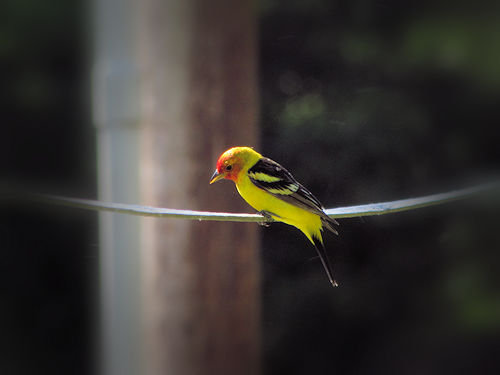
Day 257: I had a lot of help from Mother Nature in capturing this image of a Western Tanager (Piranga ludoviciana) who was visiting my yard. I've found these birds to be difficult to document photographically. They always jump out of the frame a fraction of a second before the shutter engages, or they hide among foliage, only revealing themselves with the occasional tantalizing flash of orange and yellow. How did Ma help me out? Well, we're building up to a heat wave here, and as a consequence, it's been quite windy. Mr. Tanager (yes, this is a male) was struggling to keep his balance on the wire and was so preoccupied that he didn't notice when I opened the back door and stepped out onto the porch. I had just enough time to snap four or five shots at 74x digital zoom, this being the best of the lot. I knew it had been too much to hope for his appearance on my Big Day because Tanagers don't often come to the yard. That said, this is the second time I've seen him this year.

Friday, May 28, 2021

Paint A Mile Of Canvas


Day 227: They say once you have "painted a mile of canvas," almost anyone will notice that their skills have improved. I have now illustrated over 30 birds and a small handful of flowers in addition to making a portrait of my kitty, and I am definitely becoming more familiar with what to expect from the various media I'm using in my sketches. I'm still exploring "style" and am discovering that it may need to be flexible when working with different subject matter. Inking a few feathers on a bird is one thing; applying it to a flower's center is another. I have yet to attempt watercolours seriously, having only recently begun to accumulate the hues I want in my palette. These were rendered in Prismacolor pencil and watercolour pencil, a combination I am coming to appreciate more and more. From the top left: Downy Woodpecker (possibly my best work so far), California Scrub-Jay, Red-Breasted Sapsucker, Northern Flicker, Western Tanager.

Thursday, July 11, 2019

Western Tanager, Piranga Ludoviciana


Day 271: Flighty Western Tanager (Piranga ludoviciana) isn't the easiest bird to photograph. One occasionally comes to my yard, but invariably hides in the tangled leaves of the contorted filbert. However, when Team Biota spotted one in Longmire, we went into full "Big Year" mode and pulled as far off the road as the narrow approach to the bridge would allow, and all four of us jumped out with cameras at the ready. While none of these is an ideal field-guide shot, they are still the best Tanager photos I've achieved, definitely sufficient for a positive ID. A female was more elusive, flitting from tree to tree but always landing in the protective cover of foliage. Formerly placed with other Tanagers, Western Tanager has been reclassified into the family of Cardinals. Western Tanager's diet consists primarily of insects, although they also consume various fruits. Locally, their diet includes elderberries, serviceberry and cherries (wild or cultivated). They are also an important control for tussock moth here in the Pacific Northwest.