365Caws is now in its 16th year of publication. If I am unable to post daily, I hope readers who love the natural world and fiberarts will seize those days to read the older material. Remember that this has been my journey as well, so you may find errors in my identifications of plants. I have tried to correct them as I discover them. Likewise, I have refined fiberarts techniques and have adjusted recipes, so search by tags to find the most current information. And thank you for following me!
Showing posts with label hosta. Show all posts
Tuesday, July 25, 2023
Diamonds
Day 285: Diamonds. Or perhaps more precious than. In the last twenty-four hours, my pluviometer registered a little more than a quarter inch of rain, the first which has fallen since June 21st. That may not seem significant to those of you who live in drier climates, but to a Pacific Northwesterner, the absence of rain for such a protracted period is something worthy of remark. By now, the moss on car bumpers has dried up, the green nothern faces of our homes have turned brown, and we've all invested in several gallons of skin moisturizer. We're worried about forest fires, grass fires, idiot-fool campers' campfires because we are surrounded by timber/tinder. But taking a broader view sends cold winter chills up our spines as the rest of the country is withering in unprecedented heat. Diamonds, precious diamonds are scattered in my yard.
Sunday, July 4, 2021
Hosta Inflorescence
Day 264: Well, I got through last week's heat wave by dint of having air conditioning, a luxury almost unheard-of in the Pacific Northwest. My garden, however, did not fare as well. Almost every berry on the kiwi vines, currant bushes and gooseberries dropped like a stone. Oddly, the blueberries (scant as they are) held on, but it wasn't just bad for fruit. The leaves on a number of plants withered in the drying winds which accompanied the high temps, and the hostas in particular suffered where they were exposed to it. The edges and tips curled and shrivelled, but deep within the shady centers of the plants, the emerging inflorescences survived. Various hostas display a variety of floral structures, but I love this one for its resemblance to the artichoke. Tipped with purple, its creamy green bracts are quite lovely.
Thursday, July 12, 2018
Dinosaur Chutney
Day 272: Black as coal tar, hot as lava! That's what makes dinosaur chutney my favourite condiment for meat. Originally published in some 1930s cookbook somewhere as "Abdul's Brigadiere Chutney," my mom's version became known as "dinosaur chutney" in our family because it looked like something you'd dredged up out of the La Brea Tar Pits. I have never been able to locate the source recipe, but I do know that it specifies that it should be made with mangos, although peaches are a very acceptable substitute. A batch lasts me several years because I'm not big on beef. Chutney is a way to mask the barnyard taste. It also goes well on pork or chicken, but it is a must for "luxury protein," i.e., dead cow.
A few weeks ago, I got hungry for red meat and broiled a steak. I ate half of it, smothered lavishly with dinosaur chutney, scraping the last tasty dregs from the jar with my finger. The second night, I intended to eat the other half of the steak cold, but when I opened the cupboard to get a new jar of dinosaur, I had a Mother Hubbard moment. No! I'm out? How did that happen? Fortunately, I still had pear-tomato chutney (best for pork), and was able to cover the bovine flavour enough to pronounce it edible. And then I started watching my favourite fruit stand for Yakima peaches, and yesterday, I scored. They weren't quite as ripe as I'd have liked, but that just meant I had to cook the chutney a little longer. A batch-and-a-half yielded three pints, six half-pints, one four-ounce and enough leftovers for a couple of steaks.
So...how do you make dinosaur chutney? Fyrst catch ye an dinosaure...
3 pounds of ripe peaches or mangos, chopped fine
6 cups of sugar
3 ounces of minced garlic
5 tsp. dry ginger
1 generously heaping Tbsp. chili flakes (I usually go even heavier here)
1 pound raisins
2 cups white vinegar
2 Tbsp. salt
Combine ingredients and cook at a gentle boil for at least an hour (cooking time depends on how much liquid the peaches put out). Test for consistency by dropping a little of the syrup on a plate. When it is cool, it should be somewhat sticky, but not quite jelly-like (yesterday's batch cooked over two hours to reach the right consistency). As an alternate test, the syrup should just barely fall in drops from a spoon turned sideways, unlike jelly which will "sheet" from the spoon. Only experience will tell you when it's right. Once the chutney is cooked to the proper consistency, pour it into sterilized jars, cap and process in a boiling-water bath for 15 minutes. Yield for a batch will be roughly 7-8 half-pints.
Sunday, May 11, 2014
Kevin Turtlesitter
Day 221 (by request of a mutual friend): On our way to the annual Volunteer Brunch yesterday, I mentioned to Kevin the fact that I needed a photo of something caged outdoors for the monthly photo "scavenger hunt" which sometimes inspires the material for these posts. He gave the project about three minutes' thought and then replied, "I'm taking care of Ron W's turtles while he's gone. They're in an outdoor cage. I don't know how good a subject they'd be, but I have to run over there after we get back and you're welcome to come along."
The turtles (and there are actually three of them, although only one
appears in this photo) eat earthworms. After I had taken several photos
of one of them, Kevin went about his duties as turtle-sitter, entering
the spacious enclosure to drop the worms in the turtles' water dishes.
I'm not sure why he hunkered down, but it gave me an unexpected
opportunity to capture both the sitter and one of the "sittees."
Wednesday, July 31, 2013
Flowers Of The Hosta
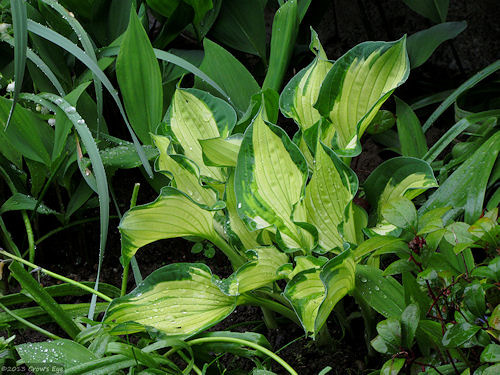
Day 302: Hostas are generally considered a foliage plant, but their blossoms are certainly worth mention. Most are white or lavender, although there are a few varieties which verge on purple or magenta. They are borne on scapes (stalks) which rises a foot or more above the leaves. Foliage may be green, grey-green or green patterned with yellow or white. Variegated species tend to display the best color when grown in partial shade. Don't dismiss Hostas from consideration for a "flower" bed! They will reward you doubly.
Wednesday, May 29, 2013
Glowing Gold
Day 239: When the heat pumps were installed, the outdoor unit for the main one needed to be placed smack on top of the Wintergreen and "Gold Dust" Hostas I'd so carefully cultivated. I was more than a little dismayed at the thought, but had no choice but to move them. I lifted as much soil as I could, dropped the shovelsful into dishpans and then replanted them, disturbing the root masses as little as possible. I expected them to suffer something for the transition, or perhaps just up and die.
Maybe it was the soil closer to the front steps. Maybe it was a change in light. Both plants not only reestablished, but burgeoned in their new environments. Or maybe it's the circulating air, product of the heat pump fan. For whatever reason, they like their new homes, and I am very happy about that!
Subscribe to:
Posts (Atom)