Showing posts with label inkle weaving. Show all posts

Monday, August 11, 2025

An Inch Per Minute


Day 303: Of all the ways I know to make cord...finger-loop braiding, kumihimo, knitting dolly, i-cord maker, tablet weaving and half a dozen more...none is as fast as inkle weaving. The process is simple. Using an odd number of warp threads, the shuttle is always passed through from the same side, but must always be brought back to that position by passing either under or over the work consistently. I prefer to take it over the work because I can see the threads curling in to form the cord. If I want to add a core thread, this means I can see where it lays in the center. Because I am right-handed (ambidextrous, actually, but I inkle right-handed), I pass the shuttle through the shed from right to left, then take it over the work and back to the right side for the next pass. Just for giggles, I timed my progress. With this weight thread (8/2 cotton), it takes me one minute to make one inch. For that, there's no reason I can't have "designer" bootlaces! (Footnote: I will wax them for additional strength by running them across a bar of paraffin several times and leaving them to rest in a hot, sunny window for a few days.)

Saturday, July 26, 2025

Weaving A Rainbow


Day 287: A friend contacted me a week ago to see if I had any woven bands she could use for a strap for a musical instrument. I asked for specifics (width, length, colours), and when she replied, I put together a photo with multiple options. She selected two from the lot, one of which was the last bit left from a card-woven rainbow, but we weren't sure it would be long enough to suit her purpose. As it turned out, it was just long enough. Now it just so happens that I'm in the middle of trying to tidy up old projects before starting a new one (Max, my Bergman floor loom, is empty!), but I wanted to make another rainbow band to replace the one I'd sent out. Since I didn't want to do another card-woven one, that meant getting a tediously boring piece of Baltic pickup off my largest inkle loom. Job done, I loaded the inkle with a rainbow. Because it's plain weave, it's going very quickly. Over there on the other side of the room, the 30+ feet of band intended to go around the borders of a handwoven tablecloth is almost ready to take off the Glimakra. That will leave two inkles, the Leksand band loom and my table loom to empty. Oh, and both rigid heddle looms, but those are both quick projects.

Monday, March 3, 2025

Inkle Pickup


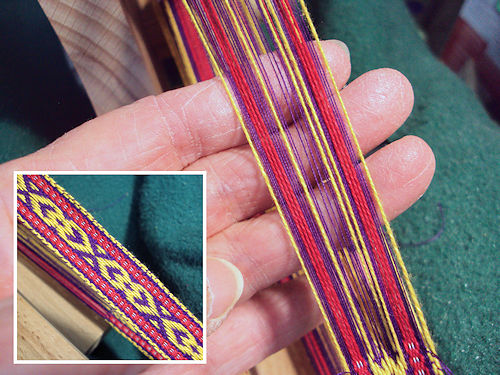
Day 142: In the last few days, I finished up two inkle-loom bands. The sheep krokbragd went quickly, even more quickly than I'd expected. The green-gold band took a little longer because it used regular sewing thread for the ground (background threads), but I enjoyed working with the fine thread so much that I immediately replaced it with another sewing-thread band. If I had thought the green threads were difficult to see, that was because I hadn't tried dark purple yet! Each gold thread in the pickup design has to be separated from the next gold thread by two purple threads, and these purple threads have to be kept in precise order. Even slight variations of tension in the warp threads can make this hard to achieve. I've found that if I separate the threads as close to the heddles as fingers will allow, I am less likely to make mistakes. The finished band will be approximately 60" long.

Sunday, December 1, 2024

Nine Pattern Threads


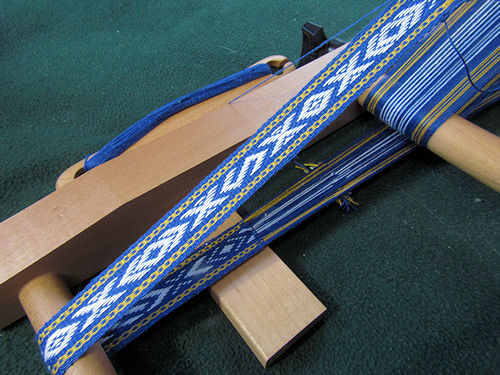
Day 49: In Baltic-style pickup on an inkle loom, warping is done in the usual manner with alternating threads being either heddled or unheddled, regardless of their colour. The pattern threads (white, in this case) are separated from one another by two ground threads (blue). For the sake of explanation, let's say that the first pattern thread is heddled. The two ground threads immediately following it will be unheddled and heddled respectively, and then the next pattern thread will be unheddled (i.e., opposite the first pattern thread). The warping continues across the pattern area in sequence (heddled, unheddled), meaning that because we began with pattern thread #1 being heddled, odd numbers will all be heddled, and evens will be unheddled. Since there are two possible sheds in inkle weaving, odds will be on the surface in one shed, evens in the other. Designs are created by either lifting pattern threads to the surface of their non-native shed, or pushing them down so that the weft thread passes above them, preventing them from appearing on the surface of the cloth. In this nine-thread pattern, there are a few passes where I have to do both in a single shed, i.e., lift some and suppress others. It is important to be sure that two ground threads remain between the pattern threads. If one happens to get picked up out of sequence, the result will be a twist which conceals part of the pattern thread, throwing the design out of kilter. When the weft is beaten into place, check to be sure that two ground threads appear between each pair of pattern threads, which here would appear as one white, two blues across the design area, ending with one white.

Sunday, December 5, 2021

Sheep In The Daisies


Day 53: I can't help it. I love sheep, and couldn't resist doing yet another variation on this inkle-woven krokbragd design, this time putting daisies in their field. In hindsight, I wish I'd made the stems a little longer and darker green, but that just means that I have an excuse to make more. Krokbragd on the inkle loom is fun to do, but it does not lend itself to complicated designs. Creating a pattern could be likened to designing a font for a nine-pin printer (remember those?), because although it can be made as wide as you like, the actual pattern must develop over four rows, two of which are identical and alternate. In this case, row one separates the sheep and is also the center and stem of the daisy, then row two creates a leg and a leaf, row three is the sheep's body and face, and also the space between the daisies, followed by row four which is a repeat of row two (i.e., the second leg and leaf). Krokbragd is not reversible. Solid blocks of colour appear on the reverse, visible here where the ribbon turns back on itself. Inkle weaving of any type (krokbragd or otherwise) is limited by the size of the loom. Three yards is the biggest flock I can manage.

Tuesday, November 16, 2021

Just Flocking Around

Day 34: Baa! Back in the days when I had my flock, I was primarily raising them for wool with mutton and lamb-burger as an annual bonus. For the most part, my sheep were "black," which is to say that their wool ranged in colour from dark charcoal through greys and brownish-greys to a soft silver. The natural colours were what I liked best for spinning, and I usually sold my white fleeces to Pendleton rather than keeping them for my own use. It seemed appropriate, therefore, that after finishing an inkle band of white sheep, a herd of brown woollies should follow. Truth is, this krokbragd design is fun to weave on the inkle loom. The catch is that the nature of krokbragd limits the way the warp threads can be brought to the surface to only three options. As I'm weaving, I repeat to myself, "background, leg, body, leg; background, leg, body, leg" as the sheep take form with each throw.

Saturday, August 28, 2021

Baltic Inkling


Day 319: Long-time followers might possibly recall Crow's Project Rule which states that I may not have more than one project piece of any specific type of fiber art in construction simultaneously. There is some flexibility in the Rule when it comes to weaving because there are so many different techniques by which a cloth can be manufactured. At the moment, I have a lap throw on the floor loom, a scarf on a rigid heddle, and this Baltic-style band on the inkle. The floor loom is operated by my feet. The rigid heddle requires much arm/shoulder motion, and the threads on the inkle are largely manipulated by my hands. I prefer to have this variety so that I can change up the physical stressors as well as the mental focus necessary for each style of weaving. To me, they qualify as "different," if not perhaps as different as knitting is from crochet, even though they all fall within the category of "weaving." Baltic patterns such as this one demand a heavier single or a doubled thread for the design floats. These pattern threads are raised from below or pushed down from the upper warp layer as needed. The back side (visible in the lower background in the image on the left) is often as attractive as the charted design.

Tuesday, February 23, 2021

Design-A-Crow


Day 133: I'm quite taken with South America pebble weave. Not only is it fun to do on the inkle loom, I like the highly stylized designs. Birds are a common motif, but none of the patterns I've found thus far resemble a crow. The only logical course of action was to make my own, keeping within the strictures of the style. The "stitches" are long and narrow, so as a general rule, the traditional designs also appear somewhat elongated. Creating a shorter, stouter outline for my namesake bird was the primary goal in order to make it recognizable as a corvid. Several experiments with beak position had to be picked back and rejected, and although I was satisfied with the design on the left, I thought the beak looked like it belonged on a parrot rather than a crow or raven. Out of necessity, I reverted to the typical representation shown on the right: upturned, cawing to the sky. I also wanted to keep within the limits of 21 pattern threads, another factor which tends to stretch designs lengthwise. While my final draft might only be recognizable as a crow to someone who could make the association between the motif and my name, at least it doesn't look like a hummingbird. Now comes the second part of the challenge: reading the pattern the opposite direction to make the birds face right and left alternately. When I'm done, I'll have a custom strap for my ukulele/blues box guitar.

Wednesday, February 17, 2021

South American Pebble Weave

Day 127: A pebbled or speckled pattern in the background is characteristic of a number of different regional styles of weaving historically practiced in South America, and you will find it variously called "Guatemalan," "Bolivian," Peruvian" depending on the reference and usually with either adjective ("pebbled" or "speckled") preceding it. The geographic distinction seems to lie at least partly in the type and weight of the threads used to create the motifs, i.e., doubled threads of the same weight as used here, single threads of a heavier weight or ply and so on. In any case, the background, border and weft threads are functionally finer to allow the pattern (motif) threads to dominate the weaving. Typically, these motifs are highly stylized and elongated. The design on the left is "corn" (growing in a flower pot?) and the bird on the right appears to be a roadrunner or one of its kin. Both designs appear in "The Weaver's Inkle Pattern Directory" by Anne Dixon, a marvelous resource covering many different styles of inkle weaving.

Pebble is a heavily manipulated weave. On almost every row, the weaver must drop or lift pattern threads from one layer of the shed to the other. Warp floats in the motifs generally cross three weft passes, sometimes four or five (longer floats tend to snag, and are therefore not practical). The "pebbles" are picked up in the background on every other pass of the shuttle, staggered so that they do not occur one above the other in this particular style. Although this is rather time-consuming and requires the weaver's strict attention, I find it a very enjoyable process.

Tuesday, February 9, 2021

Overshot Weaving

Day 119: Overshot weaving is a technique in which floats of pattern thread ride above a contrasting background of plain (tabby) weave. It has a number of variations, each with their own name, but the principle is the same when weaving on a standard loom: one throw of a heavier weft is followed by a tabby throw of the lighter thread to lock the pattern thread in place. However, when adapting overshot to a warp-faced weaving method such as inkle weaving, the process has to be "stood on its head" so that the warps create the floats rather than the weft. I had not done any overshot on the inkle loom, so I decided to go all-out and picked up the challenge of weaving Celtic knots in the style known as "Monk's Belt." It took the better part of the morning and a lot of picking back before I'd gained confidence in the technique, but as you can see, it is now progressing nicely. The pattern thread is less than optimal, knitting worsted being rather "grabby" and requiring a lot of coaxing when trying to open a shed, but it was what I had on hand and it wouldn't have busted the piggy bank if I'd decided to cut it off and throw it away. My next piece of Monk's Belt will use a smoother thread for the floats, but the same 8/2 cotton for the background.

Wednesday, February 3, 2021

Floats And Faces


Day 113: Now that you understand the difference between warp (lengthwise threads) and weft (those which run across the cloth), let's explore the ways they can interact with one another. The number of patterns which can be created by raising some threads and lowering others is almost limitess, and by changing the type of thread or the number of threads per inch either horizonally or vertically opens out an even wider field of possibilities.

In the upper left, the photo shows a pattern woven on a traditional bird's-eye draft. What does that mean? In tabby (plain) weave, the threads cross each other in a very simple 1:1 pattern. The heddles are set up to raise every other thread in alternation, i.e., to form sheds of threads 1 and 3, then threads 2 and 4. The shuttle is passed at each change and a simple over-and-under weave emerges. But what if the weaver raised threads 1 and 2 on the first pick, then 2 and 3, then 3 and 4, and finally 4 and 1? If you took a piece of graph paper and coloured in the appropriate squares, you'd see that a diagonal line results. This is how a "four-shaft twill" is woven. That said, this assumes that you have run your warp threads through the heddles held in harnesses 1, 2, 3 and 4 in a repeating sequence. What if you used a different sequence to accommodate a multiple of six threads, e.g, running them through heddles 1, 2, 3, 4, 3 and finally 2 before starting the sequence at 1 again? You could still weave a plain weave by raising 1 and 3 alternately with 2 and 4 (the cream-coloured stripe in the photo), or you could create any of a number of different surface patterns by raising different combinations (the red and lavender bands are just one example). When the weft passes over more than one warp thread, it is referred to as a "float" because it floats above the background. Setting up the heddles is the most critical part of any weaving. A mistake in following the draft (pattern) will show up throughout the whole cloth. Once you're past that point, it's easy sailing.

Can you have warp floats instead of weft floats? Certainly! They are common in inkle weaving because it is warp-faced, i.e., the warp threads dominate the weaving, as opposed to a balanced weave where warp and weft share the spotlight. When creating an inkle band, warp threads are brought to the surface on throws where they would not occur in the natural shed, thus being forced to lay above the weft thread (diamonds, upper right). Tablet-weaving is also warp-faced (lower left), but the pattern is determined by the manner in which the colours are threaded through the cards and then turned into position. In both inkle and tablet, the weft threads are almost entirely concealed.

In contrast to balanced or warp-faced weaves, krokbragd (lower right, a Scandinavian development) is weft-faced. It can be made on a standard loom or rigid heddle, and employs three different sheds. The weft is beaten into place very firmly and covers the warp threads completely. The end product is a very dense and durable cloth suitabe for wall hangings, rugs, bags, etc.

Monday, January 25, 2021

An Inkling


Day 104: For anyone wanting to learn to weave, here is a relatively inexpensive and uncomplicated way to get an inkling of what is involved. Now whether or not the words "inkling" and "inkle" are etymologically related is a matter of some debate. A good dictionary will tell you that the former most likely has its origins in the Middle English term "yngkiling," i.e., to indicate or hint at, but on the flip side, the authors of that same dictionary are bound to refuse to commit themselves to identifying the root for "inkle." More liberal sources may suggest that it derives from Old Norse, though to me it suggests Scotland which, all things considered, would be a logical extension. In any event, the inkle loom or something which was built along the same principles was used widely throughout Europe for centuries before our time as a means to create sturdy, warp-faced bands from a variety of weaving fibers. The manner in which the warp is wound over pegs allows the weaver to create two different sheds by raising or lowering half the threads with a single motion of the hand. The shuttle is then passed through the gap and the weft thread is beaten into place. By alternating "up" with "down," a simple over-and-under weave is created. Variations may be used at the weaver's discretion using the "pick-up" process to raise or lower threads not affiliated with the current shed, allowing more versatility in creating unique designs. Tablet weaving may also be done on an inkle loom.