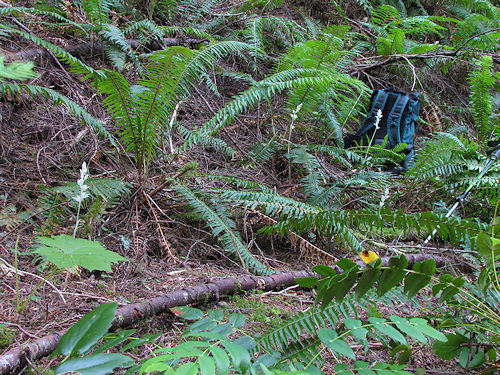
Day 268: Park Plant Ecologist Arnie Peterson and I met up Friday morning, left my car on one side of a hill, drove around to the other side in his car and hiked into the site where Team Biota had discovered seven Phantom Orchids, a rare and endangered plant found only in the Pacific Northwest. Arnie wanted to see them for himself, and my last visit had shown him that they were almost fully open. We arrived on site and after GPSing and photographing the plants, we split up and began exploring the surrounding area. I had not gone more than about twenty feet when I yelled out, "Arnie! Arnie! I've got three more! No, four...no, five! No, SIX! There's a young one in the ferns! I swear these were not here Monday. I KNOW they weren't! I stepped over this log right there!" Arnie came across to survey my finds and then said, "I'm going to check this drainage," with a gesture uphill. I reminded him that I'd been up there on Monday and had found nothing, but he said he wanted to look. I kiddingly commented, "You just want to find one all of your very own, don't you? I'll just stay right here and take more pictures of these." Off he went. I took more pictures, then patrolled the banks of another small intermittent stream but found nothing. On my way back to "orchid base," I heard Arnie: "I've got one! And where this one is, it changes everything we thought we knew about the habitat!" "Hang on," said I. "I'm coming across."
Upon reaching Arnie's specimen, I understood what he meant. It wasn't near water. There was none of the greenery we'd come to associate with the other specimens: no Oxalis, no Enchanter's Nightshade, no moss. More importantly (to our theories, anyway), there was no Red Cedar near the plant. Both of us addressed the innocently-offending orchid with the same question, "What are you doing here, little guy?" At this point, our census of "rare and endangered" individuals had grown to fourteen, all within a hundred feet or so of each other. "One plant couldn't be expected to thrive," said Arnie, "but we have a healthy population here." That said, we agreed that the numbers weren't large enough to sacrfice one of its members for an herbarium specimen.
 |
| Cephalanthera austiniae |
Our main goal accomplished, Arnie thought we should do an extensive survey of a couple of other drainages. The largest of these was attacked bilaterally, Arnie on one side, Crow on the other. When it yielded nothing in a quarter mile, we decided to abandon it for another potential site on the other side of the hill. Please bear in mind that this is old and trailless forest. Every five or ten feet of travel meant heaving our aching bones over another fallen tree or series of fallen trees. There were occasional open patches which we greeted with great enthusiasm, but on the other hand, there were those devil's-club thickets which are part of the definition of "drainage" in the Pacific Northwest.
While going through one particularly nasty section of devil's-club, I stepped in a hole. My unavoidable collapse occurred in slow motion, but at the end of it, I found myself with my feet uphill of my head, on my back in the devil's-club. I was grateful for the pack which saved me from becoming a human porcupine, but the position was awkward and any hand-hold I could reach was covered in thousands of spines. I writhed and wriggled while Arnie, drat him, looked on, encouraging me with comments in the nature of, "I should get the camera out!" It was not the only such occurrence during our transit. I fell two more times, although in slightly better circumstances. Arnie also fell twice, at which point I reminded him of his camera threat. Unfortunately, he righted himself too quickly for me to make good on the idea.
Route-finding was governed by density of devil's-club, at times driving us up hillsides we'd hoped to avoid climbing, and somehow, somewhere along the line, we went awry and got on the wrong side of a hill. We wound up laying a new course to waypoints I'd pre-installed on my GPS, points which took us a quarter mile back the way we'd come, and then down some rather steep terrain until we finally reached my car. The distance we had travelled from the orchids was roughly two miles. It is a measure of its ruggedness to say that it took us six hours to complete it. I came home, took a bath, and promptly fell asleep in my chair.