Showing posts with label rare species. Show all posts

Thursday, May 31, 2018

Myriad Myrios


Day 230: The Myriosclerotinia head-count jumped from seven to 65 in the space of a week at Site 1, but snow cover thwarted Team Biota's plans to visit Site 2 and kept us from checking another potential location. That said, Site 1 contains two separate plots where this rare and short-lived cup-fungus occurs. The second plot yielded up only a few as yet. On this occasion, we flagged each one for a long-view photo, measured water temperatures and dimensions of the larger cups. The following day, another Park colleague and I returned to take specimens of the sedge and sphagnum, and were surprised to find that the census had diminished by over half in a mere 24 hours. Were the missing fungi eaten by some critter? Was our failure to find them due to brighter light? Or was their absence simply part of their ephemeral nature? So many questions, and so few days in which to find clues or answers!

Wednesday, May 30, 2018

The Aspen Mission


Day 229: This is the first installment in the saga of Team Biota's May 29 field trip. There will be several more forthcoming.

Until yesterday, there had been no official record of Populus tremuloides (Quaking Aspen) within the Park boundaries. Plant Ecologist Arnie Peterson had received a report and photos from a member of the Owl Crew, but with anything of this nature, the plant's presence needed to be verified and herbarium specimens needed to be collected. Arnie provided Joe Dreimiller and I with coordinates for the site and off we went.

It didn't look like a place where you'd expect Aspens to grow, and indeed the 41 specimens we identified and flagged looked like they'd been struggling for many years just to reach a height of thirty inches (the tallest), but there was no doubt that they were P. tremuloides: stunted, but definitely Aspen. Any obviously live growth (fresh foliage) occurred on stems no larger than my little finger. However in many cases, multiple shoots were observed emerging from a thicker (1.5") woody base, often with the dead wood of former growth attached to it. All but three specimens occurred in a narrow swale approximately 10' x 100', in thin soil over rock better suited to moss and lichen. With such a small population in a very localized area, we couldn't reasonably remove an herbarium specimen roots and all, so three twigs were taken, sufficient to document the species.

Arnie, Joe and I are baffled by the presence of these trees. How did they get here? They're too far from any known Aspen population for a seed to have been excreted by a bird, although I believe that there could be a slim chance that one might have been caught in feathers. Likewise, although elk enjoy the occasional snack of Aspen, the same distance limitation applies. We searched for a larger parent tree, but found nothing. It is, as they say, a puzzlement, but Team Biota is on the case!

Tuesday, May 22, 2018

A Myrio Of Rare Device


Day 221: Most of my readers will be familiar with these inconspicuous but very special little fungi from earlier entries in my blog. However, if you happen to have missed the fanfare, this is Myriosclerotinia caricis-ampullaceae, a critter which is rare world-wide not only as a species but as a genus. In 2016, my botany partner Joe Dreimiller and I found them in Mount Rainier National Park where they had only been recorded once previously in a different location in 1948. After some substantial research into the species' preferred habitat and the historical record, we were able to locate the 1948 site and found them present there as well. Since then, the Hunt for Myriosclerotinia has become an annual project for Team Biota under the aegis of the Park's Natural Resources division.

Last year, we found a record number in "our" site, but none in the historic site. Of even greater importance was the discovery of a specimen still attached to its host. Our Plant Ecologist Arnie Peterson and I spent the remainder of that day dissecting it to reveal the knobby sclerotium characteristic of the species. At that point, any doubts about correct identification evaporated.

Today, Joe made a preliminary foray to "our" location and after an hour and a half of searching, returned to Longmire to report to me that he had found a single specimen. I dropped what I was doing, grabbed a radio, let a confidant know where we were headed and returned to the site. Over the course of the next hour of slopping about in snow melt, we found a total of seven cups. Not bad for a start to the season!

Tuesday, July 4, 2017

Chasing Phantoms


Day 264: First, let me correct the dates I gave previously. Until recently, Cephalanthera austiniae (Phantom Orchid) had only been seen in Mount Rainier National Park on two occasions, both times as a single specimen. The first occurrence was in 1892, the second in 2005...a gap of 113 years. Last week, I found two with my botany partner Joe Dreimiller. Yesterday, I did a wider survey alone and discovered seven specimens, one of which had been cropped of all but its lowest blossom by a deer. The tallest of the plants was roughly 16", the shortest about 8". I took many photographs and GPSed the three locations in which they occurred, and further exploration up the drainage revealed what to my eyes looked like ideal habitat, but no more orchids. Still, seven individuals is not a bad score for a "rare and endangered" species.

Spotted from a distance
Like many other members of the Orchidaceae, Cephalanthera is a mycoheterotroph, i.e., it relies on the cooperation of a specific fungal component in the soil in order to grow and flower. Unlike some other orchids which are capable of photosynthesis on their own because they are possessed of some chlorophyll (partial mycoheterotrophs), the Phantom is an obligate mycoheterotroph, which is to say that it cannot exist without its mycorrhizal partner. Consequently, its survival depends on its ability to lay dormant for many years, waiting for the proper fungus to become active. That's why it is so rare.

Can you find all four?
Over the last five years or so, I have noticed a dramatic rise in the bloom rate of a number of mycoheterotrophic species in the Park. They have long been of special interest to me. I suspect this increase may have its origins in the milder, wetter winters we've experienced over the same period of time, as well as the warm springs which have followed them. Many fungi have been appearing in growing numbers as well. The wet weeks of early June and warm conditions later in the month set the stage for chasing Phantoms, and seems to be bringing out other mycoheterotrophs as well (notably Indian Pipe, which is beginning to erupt). However, the census of Corallorhiza maculata is down, although the count C. trifida was up substantially. Clearly, there is a fungal backstory here which I don't fully understand.

Joe and Sharon knew exactly what I meant when I shot a cryptic one-word post to Facebook last night: "Seven." Joe is recovering from shoulder surgery done only a few days ago and will be out of commission for the rest of the season. At least he got to see two.

Wednesday, June 28, 2017

Cephalanthera Austiniae, Phantom Orchid


Day 258: About a year and a half ago, Park Plant Ecologist Arnie Peterson gave me a challenge: every week, I was to find a new plant (i.e., a species occurring in a previously unrecorded location). By the time last August rolled around, Team Biota (Joe and Sharon Dreimiller and I) had given him enough to fill out the remainder of the year. The challenge resumed this spring, and we're already ahead of schedule.

Arnie decided to up the stakes during the winter. He had received a photo from a botanist friend who had discovered a single specimen of Cephalanthera austiniae in 2005. Despite his long career in the field, Arnie has never seen a Phantom Orchid in the wild. He had been given vague coordinates by the friend and supplied us with a rough estimate of where the 2005 sighting had taken place, a circle roughly a tenth of a mile in diameter, off trail and into tangled forest. After our other duties were done for the day, Joe and I decided to give it a try even though we felt we were a month too early. Thus the saga begins.

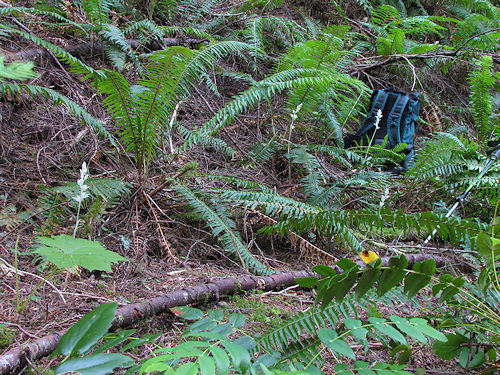
My thought process after clambering over several large fallen trees, wiping spiderwebs from my face (they're sharp when they get in your eyes), and following a number of false leads ran along these lines: "That's another white stick...the ground cover is so thick in here you couldn't find an elephant...licheny bit...stick, yeah, another white stick...stick? Waitaminit, that doesn't look like a stick. That doesn't look AT ALL like a stick!"

Then as I got a clearer view, I said very loudly, thoroughly at a loss for any other words, "Oh, shit! Oh, shit! Oh, SHIT! Joe! Joe! Joe! Shit! Oh, Joe!" to which Joe responded, "Are you all right?" I said through copious tears flowing down my cheeks, speaking rather breathlessly and not solely due to exertion, "Joe...I've got the plant!"

"What?" said Joe from 75 feet away. By then, I was crying so hard I could barely speak, "I've...got...the...PLANT!" and I knelt down beside it to pay homage. I heard Joe say, "There's another one behind you!" There was another one five feet away. Neither displayed open flowers, but we had found them, one of Mount Rainier National Park's rarest species.

I tried radioing Maureen, our contact. No response. It registered with me that I had never gotten Arnie's radio number, so I did the next best thing. I called Dispatch. "Dispatch, 442. Please call Arnie Peterson and ask him to contact me by radio." Dispatch replied, "Stand by." Less than a minute later, Arnie's voice came over the air: "442?" "Arnie, Joe and I are kneeling beside two Phantoms," I responded. Short and to the point, he replied, "GPS and photos. Check in with me later." I already had my GPS on the ground, averaging a reading.

For the most part, my photos were poor due to lack of light except for this one, but in any event, a return trip is in order next week to see if the flowers have opened. Our retreat was made somewhat easier by following a distinctive geographic feature, eliminating some of the route-finding hazards we encountered on the way in. Still, you don't want to get into a patch of Devil's Club, and even more to the point, you don't want to grab its stalks to pull yourself uphill. Nor do you want to exhaust yourself by repeatedly heaving your body over the jackstraws of blowdown. That particular exercise gets old really fast.

Some time later, we attained the truck and made our way to Longmire. As we were leaving Arnie's office after showing him the results of our search, I reminded him of the challenge he'd given us. His comment: "It'll be hard to beat this one." I've promised to guide him to the site if he can free up the time. Those herbarium specimens he was cataloguing will keep. The Phantom won't.

Monday, June 5, 2017

Counting Noses


Day 235: My readers may recall that about this time last year, I returned home from a swamp expedition with photos of a mystery fungus, and that after two weeks or so of referring it to one expert after another across the globe, it was determined that it was a rare species (Myriosclerotinia caricis-ampullaceae) and further, that even the genus was considered rare worldwide. As such, the find marked the undisputable apex of my history as a botanist, and I can't imagine what could top it.

This species had been reported as occurring in the Park, but the only record was contained on a 1948 herbarium card which cited it as having been found in an entirely different location. My companions in Team Biota Joe and Sharon Dreimiller and I set about trying to find the 1948 location immediately. We were successful, and between the two sites, we documented 64 specimens in 2016.

These fungi are extraordinarily ephemeral as we discovered on subsequent trips. Here today and gone tomorrow, we knew that our chances of finding them again in 2017 would be governed by some very precise timing. We have been monitoring Site A for several weeks (the second location still being under several feet of snow), and yesterday, the three of us sallied forth through soaky-wet snowmelt meadow and emerged victorious with a total of TEN examples recorded for posterity by multiple cameras. The newly-emerged specimens are as yet quite small, the three in the upper photo the most well-developed. The smallest was hardly larger than a straight pin. The rest of our happy family can be seen in the collage below. The little guy is just right of the three in the top left image, about a third the height of the one immediately to its left.

Team Biota doesn't usually bring home the bacon in quite such grand style, although we do turn up a number of botanical rarities or new locations for uncommon plants almost every time we go out. Yesterday's tally was not limited to Myrio by any means, and over the next few days, I'll be bringing you more Park peculiarities.

Tuesday, June 21, 2016

Joe And Myriosclerotinia


Day 252: Joe dropped me off about twenty minutes ago and is en route home as I write this, and I think neither of us will sleep a wink tonight. Our primary goal for the day was to bushwhack into the site at which in 1948 Myriosclerotinia caricis-ampullaceae was last seen in Mount Rainier National Park. We had noted a small clearing in which Carex was growing, a known host for this rare species. A narrow stream of trickling water ran through the center of the mini-meadow, so we began patrolling its edges with our eyes peeled for even the smallest cup. Joe went up a secondary stream which fed into the main flow and was about fifty feet away when I suddenly shouted, "Oh, my gawd, I've got one!" I honestly had had no expectations of success, and immediately pulled out my GPS to mark the location. I got down on my knees and began taking photos from different angles, and in viewing my specimen from the side, I saw two more near it. Then the hunt began in earnest, Joe on one side of the stream and me on the other. In the course of the next hour or so, we found a grand total of fifty-one specimens. Although none were as large as the ones we had found in the first location on June 2, these appeared to be newly emergent and still growing. Many were only about 3 mm. in diameter. As we studied the area for clues into Myriosclerotinia's habitat requirements, we noted that the fungi only grew on the south bank of the stream and never more than 8 inches from moving water. All but one occurred in a strip approximately 8" x 30', and nowhere else in the meadow. Two are visible in this photo if you have keen eyes, and Joe is photographing another cluster of three hidden in the sedge. Fifty-one!!!

Saturday, June 18, 2016

Myriosclerotinia Caricis-ampullaceae


Day 249: Since my botanizing partner Joe and I (Team Biota) discovered this unusual cup fungus in a snow-melt meadow in Mount Rainier National Park, a flurry of emails went out, first from Joe to a friend who is a mycologist, thence to a mycological society and further, to mycologists around the globe. The consensus is that it is Myriosclerotinia caricis-ampullaceae. This particular species is considered "very rare," but the genus is rare as well. Who would have thought that such a lowly thing could generate such interest? And who would have expected to stumble across it while hunting for rare/uncommon vascular plants?

Joe, his wife Sharon and I have made several return trips to the site over the last two weeks, and have learned that these fungi are extremely ephemeral, here today and gone tomorrow. Joe and Sharon found a few on their second trip, but none since. After a conference with the Park's Plant Ecologist earlier this week, I was authorized to take an herbarium specimen if enough examples were present. Arnie knows my feelings on collecting, and trusted me to make the critical judgment call for collection of a rare species.

I went into the meadow in full rain gear on a blustery, cold day and began searching the margins of snow-melt pools and the banks of a tiny stream, but was frustrated at having no success in finding my quarry. With additional information I had been given about the species, I examined several dozen stems and leaf sheaths of the Carex (Cotton-grass) native to the site, but found no evidence of sclerotia. It was beginning to look like my mission was going to be a bust. Then, just as I was packing up to leave the meadow, I saw something floating in the water, loose. It was a single specimen, not attached to anything, waiting to be lifted out for preservation with only minimal pangs of conscience on my part. It was in less than perfect condition, admittedly, but it would serve for DNA analysis at some future date, should the budgeting for such advanced research ever be possible.

Team Biota has another trip to the site planned, but even if this ephemeral species is done for the year, there will be other years. The last known record of it at Mount Rainier is dated 1948, and a specimen from that date is preserved in the University of Illinois herbarium. I may be dead and gone before it sprouts again, but for 2016, I was there. I saw it. A solitary specimen is drying on my desk as I write this. I have a feeling the story of Myriosclerotinia caricis-ampullaceae is not at an end.

Friday, June 3, 2016

Erythranthe Breweri - A Penny Perspective


Day 233: I barely know where to begin. Yesterday, I went on a botanizing expedition with my friend Joe. He'd baited me with a report of an insectivore I'd never seen in the wild, but by the time the day was over, we had recorded half a dozen rare/uncommon species. The prize was won by Erythranthe breweri, formerly called Mimulus breweri and known commonly as Brewer's Monkeyflower. It has only been recorded in a few locations in Mount Rainier National Park, and the site at which we observed it was not one of them.

Upon referring our find to the Park's Plant Ecologist, we were dispatched on another mission: to collect a single specimen for inclusion in the Burke Museum's herbarium. I am of two minds with respect to taking herbarium specimens, one side of my head arguing that if it's rare, it should be left in place, even as the scientific part of my brain protests that being able to profile the DNA or otherwise study a rarity has great and growing value. Since we were able to count at least 36 individual specimens at this site, I carefully removed one, cleaned its hair-like roots of soil and pressed it temporarily between the pages of a notebook, laying it out as naturally as possible. Spreading the petals was no easy task since even in the space of a few minutes, they had begun to curl. Immediately upon returning home, I transferred it to acid-free paper and weighted it for drying. Once the process is completed, I will return it to the Park where it will be catalogued and archived.