Showing posts with label sourdough. Show all posts

Monday, August 26, 2024

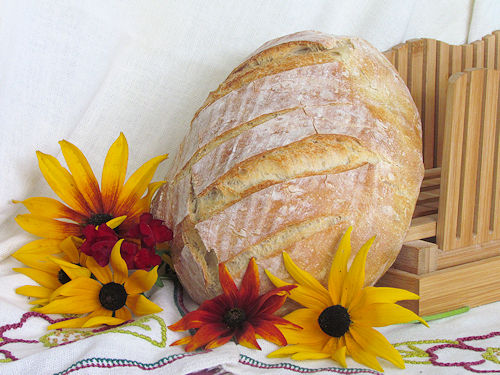
Still Life With Sourdough


Day 318: What one comestible would you be unwilling to forgo? I think I would give up coffee before I gave up homemade bread, and that's saying a lot. In the last fifty-plus years, I have probably purchased less than two dozen loaves of the commercial substance I refer to as "whipped air," and that only when I needed to make croutons for stuffing or possibly emergency sandwiches. The stuff sold in grocery stores is barely edible. True bread has substance and weight. It "sticks to your ribs," as my mother used to say. Since discovering how to make a high-hydration sourdough in a Dutch oven, it has been my go-to, with occasional detours for cinnamon swirl, bagels, a millet loaf I call "birdseed bread" or oatmeal-whole wheat. I feel white is too boring to bother with, although sometimes I'll make a sweeter egg bread. If I'm ever confined to a home or hospital where meals are prepared, I hope someone among my friends will smuggle in homemade bread.

Thursday, June 22, 2023

A Good Ear


Day 252: When my sourdough starter died of causes unknown approximately a year ago, I was plunged into a period of existential crisis which lasted about six months. During that period, I could not turn out a decent loaf of bread. Oh, they were fine as far as taste was concerned, but invariably, the second rise would be weak and I would get very little oven spring. I blamed the weather. I blamed the cold. I blamed the yeast and the wheat crop and the flour mills. I tried waiting for a warm sunny day. I changed brands of flour and yeast. I bought a bread machine. But for the life of me, I could not figure out what was causing my loaves to be flat and dense. In over fifty years of bread-making on a ten-day schedule, I had had a few unresponsive doughs, but never such a long run of failures. "I think," I said to myself, "that I've lost my mojo."

I was lamenting the issue to a friend one day, and he offered me some of his sourdough starter. I am tempted to say I prefer sourdough over yeast breads, but the truth of it is that I simply prefer homemade bread regardless of the type. I took Ed up on his offer, and after doubling his starter a couple of times, I made a sourdough loaf. The results fell somewhat short of my expectations, but I could see there was hope. Then I started poking around for different recipes and came up with a high-hydration "artisan" loaf which required baking in a Dutch oven. It has now become my favourite version of sourdough.

This loaf should have the perfect "ear" typical of artisanal breads, i.e., it must be shallowly scored with a bread lame or sharp knife so that when oven spring occurs, it does not burst along the top or sides, but opens along the cut. It tends to get rather crisp along the edge and is inconvenient when slicing the bread, so after my loaves have cooled, I make a horizontal cut to prune the "ear" from the top of the loaf. You understand, of course, that this is for purely functional reasons. It has nothing to do with wanting to have a piece of fresh-baked sourdough lavished with butter for a nibbly-bite, nothing at all.

Monday, April 20, 2020

Sourdough


Day 190: If you will forgive the pun, bread-making has experienced quite a rise in popularity since COVID-19 has left stores short of the ready-made product. I've seen a number of people complaining that yeast is also in short supply, so why not make sourdough instead? Can't find commercial starter? Make your own! Most homes contain enough free yeast spores to get a starter going from scratch. Here's how:

Using a wooden or plastic spoon (no metal!), mix together 1 cup of lukewarm milk, 1 cup of sifted flour and 1/2 cup of sugar. Allow the mixture to stand UNCOVERED for 4-7 days, stirring it down once a day. It may crust up; stir the crust into the liquid. When it has fermented sufficiently, it will be nice and bubbly. Your starter is now ready to use. Store it in the refrigerator. Separation in the starter is normal during storage. If a greyish liquid has risen to the top, stir it in until the starter is smooth and uniform before use.

You will need to allow two days to make sourdough bread. To begin, you will make a "sponge." Use only wooden or plastic utensils! The evening before you plan to bake, combine 1/2 cup of starter with 1 1/4 cups of flour and 1 cup of lukewarm water. Cover it lightly and set it in a warm place to "work" overnight. It should be bubbly and thick within 12 hours.

Recipe:
1 1/2 cups of sponge
3 - 3 1/4 cups of sifted flour (360-400 grams bread flour)
1 Tbsp. sugar
3/4 cup milk
1 Tbsp. butter
1 tsp. salt

For those of you who prefer to measure ingredients by weight, here's the conversion, but note well that if you are using other than bread flour, you may have to adjust the measurement:

Sponge:
125g starter
150g flour
235g water at 110 F.

Dough:
380g Sponge
360-400g flour
14g Sugar
14g Butter
6g Salt
180g Milk.

To make the bread itself, warm the milk, to which has been added the butter, salt and sugar. Cool to lukewarm. Place measured "sponge" in a bowl. Return the remainder to your starter storage jar and put it back in the fridge. To the sponge, add 1/2 cup of sifted flour and stir it in well. Then add the cooled milk mixture and stir it in. Now begin adding flour. When the dough becomes too stiff to stir with a spoon, put it on a well-floured board and begin kneading. You should knead for 10-12 minutes to ensure a smoothly textured loaf. Never force the dough to take more flour than it will readily accept.

Place the finished dough in a greased bowl and turn it once so that all sides are lightly greased. Cover with a cloth and allow to raise in a warm spot for 2 hours. Punch it down (i.e., knead it for a minute or so between your hands) and return to the bowl, and allow to raise for another 30 minutes. Punch the dough down again, and form it into a loaf. The loaf may be placed in a greased loaf pan or shaped and put on a greased cookie sheet at this point. Cover with a cloth, and allow to raise for another 1.5 hours. Pre-heat oven to 375 degrees. Before baking, slash the top of the loaf diagonally in several places. Bake for 45 minutes. Remove from oven and brush the top lightly with butter. To perform a "doneness check," turn the loaf out onto a cooling rack. It should sound somewhat hollow when tapped on the bottom.

I like to substitute 1/2 cup of millet flour for an equivalent portion of white. I also throw in a little golden flaxseed and golden flaxseed meal, and/or any other edible seed (teff, sesame, etc.) for crunch.

See? You didn't really need to go to the store, did you? And once you've experienced the delicious taste and hearty texture of homemade bread, you'll never buy the "whipped air" product again.
Thursday, March 8, 2018

Bread Day


Day 146: In polite terms, I might be called a "utilitarian" cook, i.e., I only cook because I have to eat, and dining out isn't an option. If it takes more than one pan and five minutes, I can't be bothered. Still, every rule has its exceptions, and the one deviation from norm in my world is that I like to bake, and particularly, I like to make bread.

I was in my late teens when I made my first loaves. They weren't exactly bricks, but I definitely didn't have the science down pat. I'd watched my foster sister's grandmother making bread, tried to remember the rules she'd laid down, like not forcing the dough to take more flour than it wanted, testing the rise with a pressed-down thumb, working the dough until it felt satiny under the fingers. Persistence pays off. In a few years as a young housewife, I was making bread on a weekly basis.

The tradition continues to this day. With the exception of the months I had one arm in a sling following a shoulder rebuild, I have made bread approximately every ten days for almost half a century. Bread Day is as much a part of my household routine as...well, I'd say "dusting and vacuuming," but I don't do those tasks nearly as regularly. I love the aroma of the rising dough (sourdough in this case), and of course nothing in the world beats the scent of bread fresh from the oven. Yes, it requires a certain degree of commitment and scheduling to set aside five hours for the process, but oh, the end result is worth it!

Monday, December 18, 2017

The Gift Of Bread


Day 66: For as long as I've been baking bread (and that's almost half a century), I have given loaves as gifts for numerous occasions, but during the Christmas season, my oven goes into overdrive and for about a week, I make bread daily and deliver it to nearby friends. As part of the tradition, each loaf is wrapped in a cotton towel as part of the gift. The style of towel varies from year to year, sometimes terry, sometimes birdseye, but generally, I choose a plain white fabric. This year's "pain du jour" is sourdough with a slashed crust liberally painted with butter. Is there a person alive who does not appreciate fresh bread?