365Caws is now in its 16th year of publication. If I am unable to post daily, I hope readers who love the natural world and fiberarts will seize those days to read the older material. Remember that this has been my journey as well, so you may find errors in my identifications of plants. I have tried to correct them as I discover them. Likewise, I have refined fiberarts techniques and have adjusted recipes, so search by tags to find the most current information. And thank you for following me!
Thursday, July 1, 2021
Paint What You Love
Day 261: After two pitiful attempts at painting a scientifically-accurate Delphinium, I was beginning to feel rather frustrated and was questioning whether or not watercolours were a medium I could work in. I went a couple of days without drawing anything before saying as much to an artistic friend, but when I confided in her that I was feeling "rather deflated," she said I needed to shut off the strongly dominant analytical portion of my brain. I wasn't quite sure how to do that, but the following afternoon as I sat at the window with a Delphinium spike immediately outside, I thought, "Okay, I will try to paint what a Delphinium feels like." Using the actual plant only as a general reference, I did a quick pencil sketch and then moved into the kitchen to paint it, the model out of sight. When I was done, there was no question as to what flower I had portrayed: unmistakably a Delphinium, and decidedly a better representation than my first two attempts. The next day, I ventured out into the Barren Wasteland in early morning light, captured the basic shapes of California Poppies, Rose Campion and peppermint, applying watercolours indoors in a location where I could not see the plants. Again, the painting is not scientifically accurate, but the plants are readily recognizable. Yesterday's subject was a fidgety Goldfinch who perched in the raspberries, and although I took quite liberal artistic license with the composition, both bird and plant are identifiable. Maybe there's hope yet that my clinical mind can give way to its poorly developed creative counterpart to allow me to express my love of nature in watercolours. All three paintings were done on 5.5" x 8.5" mixed-media paper.
Monday, June 21, 2021
Botanicals And A Friend
Monday, May 24, 2021
Not Just Birds
Monday, May 17, 2021
Birding With Pencils
Day 216: For the moment at least, I am attempting to make one bird sketch each day. I find that it takes at least an hour and a half (sometimes substantially more), and during the endeavour, I tend to lose track of the passage of time. When I finally reach the "Okay, that does it" stage, the morning has all but disappeared. I am also trying to improve my technique by watching YouTube videos on shading, blending, layering and so on, and it is obvious to me that I still have a lot to learn. Still, for someone who has had absolutely no training in art, I am happy with most of the portraits: 18 to date, one of which I will not make public because I could not capture the colour accurately. Top to bottom, left to right, here you see a female Black-Headed Grosbeak, a Piping Plover chick, Northern Cardinal, male Black-Headed Grosbeak, and a head study showing the differences in the field markings between Golden-Crowned and White-Throated Sparrows, often confused by novice birders who only catch a glint of golden yellow on the forward portion of the head. Each drawing was made from photos I have taken of the "locals" with the exceptions of the Plover chick (reference image from a friend) and the Northern Cardinal (a species we do not have in western Washington).
Tuesday, May 11, 2021
More Birds
Day 210: Believe me, no one is any more surprised than I am by these sketches. A month ago, I was telling friends that I couldn't draw a recognizable cardboard box, and I meant it. The few things I have drawn well (a portrait of my poodle, done when I was about 11, a Sphinx moth and a handful of pen-and-ink backcountry landscapes) were works I considered "happy accidents." However, there was a clue among those few successes: the love I felt for the subject matter. Perhaps that hint explains these birds, at least in part. Anyone who has ever exchanged more than a few sentences with me will have discovered that I am a "bird person," something which goes beyond mere birding/birdwatching. I try to get inside their heads, to figure out how they think, why they do what they do, to understand the way they perceive a world which is very different from my own vision of it. I attempt to communicate with them on their level, learning a few carefully modulated phrases in the conceptual spoken language of the crows, for instance, or refraining from smiling when a chickadee is eating from my hand lest the bird interprets the upturned corners of my mouth as the beginnings of a predatory threat. I do not make eye contact until the bird initiates it, allowing it to be the one who makes the first social gesture. There is no question that I love my "birdies," so please indulge me as I present another set of portraits of the friends who come to my yard: male and female Rufous Hummingbirds, Cedar Waxwing and Steller's Jay.
Thursday, May 6, 2021
Yard Birds
Day 205: I don't want to bore my readers with too many posts of my sketching attempts, but on the other hand, I'm rather proud of what I've accomplished with the help of "Laws Guide to Drawing Birds." Each of these was based on a photo I've taken of the respective species: American Goldfinch (Spinus tristis, formerly Carduelis), Chestnut-backed Chickadee (Poecile rufescens), Purple Finch (Haemorhous purpureus), Pine Siskin (Spinus pinus). In the case of the female Purple Finch, I changed up the background to reflect a behaviour I observed recently. Several Purps settled in on my blueberry bushes in late afternoon and began plucking the blossoms! Cornell advises that they consume nectar by biting the base of the flower. The bushes are now netted and outfitted with mylar ribbon, and now I understand why I didn't get many blueberries last year. The drawings were executed in a combination of ink and coloured pencil, and the wing detail in the Pine Siskin was a real challenge to maintain.
Thursday, April 29, 2021
How To Draw A Bird
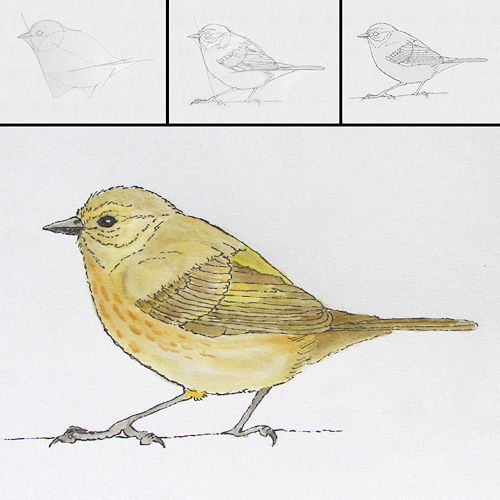
Day 198: A month ago, I was telling an artistic friend that I couldn't draw a cardboard box well enough to make it recognizable, and it was true. She encouraged me to keep trying, pointed me toward another artist whose explanation of perspective was very helpful (at least it taught me to draw the cardboard box so that it didn't look like someone had sat rather heavily on it) and, bolstered by that small success, I invested in a couple of cheap sketchbooks. For the last week or so, I've been drawing something every day. Birds have been a recurring theme, although they haven't been my only subjects. Another friend suggested that I buy John Muir Laws' "Guide to Drawing Birds." I did, and here you see the results of the first lesson. Laws' system was for a pencil sketch, but once I had inked in my "wobbler," I decided he needed some colour. Since I hadn't illustrated facial markings, I turned him into a Yellow Warbler. The pencil and ink drawings at the top of this image show the various stages of my work, first creating a basic bird shape with a few lines, an oval and a circle, into which I "carved" the arcs of neck and throat. Then I added detail to the body, face, wing and tail to show the major feather groups, following that with drawing individual feathers. In the penultimate phase, I applied ink with a fine-point Sharpie. Then, not having a "wobbler" to pose for me, I sat at the kitchen table with Roger Tory Peterson in hand as a guide to colour. For a first attempt at drawing a realistic bird, I don't think I did half bad.
Tuesday, April 20, 2021
"Measure Twice, Cut Once"
Day 189: Inspired by a friend's artistic endeavours, I decided to give sketching another go. As I may have mentioned, the House of Chirp has new tenants. They've been moving furniture in for the last week or so, and as all of us who have moved around a lot know, sometimes the couch won't fit through the door without some serious finagling. We don't take the couch back to the store; that would be silly. We fiddle with standing it on end, turning it around the other way, maybe even taking the legs off until we can maneuver it into the house. Nor are Tree Swallows likely to discard their selection, and if a twig or feather won't fit through the hole, they try this angle and that until it goes in. Now it must be said that I had intended to make this drawing more cartoonish to suit the caption, "Measure twice, cut once...right," but as I was standing at the kitchen window with the sketchbook held up in one hand and my pencil in the other, watching the antics of the new renters, the drawing took on a style independent of what I had in mind. Once the details had resolved themselves, I sat at the kitchen table to ink and colour it. A second effort made later in the day, drawn entirely from my imagination, did not work out as well. I will not make any claims of artistic talent, but at least my ability to draw a recognizable object is improving.
Saturday, March 27, 2021
Stick Art
Day 165: First and foremost, Mother Nature is a scientist. Of that, there can be no doubt, but it is not always about improving design to make it more efficient or durable. Sometimes her creative side surfaces and then, if we are privileged, we may witness an exhibition of her art.
I had several goals in mind when I left home yesterday for a hike. Very few of them bore any fruit. I did manage to cover five or six miles without seeing or hearing another human being, although the buzz of a chainsaw was audible from the top of the hill. It temporarily drowned out the chorus of Pacific Tree Frogs who were singing their spring anthem in the wetland below, though not the voices of Canada Geese flying overhead. Once back in the forest, the chips and cheeps of woodland birds were the only sounds, and I was left to enjoy visual immersion in uncountable shades of green. Here and there, the Cardamine inserted a pale pink accent, its flowers nodding, unwilling to fully wake into the light, damp chill of the morning, and a few Trillium who had had too much rain at last night's party tried to shake off the aftereffects with limited success. There were no spring mushrooms, not yet, and the nettles were too far advanced to pick for tea. They were quite defensive, and expressed their sentiments toward being gathered by biting me through nitrile gloves. With "gathering" removed from my list on those two counts, "exercise" was the next best option. I decided to cover as much ground as the weather and mud would permit, with "photography" a given as it is any time I am out and about.
The wildlife area near Mossyrock Dam affords a variety of ecological niches. Managed by Cowlitz Wildlife under the auspices of WDFW, it offers woods, ponds, grasslands and thickets spaced throughout roughly 14,000 acres. There are only a few maintained trails and no "destinations," rendering it less popular with hikers than other areas. I have observed a number of interesting plants and fungi there, and a wealth of lichens, many of which I have yet to identify. I was walking the ADA trail when I found this stick, barely recognizable as such beneath its lavish embellishments of lichen and moss, Art in its purest form. The scientific half of my brain registered Ochrolechia (little round dots), Usnea (wiry threads), Platismatia (ruffled lobes) and a moss even as the artistic side exclaimed, "That's beautiful!" Ma Nature had succeeded in engaging my full appreciation, a feat no human artist has ever managed. All other considerations aside, the Stick was the highlight of my hike, and I don't say that lightly.
Friday, October 23, 2020
Botanical Art
Day 10: I'm not kidding myself. I know that I don't have an artistic bone in my body. I couldn't draw a square square if you paid me, and to try to get the proportions and perspective right on something as simple as an egg is as far beyond my skill as trying to recreate the work of one of the Old Masters. However, I do think I have a good eye for colour, which is probably the product of years of doing needlework. I never need to carry a fabric sample to the store to match thread. I simply commit it to memory before I go shopping. Lack of artistic talent aside, I have long desired to be able to do botanical illustrations in some medium or another, so when a friend began taking watercolour classes, I thought I'd give it a try. I bought a cheapo kit: several brushes, some paints in tubes and some in "tablet" form. The tubes struck me as likely to waste a lot of paint, so I haven't cracked them yet, but I seem to be doing okay with the hard sort. After my first few attempts turned out rather too light (the vine maple, for example), Patty advised me to allow the paint to dry and then add a second layer to make the colour stronger. While I don't think I'm there yet, I'm not unhappy with the results either. That said, I have to admit to a certain cheat: I know I can't draw, so I traced around real leaves and then laid in the colour. Hey, at least I stay within the lines.
Sunday, January 17, 2016
Botanical Art
Day 97: My talent for art is feeble at best, although I'm learning how to handle coloured pencils thanks to a Christmas gift of Johanna Basford's "Enchanted Forest" colouring book. As I've experimented with shading and blending, it has occurred to me that any naturalist worth the name should at least dabble at illustrating. Here you see my first effort, catkins plucked from Harry Lauder, the contorted filbert in my yard. I made a faint outline of my subject with a standard lead pencil and then began applying colour. Unfortunately, I failed to center the drawing on the page (laziness on my part...I should have erased it and started over), and I find the colour saturation to be lacking (best I could manage with these pencils), but as a first attempt, I'm not too disappointed.
Saturday, December 6, 2014
Giving Credit Where It's Due
Day 54: I cannot take full credit for this piece of surrealist art, only for rendering it in three dimensions. The concept originated with my mother, and was executed as a pen-and-ink sketch which she presented to my grandmother with a book of original poetry on Mother's Day 1945. I believe she may have drawn her inspiration from a greater mind, that of Salvador Dali. In any event, the idea has gone through so many permutations that I feel no shame in claiming this as "mine," since it is said that in art, there are no new ideas, only new ways to represent the same old things.
Surrealist art is meant to jolt the mind by presenting things out of context, nonsequiturs to the natural state of their existence. It is often laced with hidden references and meanings, but not always. Sometimes, as here, it is simply a mental meandering down a convoluted path through hyperreality, art for Art's sake, without agenda.
Tuesday, October 28, 2014
Still Life ON Gold
Day 15: In the purest interpretation of the phrase, a still life contains as one of its major elements something which was but is no longer living, i.e., life which has been stilled, such as fruits picked from a tree, flowers gathered from a garden, even (shudder) dead animals. While you will find none of the latter in my compositions, I do love a good still life although I stop short of including any of the arcane symbolism present in many historical works...or do I? Do we read into art things which are outside the artist's intentions? And is it not the place of Art to evoke interpretation? What hidden meaning might lie in this simple arrangement of seed heads and ceramics displayed against softly draped, rich fabric? Though Art addresses the eye, it also engages the mind whether by design or accident.
As still lifes go, this one is pretty basic, but I hope it stimulates you to think beyond pottery and plant matter. Have fun developing your own "read" of the photographer's constructive process!
Monday, February 3, 2014
Parsing Ardea Herodias
Day 124: I had never heard of David Hockney or "joiners" until the subject came up in a photographic forum and we were given the assignment to create a thingumabob in the style of what's-his-face. I googled the subject and got your typical assortment of fact and fallacy the internet serves up, but I believe I got a feel for what I was being asked to do. The problem was to find an appropriate subject for parsing into small pieces. Ideally, I'd have used a wildflower for the experiment, but a Great Blue Heron came along at the proper moment and here you see the result.
Artistic endeavours are not my long suit. I prefer recording nature as accurately as possible through my lens, at least most of the time. I occasionally venture into wild post-processing (especially if I've had too much caffeine or not enough sleep), but creating capital-A Art falls fairly far outside my purview. That said, I rather enjoyed sectioning Ardea herodias and reconstituting him in the transporter room of PaintShopPro.
From the original photo, I created a black-and-white enlargement which I then pasted and merged onto a white background at reduced opacity. Then I mapped offset sections of the original by pixel position, copied them and pasted them onto the b/w background, adding a slight drop-shadow around each one. These sections were also reduced in opacity. They were arranged using the snap-to-grid function so that they would be aligned vertically. When I was satisfied with the positioning, all layers were merged and the resultant image was copied and pasted over the color original, again at reduced opacity. Finishing touches included some light tone-mapping, lightening of the shadows and adjusting the contrast.
That's a lot to put a poor Heron through.