365Caws is now in its 16th year of publication. If I am unable to post daily, I hope readers who love the natural world and fiberarts will seize those days to read the older material. Remember that this has been my journey as well, so you may find errors in my identifications of plants. I have tried to correct them as I discover them. Likewise, I have refined fiberarts techniques and have adjusted recipes, so search by tags to find the most current information. And thank you for following me!
Wednesday, June 24, 2026
Spin Cycle
Then came my reward. I'd promised myself that when I got the "Charm" done, I'd try spinning cotton on the Minstrel. I'd become fairly adept at spinning cotton with a tahkli or on my book charkha, but it's quite a different procedure on a standard spinning wheel. As it turned out, I was pleasantly surprised. Using a very short forward draw, I was able to produce a uniform, fine thread. The 62-yard skein you see here is my first attempt. There are a few lumps and bumps which occurred as I tried to determine the best technique, and now I am well into spinning another much larger skein with far fewer irregularities. In fact, I might get it done in time to put in the Puyallup Fair!
Saturday, August 12, 2023
Fulled Vs. Raw
Day 303: First, a qualifier: these are two different shades of blue, so please factor that in while comparing the fulled version (left) to the raw (right). Fulling is what occurs when a woven item is wet-finished. The fibers, tightly spun for durability, plump up and fill in any small gaps left in the weaving process. Depending on fiber content (in this case, 100% cotton) there may also be varying amounts of shrinkage in the finished cloth. This is where experience with a specific fiber or manufacturer comes in handy for the weaver, in that they can better estimate what the finished dimensions of a piece will be. For example, I have learned that when I am using Valley cotton, a 16" warp width will give me a 12.5" width towel, and I need to weave a 24" length to obtain a long dimension of 21". Even when changing brands of the same fiber, your mileage may vary due to a number of factors. With cotton, the obvious reason would be how tightly the yarn is spun and plied, but plant species and regional growing conditions may also affect how the fiber will full. Although these latter two considerations are not something the weaver usually thinks about, they can account for differences in the way a yarn behaves when washed. How will drought conditions affect cotton grown in Brazil? Will stressed cells full more readily, hungry for moisture, or will the fiber be more harsh? I don't know, but I have a feeling that if I'm still weaving ten years from now, I may need to adjust my formula for the ideal towel.
Thursday, March 16, 2023
What's That Fiber?
Day 154: Today, we're going to play a little game called "What's That Fiber?" I was curious as to whether my fingers could distinguish the bamboo/rayon in a mixed roving, so I put some samples under the microscope. There are two cellulose fibers here (as in "plant-based") and wool from two different breeds of sheep (Coopworth and Merino). Cellulose fibers are made by pulping plant material and treating it with chemicals to break it down into a solution which can be extruded, and therefore they tend to be smooth. On the other hand, wool is a protein-based fiber with a rough cortex (outer layer). As opposed to other sources such as rabbit or camel, sheep's wool varies in diameter from breed to breed. Merino is classified as a fine wool, rated at 15-25 microns; Coopworth comes in at 30-39. By comparison, an average human hair measures 70 microns. Cotton fibers average from 11-22 microns, rayon for fabric production falls between 8-25. Given this information, you should be able to identify the bamboo, cotton, Merino and Coopworth fibers shown above. In the top and bottom rows, magnifications are 40x, 200x and 800x. The second row shows a "mixed" fiber at 40x and 200x, with the two fibers isolated in the third row at 800x. Are you ready? Go! (Answers below.)
(Top row: cotton; Second row, mixed; Third row, bamboo and Merino; Bottom row, Coopworth)
Thursday, March 9, 2023
A Different Spin
Day 147: Spinning cotton is quite another breed of cat from spinning wool. Cotton is a "short staple" fiber, i.e., the length of the individual fibers is much shorter than that of wool. This means that it needs substantially more twists per inch to make a sturdy thread. Although some standard spinning wheels can be set up to spin cotton successfully, mine does not accommodate a high-ratio bobbin, so I spin cotton on a charka wheel. Not many spinners work with cotton, but of course I am always looking for new challenges, so last year, I indulged a whim and bought my "book charka" after playing around with a manual, supported tahkli to see if I could get the hang of it. I am happy to say that now I can spin a consistent, fine thread which holds together nicely and can be plied into a double strand. If you study the photo, you will see that the big wheel in the foreground drives the smaller wheel at the midpoint. In turn, the smaller wheel drives the tahkli at high speed. Each turn of the main drive wheel results in over 100 turns of the tahkli to put plenty of twist in the thread. That said, this is where your long-draw skills come into play. One hand runs the wheel while the other manipulates the cotton fibers, drawing them out from roving or a puni as far as possible. Then the fiber can be pinched off as more twists are added. Then the thread can be wound onto the tahkli in a self-building cone called a cop/copp. Once you have two tahklis fully loaded, it's time to ply. Of course, you may choose to leave your thread as a single, but it won't be as durable.
Friday, July 30, 2021
Gettin' My Gandhi On
Day 290: Seeking to broaden my spinning skills earlier this year, I purchased a small kit which included a tahkli spindle, its bowl and several ounces of cotton. Within a few days, I was hooked despite the fact that I was making some rather lumpy and thick thread. In another leap forward, I bought a book charkha, essentially a fold-out spinning wheel in a wooden box the size of a hefty hardbound novel. By the time I had run through the two least appealing-colours of kit cotton, I was achieving a thread suitable for weaving. There was one problem: the charkha was designed to spin singles, not to ply, so I cobbled together an arrangement whereby I could create a two-ply thread with my standard spinning wheel with the singles mounted in the charkha's spindle storage holders. The system worked quite well and in fact, allows me to put more single-spun thread on each tahkli, and therefore more yardage in my finished skeins. Here you see two fully loaded spindles. To give an idea of scale, each cone of thread is roughly 2.5 inches long. While I'm not sufficiently ambitious to think that I will ever spin enough thread to weave and sew into a whole garment, I'm still gettin' my Gandhi on.
Thursday, June 10, 2021
Contraption Connection
Day 240: It didn't take me long to figure out that the book charkha really wasn't designed to accommodate plying, i.e., twisting two strands of spun cotton together to make a heavier, stronger thread, but I figured that since it had a built-in "lazy Kate," it should serve some purpose. Several attempts with the parts in various positions only resulted in tangled or broken threads, and YouTube was no help at all. I spoke with the seller and was told that my original assumption was correct, that the charkha was meant to spin singles. Therefore, it was up to me to devise a way to achieve a two-ply thread. I tried putting the tahklis in separate tall glasses. The threads still tangled and broke, and in the process of trying to untangle them, I impaled my hand with one of the points. Then I tried using a test-tube drying rack. That worked somewhat better, and although this solution was improved even further by the addition of twisted wires to hold the tahklis in place, it was still far from perfect. Then it occurred to me that perhaps I was approaching the problem from the wrong side. Maybe I didn't need a different "lazy Kate." Maybe what I needed was a different means of controlling the single threads.
My Louët wheel (standard spinning wheel) does not spin fast enough to spin a cotton single, even when geared at its lowest tension. It was designed to spin wool or other long fibers. However, when threads are plied, the direction of spin is reversed, an action which to some minor degree "un-spins" each single. It occurred to me that this might be exactly what I wanted for a plied cotton thread: minimal untwist. With some degree of trepidation at the thought of possibly ruining my hard work, I set two tahklis up in the charkha's "lazy Kate" and hooked them up to the Louët. After spinning a few inches, you might have heard me shout, "Yes! Perfect!" when I realized my connection of contraptions was producing the exact result I'd wanted. Necessity, they say, is the mother of invention. Move over, Rube Goldberg.
Wednesday, March 24, 2021
Laws Of Weaving
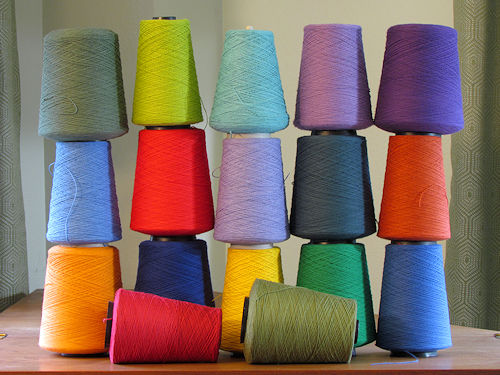
Day 162: This photo is illustrative of one of Crow's Elementary Laws of Weaving. Can you tell what that might be? Simply, it states that whatever your next planned project requires is inversely proportional to its availability. In other words, two-thirds of the threads I have on order are out of stock, the most critical absence being the natural colour I need for the warp of a summer-and-winter weave lap throw. Now admittedly, there's enough fiber here to keep any weaver occupied for several months, and I'm sure many would envy the selection I have at my fingertips, but I am reluctant to put an interim project on the floor loom for several reasons. The first is subject to another factor in weaving: the smaller the project, the greater the waste by percentage. I allow roughly two yards of waste when measuring warp for the floor loom, four feet for the table loom. This is why I usually warp for long-term projects on either. The second factor is personal: I tend to get bored with interim projects easily, and therefore they hang on the loom for longer periods of time than projects I'm inspired to do (like the pending summer-and-winter). This said, I still have two towels to weave on the current warp, so I guess I'll ration my time at the loom while I wait for the supplier to receive their next shipment.
Thursday, September 13, 2018
Weaving Double
Day 335: Just prior to the footstool cover project, I set up an experiment on the loom which failed miserably: weaving a double width of cloth. The technique allows you to make a wider piece (a tablecloth, for example) without having to seam the center. The same principle can be used to make seamless bags or to make a double-thick fabric with bound layers, but my intention was to weave a continuous cloth with selvedges. The experiment failed for a couple of reasons which I'll go into later in this post.
A major difference between a table loom and a floor loom is the method by which the harnesses are raised. A floor loom has treadles which operate jacks as the weaver depresses them with the feet. On a table loom, the jacks are operated manually (literally by hand) and remain in place once pulled down. Since human beings are only equipped with two feet, it's awkward and difficult to depress more than two treadles on a floor loom, but on a table loom, it's quite easy to pull down three levers. We get around this problem with a floor loom by means of the "tie-up," i.e., by attaching one treadle to more than one jack. For this reason, floor looms are usually equipped with six treadles. The most common tie-up is to have treadles 5 and 6 set up to create the sheds used in plain (tabby) weave, i.e., treadle 5 operates harnesses 1 and 3 simultaneously, and treadle 6 operates harnesses 2 and 4. The remaining treadles operate harnesses 1, 2, 3 and 4 individually (aka a "direct tie-up"). These can also be used to weave tabby by raising harnesses 1 and 3 alternately with 2 and 4, using two feet instead of one. The choice is a matter of preference and convenience.
That said, sometimes you need to alter the tie-up. In the case of double-width weaving, you need to lift harnesses 1 and 2 out of the way as you weave the lower layer of fabric on 3 and 4. Otherwise, the layers of cloth will be bound together in a double thickness. To this end, I needed to change the tie-up of treadle 5 to lift harnesses 1 and 2. Crawling around under a loom trying to see what you're doing through trifocals in a poorly-lit room is a recipe for error, and that's where I made the first one. My second mistake came when I automatically started weaving with a throw from left to right. It should have been right to left in order to have the selvedges on the left of the work. I might have spotted the tie-up error if I had made my first throw from the right side, but that's hindsight. The experimental weave was bound together as surely as night follows day.
Having used the technique successfully on my table loom, I wasn't about to give up. I dragged out the "other" book (Mary Black's "Key to Weaving") and studied up. Rather than simply showing drafts like "Handweaver's Pattern Book," Ms. Black explains the mechanics, and through her description, I was able to see where I might have gone wrong. She gives a slightly different draft than HPB and in order to follow her instructions, I needed to change the tie-up again. As I was crawling around in the wool fuzzies under the loom to change the ties, I discovered that I'd tied treadle 5 to jacks 1 and 3 instead of 1 and 2. Once that was remedied, I used a handful of old warp ends to sley a few inches for a second experiment, which I am happy to say worked out exactly as planned. Now for the big project!