365Caws is now in its 16th year of publication. If I am unable to post daily, I hope readers who love the natural world and fiberarts will seize those days to read the older material. Remember that this has been my journey as well, so you may find errors in my identifications of plants. I have tried to correct them as I discover them. Likewise, I have refined fiberarts techniques and have adjusted recipes, so search by tags to find the most current information. And thank you for following me!
Showing posts with label Hatiora rosea. Show all posts
Monday, June 5, 2023
Hatiora Rosea
Day 235: We could debate the taxonomy all day. The currently accepted nomenclature for this cactus is Rhipsalidopsis rosea, with Schlumbergera rosea and Hatiora rosea listed as synonyms. It was Hatiora when I first learned it shortly after the internet became "a thing" and I was able to research the plant after cultivating it for a decade or so, and thus it became "Hattie" for short. Some of my plants have nicknames like that: Fitch (Hoya fitchii), Knob (Ceropegia woodii), Bella (Hoya bella). Hattie earned her moniker when she bloomed after spending years as a tangled mass of prickly stems. She'd been known as my "Swedish Christmas cactus" before that, solely because I'd been given a slip by a Swedish friend. Then, as I mentioned, the internet came along and I was able to determine her real name: Hatiora rosea. However, her name was not carved in taxonomic stone, or else taxonomic stone is in the same mineralogical category as talc. In any event, the next time I looked up "Hatiora rosea," she'd undergone a name change. Neither "Schlummy" or "Rhippy" suits her, so Hattie she remains.
Labels:
Hatiora rosea,
houseplants,
Rhipsalidopsis,
Schlumbergera,
taxonomy
Saturday, May 21, 2022
Happy Hattie
Day 220: Longevity is not something a person normally considers when bringing a houseplant into their home. We may remember that the last orchid we purchased at great detriment to our grocery budget survived less than a month, or that the Maranta ("Prayer Plant") turned leggy after half a year, and that all attempts to prune it back into the compact shape which had attracted us in the first place failed miserably. We may recall grocery-store African violets with brown and soggy stems, a Ficus holding onto its last few leaves in a dark corner of the dining room, withered begonias, jade trees gone silvery with Botrytis mildew. Overall, when getting a houseplant, we don't expect it to live forever. In fact, we generally accept that its lifespan is less than that of a cat or dog, and we're fine with that. But every now and then, there is a notable exception to the rule. My Hatiora was started from a slip between 40 and 50 years ago. It has had a few rough patches to get through, but it is still in a four-inch pot, and still rewarding me with its beautiful flowers. It has endured underwatering, sunburning and chills with very little complaint other than the occasional dropped tip. And whether its correct taxonomy places it in Rhipsalidopsis or Hatiora has ceased to concern me. What matters is that Hattie (as I call her) appears to be happy under my care.
Wednesday, May 12, 2021
Hattie
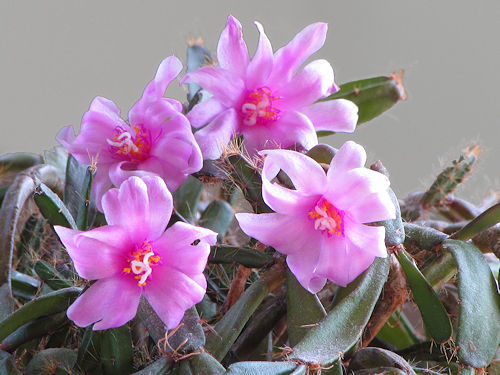
Day 211: Hattie is in bloom. It's hard to believe, but this plant is over forty years old. I was given a tiny slip (two or three sections) by a friend who cautioned me, "It's very difficult to bring into flower." A decade passed before I figured out what its requirements were. It took me longer than that to discover its true identity. The friend had not known its scientific name and simply called it her "miniature Christmas cactus. Since the friend was Swedish, I referred to it as my "Swedish Christmas cactus" for many years before identifying it as Hatiora rosea, hence the nickname Hattie. While it is a distant relative of Schlumbergera/Zygocactus, the segments are much smaller in size and the flower resembles that of orchid cacti. Some might describe the flower as "pink," but I would call it "pale magenta" for the blue note it contains, and it is an electric hue which seems to glow in almost any lighting situation. Hattie has bloomed for me almost every year since I determined that she needed to be kept in a cool room during the winter months and kept quite dry, even to the point of the segments beginning to wither. Forty years later, she still only fills a 4" pot.
Sunday, April 28, 2019
Separating Sheep From Goats - Hatiora Vs. Rhipsalidopsis
Day 197: If you'll look back to my post of April 24, you'll find a discussion of "Spring Cactus," aka Rhipsalidopsis/Hatiora gaertneri. In it, I make an entirely unscientific assertion that "Hatiora" is inappropriate for the species based on morphological distinctions between the two; "unscientific" because modern taxonomy reflects DNA, not physical commonalities. Still, I will have to be dragged kicking and screaming into the new terminology in this case because the differences in appearance are radical: my newly-acquired"Rhipsalidopsis" has broad foliage, upright blossoms and pointed, slender petals, quite unlike my "Hatiora" (still known as Hatiora rosea, and shown above) with its narrow segments and pendent flowers with rounded petals. In this instance only, I find myself in agreement with many botanists who are reluctant to accept taxonomic changes (a group which includes my good friend Arnie): if it doesn't look like a duck, walk like a duck or quack like a duck despite the fact that its DNA tells you it's a duck nevertheless, people are going to rebel against calling it a duck.
Wednesday, April 25, 2018
Hatiora Rosea, Finicky Beauty
Day 194: I sat down at the weaving bench, my eyes somewhat lower than the plant shelf in the craft room's south window, and from that angle, caught a glimpse of pink at the back of a flower pot. Hatiora rosea! This epiphytic cactus is not easy to bring into bloom. This particular specimen is over forty years old (yes, really!) and has bloomed for me perhaps a dozen times. I've never quite figured out what it wants with respect to light, soil, winter temperature, fertilizer, watering or any combination of the above, and therefore am overjoyed when it sees fit to flower. And to think I might have missed the show if I hadn't had a project on the loom!
Sunday, April 26, 2015
Hattie In Flower
Day 195: Hatiora rosea is not too often seen in houseplant collections, and it is not the easiest plant to bring into flower. Also known as "Easter Cactus," it blooms once a year. I've had mine for over forty years, and for the first decade, it refused to flower. It was consigned to the purdah of my attic sewing room where it was allowed to go dry for long intervals when I forgot about it, and there it experienced cooler temperatures than it had in a south-facing kitchen window. One day as I was looking for materials for a project, I noticed a solitary, one-inch shell-pink bloom, and therein learned Hattie's secret: a preference for cool nights in winter. I have brought this delicate cactus into flower every year since.
The intensity of color varies depending on sun exposure. The plant again resides in a south window for most of the year, and thus the color of the flower is substantially stronger. Its only admittance to the warmer part of the house is during the blooming period, featured before any guests who may drop by.
Wednesday, May 28, 2014
Hatiora Rosea
Day 238: I call it my "Swedish Christmas Cactus," and that's about as far from fact as you can get in a name. Hatiora rosea blooms in late spring and while it is technically a cactus, it is also an epiphyte/lithophyte (i.e., it grows on trees or rocks, drawing nutrients from decaying plant material which is washed down to it by rainwater). Why "Swedish?" The slip from which this blooming beauty grew was given to me forty years ago by a Swedish friend.
For years, I struggled to bring it into bloom with never a bud being set, my frustration magnified by the fact that Christine's was covered in flowers every year. I have to admit that at the time, I had no clue as to its growing requirements, but with no reward coming to me for my pains, I finally relegated it to the window of my sewing room where I seldom remembered to water it. That was how I discovered that it liked an abundance of sun and being ignored. When it put up a single bloom, I was thrilled, but I over-reacted and put it back with the more "active" plants. The next year, it gave me nothing. I chalked the previous success up to fortuituous circumstance, and Hatiora was again relegated to sewing-room purdah. However, when it repeated its previous performance the following year, I began making a connection. I left it there and made no alterations to the way I handled the plant, and from that point on, it has bloomed for me unfailingly.
These days, it lives in my craft room, and just a few days ago, I discovered that it had come into lavish flower while I wasn't looking. I've moved it to the living room for now, but when the last of the flowers drops, I'll put it back on the shelf and reinstitute my practice of scientifically ignoring it until next season.
Labels:
"Easter Cactus",
cactus,
epiphyte,
Hatiora rosea,
houseplants
Subscribe to:
Posts (Atom)