365Caws is now in its 16th year of publication. If I am unable to post daily, I hope readers who love the natural world and fiberarts will seize those days to read the older material. Remember that this has been my journey as well, so you may find errors in my identifications of plants. I have tried to correct them as I discover them. Likewise, I have refined fiberarts techniques and have adjusted recipes, so search by tags to find the most current information. And thank you for following me!
Showing posts with label Orchidaceae. Show all posts
Tuesday, August 9, 2022
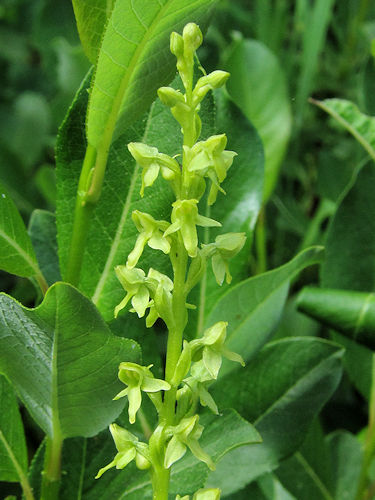
Platanthera Stricta, Slender Bog Orchid
Day 300: Mount Rainier National Park is home to at least 15 members of the Orchid family (Orchidaceae), but none has a flower larger than roughly an inch in its greatest dimension. The more floriferous members of the family put up tall spikes bearing numerous individual flowers which on close examination resemble those of corsage orchids, but on a miniature scale. Many are subtly fragrant if not particularly colourful and in fact about half are simply green or white (the exceptions are Calypso bulbosa and most Coralroots). There is some debate as to whether Orchids such as Platanthera stricta (above) can be considered truly mycoheterotrophic, but all depend on some degree of assistance from soil-borne fungi which break down nutrients into a form which can be used by the plant. Some researchers will argue that the fungus receives no reciprocal benefit from the orchid and therefore the relationship is one of parasitism, but to my way of thinking, there must be some undetected mutualism. Just because we can't quantify something doesn't mean it isn't there.
Wednesday, July 13, 2022
Bog Candles
Day 273: It's easy to see why Platanthera dilatata earned the nickname "Bog Candles" if you've ever seen one standing in a sun-fleck in dark, moist forest. The flowers are so immaculately white that they seem to shine like a flame in the darkness. The "bog" portion of their common name is quite apt as well, since the plant prefers wet feet. It is a denizen of marshes and ditches where the soil never experiences prolonged periods of dryness. As you might have guessed, it is a member of the Orchid family. There are over 200 species of orchid to be found in the United States, 33 of which belong to the genus Platanthera. Bog Candles can be found throughout the northern states and Canada, with the notable exception of North Dakota where they have not been recorded, according to the USDA. Like most orchids, Platanthera is a facultative mycoheterotroph, which is to say that it is reliant on specific mycorrhizae in the soil to break down nutrients into a form it can uptake. When that fungal component is absent, the plant cannot survive. As I learn more about mycoheterotrophy, it becomes apparent that without fungus, the earth would probably be as dead as Mars.
Monday, May 15, 2017
Twayblade
Day 214: When people hear the word "orchid," their minds immediately conjure up images of sweet-scented corsages and magnificently coloured large flowers, but the family includes many other less flamboyant species and many of them live in the Pacific Northwest. The tallest of our Orchidaceae are the Corallorhizas, as is one of the smallest and rarest. The showiest by far is Calypso which even resembles a corsage orchid, but on a one-inch scale. Our forests are full of orchids if you know where and how to look for them! One of the tiniest members of the family is fairly common: Heart-Leaved Twayblade (Listera cordata). To put the size of its blossoms into perspective, compare the little black wasp engaged in pollinating the lowest flower in this image.
Labels:
Heart-Leaved Twayblade,
Listera cordata,
Longmire,
MORA,
Orchidaceae
Sunday, June 19, 2016
Platanthera Dilatata, Bog Candle
Day 250: The word "orchid" generally brings about a mental association with a tropical paradise, warm temperatures and high humidity, so it might surprise you to learn that the Pacific Northwest hosts quite a good number of orchid species. Ours are much smaller than their exotic cousins, but taken in proportion, many species are equally as fragrant for their size. Even half a dozen Bog Candles (Platanthera dilatata) will sweeten the air with their scent. When fully open, this orchid is recognizable by its long, slender tongue (lower petal). Closer observation will reveal a pale green spur protruding from the back of the flower. Several related species are similar in form, but none is as strikingly white.
Thursday, July 23, 2015
Rattlesnake Plantain, Goodyera Oblongifolia
Day 283: Rattlesnake Plantain isn't an uncommon plant, but is best known for its basal rosette of white-veined leaves which hug the ground closely. It occurs largely in dry forest, and may be found at low to mid-elevations. The inflorescence tends to be rather inconspicuous, passed over by casual observers as an immature spike a foot or so in height. It bears a closer look. The delicate flowers of this orchid-family species exhibit satiny white petals and charmingly fuzzy-wuzzy velvety sepals. Colourful wildflowers get all the press with their flamboyant displays, but when you get right down to it (literally, in many cases), you'll find many shy beauties waiting to be admired in quiet corners of the woods.
Labels:
Goodyera oblongifolia,
Longmire,
MORA,
Orchidaceae,
Rattlesnake Plantain
Friday, June 12, 2015
Penny Perspectives - Bog Candle
Day 242: Fairly rare in Mount Rainier National Park, Platanthera dilatata bears the enchanting common name of "Bog Candle" for the striking waxy whiteness of its flowers. It is also a member of the Orchid family, one of sixteen species which can be found in the Park. Although this particular specimen was less than a foot tall, it can grow to more than three feet in height, making it one of the tallest Orchids in our forests. Look for it in boggy areas and near seep-springs.
Labels:
Bog Candle,
Longmire,
MORA,
Orchidaceae,
Penny Perspectives,
Platanthera dilatata
Sunday, May 31, 2015
Penny Perspectives - Western Coralroot
Day 230: Yet another of western Washington's native Orchids, Western Coralroot (Corallorhiza mertensiana) is the most frequently seen of the four Coralroots known to occur in Mount Rainier National Park. Its petals are marked with red or magenta stripes, and the lower petal has a spur at the base, unlike either C. maculata or C. striata. Stems may reach as much as 18 inches in height. The plant is an obligate mycoheterotroph, i.e., it has no leaves and contains no chlorophyll, and relies on a fungus to break down soil into usable nutrients. A flower dainty enough to grace a faerie's evening dress as this "Penny Perspective" demonstrates, Western Coralroot prefers the shady, "sun-fleck" forest which constitutes much of the Park's lower elevations.
Saturday, May 16, 2015
Penny Perspectives - Heartleaf Twayblade, Listera Cordata
Day 215: If I had shown you the photo on the left, how large do you think you would have said the individual blossoms were? Welcome to "Penny Perspectives" where I'll show you some very tiny wildflowers in close-up views. This is Heartleaf Twayblade (Listera cordata), another of western Washington's native orchids. Overall, the plant stands about six inches in height, and midway on the stem bears the two heart-shaped leaves which give it the first portion of its common name. The second half of its name refers to the long, two-forked petal at the bottom of the flower. Like its Orchidaceae cousins, it likes damp, shady forests and is often found along streambanks, blooming in late spring and early summer. This specimen (one of dozens) was photographed at Longmire.
Monday, April 27, 2015
Corallorhiza Trifida, Local Rarity
Day 196: One of the most exciting moments in a naturalist's career is the discovery of a species they have not observed before. Following a report from a former Park volunteer, I made a total of four trips trying to locate and obtain a decent photograph a solitary specimen of unusual orchid, and even once I had it "in the bag," I was baffled. Since I could not identify it myself, I sent the photo out to several experts in native plants, and just before bedtime last night, I received an identification from one of them: Corallorhiza trifida, aka Early or Yellow Coralroot.
According to Susan McDougall and David Biek, C. trifida is "rare at Mount Rainier....circumboreal, but is uncommon here in the northwest and recorded a couple of times apparently at the mountain...A terrific find!" It is so unusual that they want to photograph it themselves before the blossoms fade. During a plant survey in the Park last year, they had been unable to find an occurrence of the plant.
Even more exciting for me, of course, is the fact that this rare Corallorhiza is also a partial mycoheterotroph, a group of plants in which I have a particular interest. I believe our mild winter may have allowed the mycorrhizal components of many mycoheterotrophic species to proliferate, thus bringing to the surface a greater number and variety of plants than we'd see in a normal year.
Dear little Corallorhiza trifida, if you were a bird, you'd go on my Life List, but unfortunately, I haven't kept good records of my botanical finds. Maybe you've given me reason to start!
Subscribe to:
Posts (Atom)


