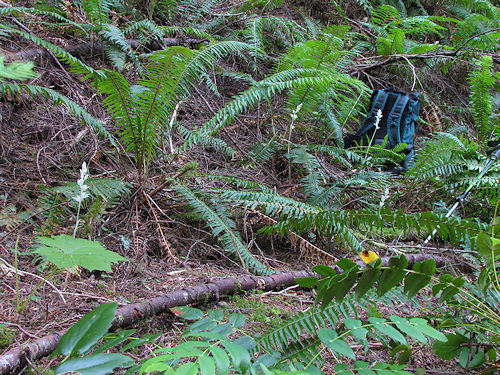
Day 255: Lovingly nicknamed Mac, my "pet" Corallorhiza maculata is now just past her prime. She reached a substantial height of 20" and bore at least two dozen individual flowers.
Although the Corallorhizas form seed ("dust seed," extremely fine), they cannot germinate without the aid of soil mycorrhizae. The exact process is not well-understood. Some research has indicated that the mycorrhiza aids in breaking down the sheath surrounding the seed. What we do know is that the mycorrhiza is responsible for breaking down nutrients in the soil, converting them to a form which can be used by the plant. Interestingly, each species/subspecies of Corallorhiza is affiliated with a different fungal partner. Apparently my back yard suited Mac's needs. In the thirty years I have lived here, I have not found Corallorhiza on the property, but another thing we know about these marvelous mycoheterotrophic species is that they can disappear and lay dormant for more than 25 years, emerging again only when conditions are ideal. Given our relatively mild, wet winter, I had predicted that this year would be a boom year for mycoheterotrophs. My projection is being borne out not only near my home, but as friends and colleagues report in, the abundance is being noted throughout the Pacific Northwest. Due to COVID-19, I'm forced to enjoy most of them vicariously, but every day, rain or shine, I step out into my yard for a few minutes to tell Mac how beautiful she is.
365Caws is now in its 16th year of publication. If I am unable to post daily, I hope readers who love the natural world and fiberarts will seize those days to read the older material. Remember that this has been my journey as well, so you may find errors in my identifications of plants. I have tried to correct them as I discover them. Likewise, I have refined fiberarts techniques and have adjusted recipes, so search by tags to find the most current information. And thank you for following me!
Showing posts with label mycoheterotroph. Show all posts
Wednesday, June 24, 2020
Thursday, June 11, 2020
Mycoheterotroph Magic
Day 242: You're going to scoff. I know that, and I know you're going to ridicule me for being about as unscientific as a person who calls themselves a scientist can get, but sometimes even the most anchored among us have to raise an eyebrow when things come together as if by magic.
During my friend Michael's pursuit of his degree in ecopsychology, he asked questions of me as a naturalist, as an animist and as a shaman. To me, the three terms form a well-balanced Venn diagram with me smack in the convergence zone. One question he posed was that, given my profound love of Nature, did I feel that Nature ever demonstrated love in return? I replied in the affirmative, but qualified my response by saying that naturally (if you will forgive the pun), this return would take a different form than human love, and might in fact manifest as something we would fail to recognize. That said, I cited at least one circumstance where it approached what we humans consider a demonstration of love, when Nature had seemingly expressed a sentiment toward me which, for want of a better phrase, I would express as gratitude. Love takes many forms among humans. Who can define it for anyone other than themselves?
My readers are aware of my passion for mycoheterotrophs, that group of plants which grow only in certain narrow ecologies, plants dependent on specific soil mycorrhizae, plants which cannot exist unless their complex requirements are met. Being in voluntary isolation has put dramatic constraints on my ability to "botanize." My expeditions are limited to walking distance from my home, but even so, this spring has brought a number of interesting finds: several slime molds, a plant not previously recorded on Park property, and a few scattered specimens of Corallorhiza maculata, one of my favourites. I mention the last specifically, because I had not observed them in this area previously, and I've done quite a bit of prowling about in the trailless woods in the last thirty years. I have been lonely for my mycoheterotrophs, more than for human company.
Yesterday afternoon, I walked out to the wooded strip between my property and the one adjacent to me, intending to pitch some radish leaves onto the unofficial compost pile. At the very margin, spotlighted in a sun-fleck as if to say, "Hey! Down here!" was a single stem of Corallorhiza maculata. The flowers were just beginning to open on the lower portion, a few maroon spots winking at me as I gaped in surprise. As I walked back to the house to get the camera, I burst into tears. If I couldn't go to my mycoheterotrophs, it seemed that at least one of them had come to me.
During my friend Michael's pursuit of his degree in ecopsychology, he asked questions of me as a naturalist, as an animist and as a shaman. To me, the three terms form a well-balanced Venn diagram with me smack in the convergence zone. One question he posed was that, given my profound love of Nature, did I feel that Nature ever demonstrated love in return? I replied in the affirmative, but qualified my response by saying that naturally (if you will forgive the pun), this return would take a different form than human love, and might in fact manifest as something we would fail to recognize. That said, I cited at least one circumstance where it approached what we humans consider a demonstration of love, when Nature had seemingly expressed a sentiment toward me which, for want of a better phrase, I would express as gratitude. Love takes many forms among humans. Who can define it for anyone other than themselves?
My readers are aware of my passion for mycoheterotrophs, that group of plants which grow only in certain narrow ecologies, plants dependent on specific soil mycorrhizae, plants which cannot exist unless their complex requirements are met. Being in voluntary isolation has put dramatic constraints on my ability to "botanize." My expeditions are limited to walking distance from my home, but even so, this spring has brought a number of interesting finds: several slime molds, a plant not previously recorded on Park property, and a few scattered specimens of Corallorhiza maculata, one of my favourites. I mention the last specifically, because I had not observed them in this area previously, and I've done quite a bit of prowling about in the trailless woods in the last thirty years. I have been lonely for my mycoheterotrophs, more than for human company.
Yesterday afternoon, I walked out to the wooded strip between my property and the one adjacent to me, intending to pitch some radish leaves onto the unofficial compost pile. At the very margin, spotlighted in a sun-fleck as if to say, "Hey! Down here!" was a single stem of Corallorhiza maculata. The flowers were just beginning to open on the lower portion, a few maroon spots winking at me as I gaped in surprise. As I walked back to the house to get the camera, I burst into tears. If I couldn't go to my mycoheterotrophs, it seemed that at least one of them had come to me.
Saturday, May 16, 2020
Mycoheterotroph Fix
Day 216: For me, the most painful part of voluntary isolation is not being able to go into the woods as much as I'd like, especially as the spring plants are emerging. However, I have been getting my botany fix during my morning walk, and on occasion, it has borne fruit which in turn led to some interesting email conversations with Arnie. One centered around the presence of Corallorhiza maculata at an unusual site: How did it get there? How is it managing to survive? As you may recall from previous posts, the Corallorhizas are mycoheterotrophs. More specifically, C. maculata (Spotted Coralroot) is an obligate mycoheterotroph. Unlike C. trifida, it lacks any trace of chlorophyll, and therefore depends entirely on soil mycorrhizae to break down nutrients into a form it can utilize. One would hardly expect it to pop up in a developed area only a few feet from pavement, and yet that's where I found eight or nine stems. Three or four others can be found in the surrounding forest, but that handful on the parking strip bother me, presenting a botanical puzzle I will never solve. Arnie and I have spent hours in discussion of the relationship between the rarer mycoheterotrophs and specific soil types which exist only in isolated pockets, and while C. maculata is not particularly rare, it does have fairly specific requirements for both soil and mycorrhizal partner. Further, the mycorrhizal components have requirements of their own. Some only grow where certain plant species are present. We refer to this as a species' "plant associations," and as good botanists, we use this knowledge as a tool to help us pinpoint where rare species may potentially occur. How, then, did dear little maculata pop up in a parking space which at some previous point had been scraped flat by a bulldozer? Yes, I'm getting my botany fix even on the short walks I take every morning, always the observer, always open to the questions the forest poses.
Wednesday, May 29, 2019
Corallorhiza Trifida, Northern Coralroot
Day 228: Northern Coralroot (Corallorhiza trifida) is listed as rare in Mount Rainier National Park. Much smaller than its relatives Western and Spotted Coralroot (C. mertensiana and C. maculata), it can be extremely difficult to see in the deep forests it prefers. A full-grown stem will seldom exceed 8" in height. This tiny orchid is partially mycoheterotrophic by virtue of containing some chlorophyll, which is to say that it is incapable of complete photosynthesis on its own, and therefore must rely on specific mycorrhizal (fungal) components in the soil to facilitate the uptake of nutrients. All Coralroots are mycoheterotrophic, however, the different species depend on different fungi.
In years past, my botany partners and I have recorded as many as 23 stems in a single season over three known locales. So far in 2019, we have observed exactly ONE. I believe this fluctuation in the census represents the overall health of the mycorrhizal system, i.e., the presence or absence of moist, warm conditions during the period of winter dormancy. If conditions are not right for the mycorrhizae, the plants will not emerge. Ironically, we are seeing C. mertensiana and C. maculata emerging earlier than normal. It remains to be shown whether their numbers will be greater than average as the season progresses.
Thursday, June 7, 2018
Corallorhiza Maculata
Day 237: Several species of Coralroot occur in Mount Rainier National Park. Of the more common ones, Corallorhiza maculata is my favourite. This mycoheterotroph displays a white lower petal marked with dark purple freckles and looks more like a tropical orchid than its cousins. Local specimens are generally shorter than C. mertensiana (the Coralroot most often seen), although in optimum growing conditions, its copper-coloured stems can reach heights of 30 cm.
Every year, I hope that somewhere in my travels, I'll find a specimen of C. striata within the boundaries of the Park. The only report of the species was subsequently proved in error. A specimen identified as C. striata was in fact C. mertensiana. Mycoheterotrophic plants are often very selective about their fungal associations, which no doubt accounts for the rarity of the species. Anybody know of research being done to determine which fungi are associated with specific Corallorhiza species?
Tuesday, July 4, 2017
Chasing Phantoms
Day 264: First, let me correct the dates I gave previously. Until recently, Cephalanthera austiniae (Phantom Orchid) had only been seen in Mount Rainier National Park on two occasions, both times as a single specimen. The first occurrence was in 1892, the second in 2005...a gap of 113 years. Last week, I found two with my botany partner Joe Dreimiller. Yesterday, I did a wider survey alone and discovered seven specimens, one of which had been cropped of all but its lowest blossom by a deer. The tallest of the plants was roughly 16", the shortest about 8". I took many photographs and GPSed the three locations in which they occurred, and further exploration up the drainage revealed what to my eyes looked like ideal habitat, but no more orchids. Still, seven individuals is not a bad score for a "rare and endangered" species.
![]() |
| Spotted from a distance |
![]() |
| Can you find all four? |
Joe and Sharon knew exactly what I meant when I shot a cryptic one-word post to Facebook last night: "Seven." Joe is recovering from shoulder surgery done only a few days ago and will be out of commission for the rest of the season. At least he got to see two.
Saturday, July 30, 2016
Indian Pipe, Monotropa Uniflora
Day 291: Indian Pipe (Monotropa uniflora) is usually only seen singly or in small clusters, but over the last two years, there has been an uptick in many of the mycoheterotrophic species found in the Pacific Northwest and large groupings are much more common. Earlier in the year, I found 20-30 stems of Candystick (Allotropa virgata) growing together, a highly unusual sight. In the area where I took this photo of Monotropa uniflora today, there were at least half a dozen clusters this size or larger as well as many smaller colonies. I suspect that our recent mild, damp winters are being enjoyed by the mycelia responsible for nourishing these plants, hence their sudden abundance.
Thursday, June 16, 2016
Allotropa Virgata, Candystick
Day 247: Arguably the showiest of Mount Rainier National Park's mycoheterotrophic species, Allotropa virgata will make any hiker stop in their tracks for a photo. The "canes" may rise as much as 20 inches above the forest floor, and although they're usually seen as single specimens, they do form colonies. Like other obligate mycoheterotrophs, Allotropa virgata is entirely dependent on a mycorrhizal component (Tricholoma magnivelare) which facilitates the plant's uptake of nutrients from the soil. Where the fungus is absent, Candystick will not occur.
In Nature, everything holds hands, a point which becomes more obvious when you study any tightly linked relationship like mycoheterotrophy. As I learn more about these species, a question arises in my mind about the harvesting of edible wild mushrooms. Like any Hobbit worth the name, I do enjoy a meal of chanterelles, morels or boletes, and if I had been possessed of the skills necessary to make a 105% identification of Tricholoma magnivelare, I'd probably have picked the "American matsutake" as well. Fortunately, those skills are not in my repertoire, or I might have been murdering dozens or hundreds of Candysticks by my gluttony. It's a sobering thought.
Tuesday, June 14, 2016
Hemitomes Congestum, Gnome Plant
Day 245: As I have said repeatedly, last year was a banner year for the mycoheterotrophic species including the relatively uncommon Hemitomes congestum, aka Gnome Plant. Prior to last year, I had only found Hemitomes a handful of times in half a century of woodland ramblings, and those sightings were mostly of single, isolated specimens. However, in 2015, I discovered it in multiple locations for a total of over 100 individual plants. Following another mild winter, I predicted that we might again see an uptick in mycoheterotrophs, a prediction which was borne out at least in part by a record number of individuals (16!) for Corallorhiza trifida earlier in the year. I've been monitoring two known Hemitomes sites for the last month, and was elated to see them beginning to emerge in both locations just one week ago. So far, the count is only five in one site and one in the other, but I am confident more will burst through the forest duff following the next spell of warm weather.
Wednesday, May 11, 2016
Corallorhiza Maculata, Spotted Coralroot
Day 211: Following on the heels of Corallorhiza trifida, C. maculata is making an appearance in the lowland forests. Two days ago, I saw a newly emerged (unopen) specimen in a friend's woods. Yesterday, three surprised me in Pack Forest where I have never found them before.
The Corallorhizas are mycoheterotrophic species, which is to say that they lack chlorophyll and rely on the presence of specific ectomycorrhiza (fungi) which allow them to uptake nutrients from the soil. Not all of these associations have been discovered, but we do know that C. maculata is dependent on mycorrhiza of the genus Russula. The presence of Russulas in the autumn do not guarantee that an area will host Corallorhiza maculata, but if maculata is present in the spring, you can rest assured that Russulas will be evident later in the year at the same site.
There is a lesson in this, particularly for mushroom hunters: everything holds hands with something else in Nature. As strange as it may sound, over-picking of a mushroom species could lead to the extirpation or extinction of an Orchid. That's serious food for thought.
Wednesday, July 8, 2015
Indian Pipe, Monotropa Uniflora
Day 268: Without a doubt, this year has been an exceptional one for botanizing. In the process of scouting out uncommon mycoheterotrophs and orchids earlier in the season, I discovered a number of colonies of Indian Pipe just starting to emerge through the forest duff, little buttons of white among the fall of needles and twigs. I've been watching them closely for six weeks or more, waiting for their ghostly pale "shepherd's crook" heads to lift and open. A solitary flower hides inside each shroud, a yellow eye, its glance downcast in demure grace.
Also called "Corpse Plant," Monotropa uniflora is not a common species, but neither is it rare. What is rare, however, is to see more than a few in any given area. Here, within the space of a few acres of hillside, there are dozens of colonies...dozens, perhaps even a hundred or more clusters have popped up, most showing 20-30 stems in a grouping. I have never seen them so lush! Is their abundance due to an increase in the fungal cooperator in this mycoheterotrophic relationship? I believe that may be a substantial contributing factor, based on my observation of other mycoheterotrophic species this year.
Sunday, June 14, 2015
Candystick, Allotropa Virgata
Day 244: Without a shadow of doubt, Candystick (Allotropa virgata) is one of the most unusual plants you will find in Pacific Northwestern forests. This mycoheterotrophic species resembles nothing quite so much as a stick of peppermint candy with its red and white stripes, and like many of Mount Rainier National Park's other mycoheterotrophs, it is appearing in abundance this year, and in places where this observer has not previously seen it. These specimens were photographed in the Longmire Stewardship Campground on June 13, 2015. Other clusters of a dozen or more spikes, some a foot tall or more, were noted within the space of approximately one acre.
Monday, June 8, 2015
Pinesap, Monotropa Hypopitys
Day 238: If you put forth the hypothesis that this is hypopitys, you'd be right, but you'd probably never get your tongue unwound. For once, you're safer if you call it by its common name, Pinesap, another of those marvelous mycoheterotrophs and fairly common in Mount Rainier National Park. Its cousin Indian Pipe (Monotropa uniflora) is white, and occurs far less frequently in our forests. Formerly referred to as "saprophytes" (a misnomer you will still see in field guides), the Monotropas are in fact one half of a symbiotic relationship with a fungus. This specimen was observed along Westside Road along with an abundance of other mycoheterotrophic species, and in that respect, I do have a hypothesis: that our mild winter has allowed the mycorrhizae associated with these curious plants to proliferate. That's why we're seeing so many of them this summer.
Friday, June 5, 2015
Cone Plant (Gnome Plant), Hemitomes Congestum
Day 235: Rare in Mount Rainier National Park and observed by your narrator only two or three times previously, Hemitomes congestum (Gnome Plant or Cone Plant) was discovered by me growing in two widely separated locations on June 4, 2015. This further fuels my theory that the mild winter has allowed the mycorrhizal components required by these highly specialized species to proliferate. I have also noted several large colonies of Indian Pipe (Monotropa uniflora) in the same area where this photo was taken, and indeed, monitoring the Indian Pipe's development was what drew me back to the site on this occasion. Additionally in the same area and others, the Spotted Coralroot (Corallorhiza maculata) has grown to an exceptional size. It isn't just a good year for mycoheterotrophs. It's an amazing one!
Labels:
Cone Plant,
Gnome Plant,
Hemitomes congestum,
MORA,
mycoheterotroph,
rarities,
Westside Road
Sunday, May 31, 2015
Penny Perspectives - Western Coralroot
Day 230: Yet another of western Washington's native Orchids, Western Coralroot (Corallorhiza mertensiana) is the most frequently seen of the four Coralroots known to occur in Mount Rainier National Park. Its petals are marked with red or magenta stripes, and the lower petal has a spur at the base, unlike either C. maculata or C. striata. Stems may reach as much as 18 inches in height. The plant is an obligate mycoheterotroph, i.e., it has no leaves and contains no chlorophyll, and relies on a fungus to break down soil into usable nutrients. A flower dainty enough to grace a faerie's evening dress as this "Penny Perspective" demonstrates, Western Coralroot prefers the shady, "sun-fleck" forest which constitutes much of the Park's lower elevations.
Wednesday, May 27, 2015
Penny Perspectives - Spotted Coralroot
Day 226: Arguably the showiest of the Park's four known Coralroot species, Corallorhiza maculata when seen from above is easy to gloss over as "a little brown plant." It's only when you take a closer look that the freckled face of this Orchid species reveals itself in all its speckled beauty. Another mycoheterotrophic species, C. maculata lacks chlorophyll and therefore relies on a mycorrhizal component's assistance in order to draw nutrients from the soil. Maculata can be quite common where it occurs, as it was where I found these near Westside Road, but since many mycoheterotrophs exist only in symbiosis with specific fungal species, its occurrence is likely to be patchy.
Thursday, April 30, 2015
Day Of The Trifidas
Day 199: I couldn't resist the play on John Wyndham's apocalyptic novel, "Day of the Triffids." I think of the book every time I say "Corallorhiza trifida."
My enthusiasm for this rare Coralroot has become widely spread, now involving members of the Native Orchid Society and an assortment of botanists, some of whom will be making field trips to the site before this ephemeral beauty fades. It occurred to me yesterday to suggest an after-work expedition to my good friend and supervisor, Kevin. Despite a few sprinkles, we stopped on the way home to take some photos and then went orchid-hunting. We managed to turn up two more specimens near to the first, bringing the total to three and a stem. However, I failed to predict the next course of events.
My photos from that late-day session were uniformly bad. I'm struggling with the technique involved in shooting macros with an add-on lens, and low light is always an issue with my camera. Consequently, I waited until I knew the sun would be penetrating the dense overstory at the site, and made a return trip at 10 AM this morning.
First, let me explain these two photos. Other than adjustments to contrast and the depths of highlight and shadow and some minor cropping, they have not been altered. They demonstrate what occurs in the "sun-fleck" forests in which species such as these thrive. In one second, a plant and its surroundings may be fully illuminated by a ray of sunlight. In the next, it may go as dark as the proverbial London coal-hole at midnight. Throughout the day, this shifting of light creates a unique microecology. Plants entirely dependent on sunlight for photosynthesis cannot survive here; often, you will see nothing but evergreen needles and twigs on Pacific Northwest forest floors. However, the mycoheterotrophic species (obligate or partial) require very little sunlight. It is in the deep forest ..."sun-fleck" forest where competitive species would die ... that you will find them.
So, lesson done, here's the story. I arrived at the parking pull-out and pulled up in front of another vehicle. I knew that one botanizing friend was planning to come down to make another observation of our little pet rarity, and noting that the car looked vaguely familiar, I assumed it was his. However, when I arrived at the site of the Corallorhizas, no one was there. Figuring that he had gone for a longer hike, I settled in to capture C. trifida on digital film.
I took up my customary position and had been flopped on the forest floor, camera clenched tightly in my fists, for half an hour or so when a fir cone hit me on top of the head. I cast a glance upward for a squirrel, but saw nothing. Not to be distracted, I went back to taking pictures. A minute or so later, I was pecked on the head by another cone. I brushed at my hat despite the fact that the cone had bounced and landed in the duff. A few seconds later, I got hit again. I looked up and swore at the squirrel, but still didn't budge from my task. Then a mischance cone tagged me at the corner of my eye. Now grumbling audibly and volubly, I pulled my hat down and, as is my usual wont, continued giving verbal posing instructions to the specimen of C. trifida before my lens.
But that bloody squirrel was not letting up! I kept getting pelted with cones, twigs and bits of debris, but I am imperturble when bent upon a goal and didn't flinch. I remained belly-flopped on the ground, talking to the light, the flower, the rocks, the roots, the camera and anything else I felt needed addressing.
Five or ten minutes passed while I endured a continuing barrage and then, thinking to get some shots of the second new specimen, I started to get up. My eyes travelled to the trail above me where I saw first a pair of legs in uniform trousers and then Kevin's laughing face. I have no idea how long he may have been there, nor how he managed to sneak up on me without my hearing his approach.
Kevin, bless his heart, has been infected with my enthusiasm for this botanical marvel, our little Corallorhiza. He had returned prepared to take photos himself, using far better equipment than I have in my arsenal, and had spent an hour doing just that before I arrived. That said, I am forced to admit that although I may and do consistently recollect rocks and trees I've met only once, I had gone up the trail without recognizing Kevin's car despite the fact that I ride in it regularly.
Monday, April 27, 2015
Corallorhiza Trifida, Local Rarity
Day 196: One of the most exciting moments in a naturalist's career is the discovery of a species they have not observed before. Following a report from a former Park volunteer, I made a total of four trips trying to locate and obtain a decent photograph a solitary specimen of unusual orchid, and even once I had it "in the bag," I was baffled. Since I could not identify it myself, I sent the photo out to several experts in native plants, and just before bedtime last night, I received an identification from one of them: Corallorhiza trifida, aka Early or Yellow Coralroot.
According to Susan McDougall and David Biek, C. trifida is "rare at Mount Rainier....circumboreal, but is uncommon here in the northwest and recorded a couple of times apparently at the mountain...A terrific find!" It is so unusual that they want to photograph it themselves before the blossoms fade. During a plant survey in the Park last year, they had been unable to find an occurrence of the plant.
Even more exciting for me, of course, is the fact that this rare Corallorhiza is also a partial mycoheterotroph, a group of plants in which I have a particular interest. I believe our mild winter may have allowed the mycorrhizal components of many mycoheterotrophic species to proliferate, thus bringing to the surface a greater number and variety of plants than we'd see in a normal year.
Dear little Corallorhiza trifida, if you were a bird, you'd go on my Life List, but unfortunately, I haven't kept good records of my botanical finds. Maybe you've given me reason to start!
Friday, April 17, 2015
Pack Forest Surprise
Day 186: I had gone on a mission to Pack Forest about 10 AM and was coming back down from Windy Ridge, walking along the western portion of the 2000 Road with my eyes scanning the slope for a better example of Snow Queens than the ones I'd found near the trailhead. Suddenly, I saw something entirely unexpected: the bright magenta flags of two dozen or more Calypso Orchids on a steep embankment, so deep in shade that I had missed them altogether when I'd gone by an hour earlier. These are the first Calypsos I've seen outside Mount Rainier National Park. They have also emerged at Longmire and at Ohanapecosh, according to reports I've received, flowering there about a month earlier than normal.
Labels:
2000 Rd.,
Calypso bulbosa,
Calypso Orchid,
hiking,
mycoheterotroph,
Pack Forest,
Windy Ridge
Friday, May 2, 2014
It's Calypso Time!
Day 212: Arguably one of the most beautiful wildflowers of the lower forest, the delicate Calypso Orchid is also one of the most fragile. As a partial mycoheterotroph, this plant relies on a mycorrhizal (fungal) component to aid it in utilizing soil nutrients. Unlike full mycoheterotrophs, it is also capable of limited photosynthesis, but cannot complete its life cycle without both processes (mycoheterotrophy and photosynthesis). A broken stalk, a crushed leaf or a disturbance of the soil will destroy these diminuitive "fairyslippers."
Calypsos spring up in the early season (May-June) at Mount Rainier National Park. At an average height of five inches, they can be difficult to spot in their preferred habitat alongside mossy stream channels and wet areas. The single leaf emerges first, followed by the development of the stalk and blossom. Although the magenta-pink flower is typical of the species, white blooms are not uncommon. Keep your eyes open, because it's Calypso time!
Subscribe to:
Comments (Atom)