Showing posts with label Spotted Towhee. Show all posts

Friday, January 9, 2026

It's Towhee Time


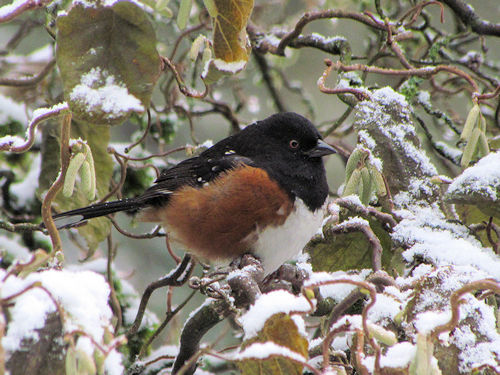
Day 89: Spotted Towhees (aka Rufous-sided Towhees) always look like they've either had too much caffeine or that they're just on the verge of a psychotic episode. It's those red eyes. Other birds can fix you with glassy or inquiring pinpoint focus , but nothing says "wild creature" as emphatically as the mad-as-a-March-hare stare of a Towhee. It is Towhee season at my house. One or two hang around in the summer, but as soon as cold weather sets in, the mob shows up to do their backward jump/scratch move as they bring loose seed and bugs up from the tangled grass. They are primarily ground feeders, although they'll occasionally take seed from a tray. I see them scurrying around in the leaf litter at the base of the contorted filbert, scratching for insects in the decaying leaves with their peculiar dance. To go with the mad eyes, their frenetic activity appears to be rooted in nervousness, although it's only normal species behaviour which has served them well in the evolutionary scheme. But the red eyes? Where's the evolutionary advantage in that? Maybe the "I'm just crazy enough to tackle a rhinoceros" look deters predators. I'll just say that I wouldn't want to meet a Towhee in a tantrum, and let it go at that.

Sunday, January 14, 2024

Become A Better Birder


Day 93: The most important thing you can learn if you want to be a better birder is what to observe. Note that I do not say, "what to look for." If you spend the fleeting seconds before your subject disppears into cover trying to look for something specific, you will blind yourself to observations you might have made when shown the overall picture. Take for example the two birds in the top picture. A novice birder might conclude that they are the same species because they are both orange and black, but might fail to note that one has a white breast and a red eye, whereas the other has orange wing markings and an eye stripe. When partially concealed by brush, it would be easy to make that mistake. Seen without interfering scrub or grass, the two are much easier to tell apart. The Towhee's wing markings are white; those of the Varied Thrush are orange. The Thrush's breast is mottled; the Towhee's white beneath rusty sides. Learn what field markings commonly distinguish species, such as wing bars, crowns, eye stripes, tail feathers, the colours of eyes, beaks and legs. You will find that your cursory glimpse registers these features more readily as you practice. And be patient with those who might insist that either or both these birds are American Robins. Take those poor uneducated souls under your wing and teach them to be better birders.

Thursday, January 11, 2024

Snowbirds


Day 90: The epithet "snowbirds" has always intrigued me. It is used quite differently in different environments. To some, it means the people who fly south to warmer climates as soon as the first flake falls. To others, it means the influx of skiers to the slopes. Since both make equally good sense when applied to humans, I have resolved the quandary with an even more logical definition to eliminate any confusion when I use it in conversation. These are my snowbirds (some of them, anyway), the faithful winter companions who appear regularly at my feeders and knock on my window when the seed supply runs low. Spotted Towhees, Dark-eyed Juncos, soon-to-be-renamed Steller's Jays and Evening Grosbeaks ("Porch Parrots" in my vernacular) are among the most reliable visitors to my yard when snow lies on the ground. Let's hear it for the snowbirds who neither slalom nor suntan!

Sunday, February 26, 2023

Snow Birds


Day 136: The term "snow birds" has been a source of confusion for me for many years because when I first heard it, the speaker was referring to the group of people who head south for the winter. Some years later, I heard it applied to the skiers who flock to the slopes and lodges, indeed quite the opposite of the initial definition I had learned. That said, I'm sure you will agree with my definition of "snow birds" upon seeing these images. These four species (Dark-eyed Junco, Spotted Towhee, Steller's Jay and Black-capped Chickadee) are among the most common in my yard when the white stuff is on the ground. And yes, that one curved twig is by far the most popular perch. If the weather forecast can be believed, we're due for more snow every day for the next week. Have fun, you snow birds!

Saturday, February 18, 2023

Mr. Towhee


Day 128: If the level of activity in my yard is a reliable indicator (and I suspect it is), the weather forecast for the latter part of next week is likely to prove accurate. Recently, NOAA has been missing the mark for the nighttime lows, their predictions coming in as much as ten degrees lower than what actually registers. I hope that holds true for Wednesday and Thursday nights when they are claim we will drop to 10-14 degrees. Admittedly, we have had some bitterly cold Februaries historically, although generally not after mid-month. In any event, the Towhees have turned out en masse, a dozen or more hopping about the yard and scrabbling for any scrap of seed or bug they can find. I hope you're wrong about the weather, Mr. Towhee, or we're all going to be hunting extra calories.

Tuesday, November 29, 2022

Spotted Towhee


Day 47: Although Spotted Towhees are resident in my yard year-'round, nothing brings them out of hiding like a snowfall. And such busy little things they are, darting here and there faster than I can bring the camera into focus. They are primarily ground feeders, scratching for seeds and insects with a peculiar backwards hop which captures debris in their front talons and sets it flying behind them in a shower. They use the same technique to dig through snow, and often mine down to bare soil beneath the feeders in the hopes of finding seed scattered from overhead. Why not dine from a whole tray of black-oil sunflower seed when it is readily available? Bird species which eat insects as a principle component of their diet also incline toward searching for seed on the ground. Those which primarily consume nuts, seeds and fruit are more likely frequent raised feeding stations.

Sunday, November 21, 2021

Mad-Eye Towhee


Day 39: I have had a long-term association with birds both tame and wild, and have witnessed various degrees of intelligence in them as it is measured in human terms. Parrots' eyes leave no doubt that something greater than response-to-stimuli is going on in that feathered head, and I have personally witnessed displays of self-awareness in a cockatoo which left no doubt that he recognized both me and himself in a video, and thought it was the funniest thing he had ever seen. Many animals avoid eye contact because it is threatening, but wild birds may allow it if they are comfortable with a particular human, e.g., a chickadee assessing a person holding a handful of seed. The light of intelligent consciousness shines from many birds' eyes, although admittedly some (pigeons, for example) are blank and vapid. That said, the red eyes of a Spotted Towhee make the bird look as if it's gone completely around the bend, mad as a hatter, crazy as a bedbug. How is it, then, that another bird was given the name Nuthatch when Towhees clearly look as if they belong in a lunatic asylum?

Thursday, April 9, 2020

Spotted Towhee, Pipilo Maculatus


Day 179: Once known as "Rufous-sided Towhee" here in the Pacific Northwest and considered to be one and the same with the eastern species, Pipilo maculatus (Spotted Towhee) was separated from Pipilo erythrophthalmus (Eastern Towhee) in 1995 after decades of debate. The bird, however, is only indirectly the subject of this discussion. Instead, we're going to talk Latin.

Ironically, both "maculatus" and "erythrophthalmus" could be applied to either species. Both are spotted and both have red eyes. That's what the two terms mean. Now while most of you won't readily be able to pull up from memory many English words with roots in "erythr-," but "ophthalmus" should ring a few bells. Have you ever been referred to an ophthalmologist for an eye problem? That medical professional may have used an ophthalmoscope to look into your eyes. Yes, "-ophthalmus" is a clue to an identifying characteristic: it tells us to notice the bird's eye. If you happen to have some medical background, you might recognize "eryth-" as being part of the word for a red blood cell: erythrocyte. "Eryth-" in "erythrophthalmus" further indicates that the eye is red.

Let's move on to "maculatus." This one is easier. The English term "maculate" is not one you hear commonly, but it is a valid adjective and means "spotted" or "stained." However, don't strain your brain in trying to remember that. Just think of its opposite: immaculate. Something "immaculate" is without stain or spot.

Seriously, folks, you use a lot more Latin in your daily conversation than you probably realize, Greek too. English is a youngster as languages go, and "modern" English (i.e., English in a form you'd be able to understand with relatively little difficulty) is only about 500 years old. Step back a little more than a century into Chaucer's day and "woot ye wel what I meene of this" as it applies to the English of his era. If you think of Latin as a "dead language," think again. It's alive and well in scientific nomenclature, and also in our everyday speech.

Wednesday, November 27, 2019

Toe-Tau-Too-Ee


Day 45: However you pronounce their name, Spotted Towhees have to be one of the goofiest-looking birds in anybody's back yard. I grew up calling them "TOO-ees" (thanks to the same mother who instilled in me my pronunciation of "LITCH-en" to rhyme with "KITCH-en"); but you may call them "TAU-ees" or "TOE-ees" if you wish, and the dictionary will defend you. "TOO-ee" rhymes with "screwy," and that's what I call them: screwy towhees, doing their little hockleback scratch-kick to raise seeds from the tangled grass, their red eyes giving them a distinctive mad-as-a-March-hare look. I mean, it's serioius business being a bird, having to hunt down your food before some other opportunist grabs it, having to defend your nest against all sorts of predators, having to seek shelter against weather extremes, but Towhees just somehow seem...well, "silly" is the word which comes to mind. You won't catch me making fun of Chickadees, Jays, Sparrows, Goldfinches or any other of the birds who rely on my feeders for sustenance, but Towhees...Towhees make me laugh.

Thursday, March 28, 2019

There's Always One


Day 166: There's always one. Every spring, I'll have at least one Towhee whose tailfeathers have gone missing all at once. Now whether this phenomenon is due to the natural moulting process (and feasibly, it could be) or to somebody waiting just a little too long to fly away from a stealthy predator is not something I can confirm with any conviction. Certainly, Towhees are not precisely the sharpest crayons in the box, but they are also predominantly ground-feeders, which leaves them more vulnerable to a hunter with a taste for fowl. In any event, I always wind up with at least one unfortunate and embarrassed Stubby and, forgive me, they always make me laugh.

Monday, February 11, 2019

Enough Already!


Day 121: "Enough already!" Towhees' red eyes always make them look a little daft, but a foot of new snow is enough to push anybody over the edge. I misjudged the depth of last night's accumulation, and when I stepped into the yard to take out birdseed, I went in over the tops of my 12" wellies, filling both of them with snow which promptly turned into ice water. I'd had the foresight to take off my socks (it's a wrestling job to get the boots off unless I'm barefoot), so by the time I'd laid breakfast for the birdies, my feet were chilled through. And now it's snowing again, which means that my feathered friends are gobbling down the seed at a rapid pace. Maybe next time I go out, I'll put on my waders.

Monday, February 4, 2019

Shelter In Place


Day 114: Following Mr. Towhee's advice, I am sheltering in place, not even going out for groceries although I discovered yesterday that I'm down to my last half dozen Red Rose tea bags. 'Sokay, I have some herbals I should use up, and I'm well stocked for coffee. That said, if you're a bird, food is a priority regardless of the weather. Towhee and friends are making quick forays to the feeders, then retreating to the relatively snow-free core of the contorted filbert. The tangled branches provide protection not only from predators, but also from the weather. If you're snowed in, you might want to think about making a few bird-sized holes in the snow/ice covering your shrubs. The little guys will appreciate your efforts.

Monday, December 24, 2018

Noel Of Small Birds


Day 72: During the years when I used to play Celtic harp and perform professionally, I wrote much of my own material. Most of it was instrumental, but occasionally, I'd compose a song.

Noel of Small Birds

All the birds of winter gather in to find a shelter,
Begging for a bit of food and warmth in the cold weather.

From their homes in barren trees, sparrows go, and chickadees.
Finches search for bright berries, flying back with treasure.

From a journey returning laden, they sing merrily.
Song fills the sky, and the snow is so white
And red the rowan tree.

Gifts of Man shall help in need, crumbs of bread and scattered seed.
Thankful small birds all indeed, merry to a feather!

Singing, soaring over the forest, freely they shall fly.
Dance on the wind over moorland and glen
In the sparkling winter sky.

All the birds of winter gather in to find a shelter,
Begging for a bit of food and warmth in the cold weather.

All along the hedgerow gay, birdsong beckons in the day,
From the holly and the bay, and the hoary heather.

Tiny birds take wing to go wassailing. Questing they shall go.
Thicket and bush for a moment are hushed
By the silence of the snow.

Masters of their frosty hall, they announce the minstrel's callm
Pleasure to accord to all, singing all together.

Thus their carol rises unbounded, joyful hearts in flight.
Echoing trills lie like mist on the hills
On a starry winter night.

Friday, December 7, 2018

Young Towhee


Day 55: The cold weather has brought the Spotted Towhees out by the dozen. Although I see them here in the summer occasionally, I think of them as a "winter bird," doing their peculiar hop-back scratching step as they hunt for fallen seed in the snow. This one is a young bird. How can you tell? Pipilo maculatus juveniles have brown irises; their eyes will change to bright red at adulthood. Primarily ground-feeders, these birds' colouration gives them excellent camouflage in leaf litter, the pattern of black and white simulating broken shadows. Handsome birds, Towhees, but those red eyes make the adults look like they've had too much espresso.

Tuesday, February 20, 2018

Winter Residents


Day 130: One of my most reliable winter birds is good old Spotted Towhee, aka Rufous-Sided Towhee (Pipilo maculatus), but exactly how his name is pronounced is a subject of some conjecture. Webster's Third New International Dictionary offers several options. I can't seem to copy the schwa (upside-down e) to a post, so you will have to make do with my phonetic renditions. A schwa has the sound of the o in "collect", i.e., cuh-LECT. Webster first lists TUHW-ee. The next choice puts the emphasis on the final syllable: tuhw-EE. Last of all comes the pronunciation I hear most often (one which sets my nerves on edge as surely as fingernails on a chalkboard): TOE-hee. As I say it, it is more like the first option, but with a slightly stronger first syllable, TOO-wee. But nowhere can I find justification for another pronunciation, TAU-ee.

I don't care how,
Too or toe,
But toss out tau.
It just ain't so.

Tuesday, November 28, 2017

Such A Puzzle!


Day 46: When the contorted filbert is fully leafed out, it provides excellent habitat for the assortment of bird species which come to my feeders, but even after the leaves have dropped, it forms a tangle through which no hunting hawk can pass quickly enough to snatch a songbird. The little guys can navigate among the twisted branches with ease, and usually, the jays are alert to any danger. One alarm call, and all the small birds disappear into the heart of the bush, warily emerging once the hawk has left. Now decorated with a lush crop of catkins, the tree puts me in mind of another type of puzzle: jigsaw! Wouldn't this Spotted Towhee make a wicked 1000-piece challenge?

Tuesday, January 10, 2017

Catching The Red-Eye


Day 89: "Catching the red-eye" isn't easy! Spotted (Rufous-Sided) Towhee is a ground-feeder, and a hoppy scratcher who is in constant motion. He plants his toes in soil or grass and jump-slides backwards, causing seed and bugs to fly into the air where he can see them. His tail is also active, flicking every few seconds. His active nature and habit of preferring to feed in the shelter of brush makes this robin-sized bird a difficult photographic subject indeed!

Our western version (Pipilo maculatus) shows more white spots on the wings than Eastern Towhee (P. erythrophthalmus), hence the common name. The voice is distinctly different with our western species calling its name, "too-EEE, too-EEE!" rather than the "Drink-your-teeaa! familiar to birders in the eastern US. That said, human pronunciations of "Towhee" vary even more widely: "TOW-ee" (like "cow"), TOE-ee (like "toe") or "TOO-ee" (the way I learned it.) Some people pronounce the H; others put the em-PHA-sis on the final syl-LA-ble.

Young Towhees' eyes may remain brown for some time after their feathers take on adult colouration. Adult female Towhees may demonstrate a black-crowned dark grey head. Young birds are brown and speckled, and resemble female Black-Headed Grosbeaks superficially, but observation of the feeding habit will clear up any possible mystery.

Friday, November 27, 2015

Towhee Time


Day 45: It's Towhee season! When the weather turns cold, I can always count on an influx of Spotted (formerly Rufous-Sided) Towhees at my feeders. They like the protection offered by the contorted filbert as do other small birds since fast-flying predators like hawks can't follow them easily into its interior. The tangle of branches all too frequently foils the photographer's lens as well. This morning, I had half a dozen Towhees show up for breakfast. I stood out in the cold waiting until one perched on an outer limb. Thanks, Towhee! Extra seed for you!

Saturday, November 23, 2013

Catching The Red-Eye


Day 52: Spotted Towhee (aka Rufous-Sided Towhee, Pipilo maculatus) is a twitchy little fellow. He flicks his tail almost constantly, darting glances from side to side as if every shrub harboured a Red-Tailed Hawk on the prowl for dinner. On the ground, Towhee is even more jumpy...literally. To raise seed from the soil or in the grass, he digs in his toenails and gives a quick backward hop. He performs the same maneuver in the feeder tray, scattering seed far and wide to be picked up by others of his kind. Photographically, he's a difficult subject. Besides his nervous behaviours, he likes to stay concealed. He gives a whole new meaning to the phrase, "catching the red-eye."