365Caws is now in its 16th year of publication. If I am unable to post daily, I hope readers who love the natural world and fiberarts will seize those days to read the older material. Remember that this has been my journey as well, so you may find errors in my identifications of plants. I have tried to correct them as I discover them. Likewise, I have refined fiberarts techniques and have adjusted recipes, so search by tags to find the most current information. And thank you for following me!
Sunday, March 14, 2021
Devil's Tower
Day 152: I talk about the Devil's Tower in conjunction with trips to Sulphur Creek Falls, but have rarely posted photos of it because it doesn't present itself readily to the lens, obscured as it is by vegetation. It is also difficult to capture its detail since it is almost always backlit by the sun. I believe it to be an ancient volcanic plug, exposed by erosion. In any event, its pockmarked, knobbled construction affords mosses, sedums and various other mosture-loving plants a place to take hold, and very little of its rocky structure remains visible through gaps in their blanket. It stands as gate-keeper to the Tolkienesque stronghold of Sulphur Creek Falls; you cannot go below its base without wearing heavy armour against the massed forces of devil's-club and salmonberry, and if you should be inclined to come in from above, there is no way down short of a treacherous rappel. I would estimate its height at roughly sixty feet from the narrow, mud-greased ledge I refer to as its base (although presumably it is anchored in some geologically impressive lava conduit far beneath the forested slope). Its ledge always draws a sigh of relief from my heaving chest. There, I can progress some thirty yards without struggling for every toehold, even pausing to admire its botanical garden. "That really is Suksdorfia," I say to myself as I admire a cluster of scalloped leaves which obviously enjoy the wet, north-facing wall. It is the only location outside the Park where I have observed the species. As much as any other reason, the botanical diversity pulls me back here, certain that there is some rarity on the Tower which I've failed to notice, being too set upon the goal of the falls.
Saturday, March 13, 2021
Crow At Sulphur Creek Falls
Day 151: I first visited Sulphur Creek Falls in 2005. I learned of its existence through geocaching. It took me two tries to get there, the first failing when I tried to follow the instructions provided on the cache page and wound up in a tangle of devil's-club, but the second successful after a friend counselled me to "use your woods sense" to pick my own route. You see, there is...or was...no trail to this magical place at the end of a box canyon. Elk and deer trails criss-crossed a steep hillside, but as animal trails have a wont to do, they often disappeared without warning. Natural hazards abound here: mud, thickets of devil's-club and salmonberry, fallen trees and so on. But once I had attained my goal and found the cache, I kept going back every year. Very few other people even made an attempt to reach the cache. The cache owner disappeared from the GC website and finally, after several years of maintaining the cache myself, I petitioned to adopt it. It was a long process, but eventually GC turned it over to me.
That said, every subsequent year brought new obstacles. There were landslips, more fallen trees. And there was evidence of human activity which I did not like: litter, and ropes put in place to make the descent to the base of the falls easier. Every time I went in, I cleared it out. If a little old lady didn't need a rope to get there, the young bucks (human) who were partying at the site and leaving their beer bottles behind could certainly make it without assistance. Then a flood came and changed the landscape even more. I had to relocate the cache about 150' from its original location. However, even that site was not secure. Last year, a large cedar tree slid down the hillside, its massive root ball coming to rest when it hit the two trees my revised cache was between. The cache was still accessible, but barely.
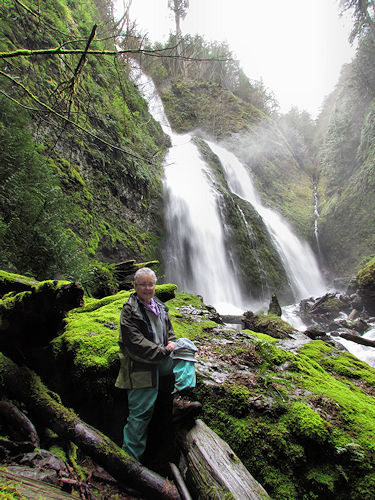
A few days ago, I made a decision to archive the cache due to two factors: increasing erosion (both natural and human-caused), and my age. You don't see very many tiny women at the three-quarter century mark prowling around in trailless and somewhat dangerous terrain. But I had one last mission which took me to Sulphur Creek Falls again yesterday: remove the cache container. After a year of voluntary lockdown, I hoped I still had the steam for the trip. "Slow and easy," I told myself time again as I struggled up the slopes using roots and branches and the occasional clump of ferns to leverage myself up one more step, mindful that the muddy ground was likely to give way and send me 50-100' down to creek level if all three of my anchor points failed. "Bush-belays" are not my favourite climbing tools, but I'll use them if nothing else is available. I went nose-to-mud twice before I reached the base of our local version of the Devil's Tower, but the challenge didn't end there. Once up to safe ground, I had the descent to cache level ahead of me, perhaps the most dangerous part of the trek. In fact, I had to find an alternate route from my usual, owing to yet another landslide. I retrieved the cache container and then made my way from this point (photo) to the base of the falls, up and around that pile of lumber behind me, and then back down again. One more "up" took me back to the base of Devil's Tower, from which I descended without incident (not counting a muddy bum) to the nice, flat South Swofford Trail, continuing there on a leisurely walk for a mile and half almost to its end, glad that my multiple missions were all complete. It is unlikely that I will return to Sulphur Creek Falls again.
Friday, March 12, 2021
First Day Of Skunk Cabbage
Day 150: I thought I knew what day today might be, but in order to confirm my hypothesis, I needed to make a serious Trip Out to visit Ma Nature. Only her phenological calendar could show it for sure. Still, I have been having a run of bad luck/unpleasant events lately, and because I also had in mind a more adventuresome outing than a visit to the bog (American usage, please!), I was a little apprehensive. Would I wind up hurting myself to cap off the series? Or could I possibly break the run by doing something fun and exciting? I was deliberating as I stepped out on the front porch to feel the temperature, and Pacific Wren's long, burbling song came to my ears from the brush pile. That clinched it. Pacific Wren is a trusted advisor, and he had just indicated to me that I needed to spend some time in his woods. I came in and immediately started packing my pack.
I saw no Skunk Cabbage as I drove over the Divide, nothing in any of the usual swampy areas. Maybe I was on a wild skunk chase after all? But as I approached my "best bog" on the South Swofford Trail, I saw a spot of yellow and, minding my footing in the mud as I got closer, a shaft of sunlight fell on a pristine example of my mother's favourite flower. It was indeed the First Day of Skunk Cabbage, a day almost as important to me as September Morn.
Then I started up the hill toward Sulphur Creek Falls. I had archived my last geocache and needed to pull the container. Over the last several years, both natural and human-caused erosion have made this trek even more perilous than before, the "trail" (such as it is, made by deer and elk) crossed by numerous fallen trees and, in the steeper sections, landslides. In fact, I found the cache almost buried by the huge root mass of a tree which had slid down the embankment. I was able to retrieve the container, but only barely.
I made my way back down without incident and then continued on out the South Swofford Trail nearly to its end, where I sat on the corner of a bridge in the company of one small Skunk Cabbage blossom and a horde of Blue Duns (well, that's what we call them in fly-fishing). Then it was back to the car and home, where yet another catastrophe appeared to loom into view, but thanks to Kevin's internet skills, I was able to restore my computer's health by blowing the dust out of the transformer plug. Have I gotten around Murphy's plans for my future? I hope so.
Wednesday, January 2, 2019
Sarcoscypha Coccinea
Day 81: Experts will argue that Scarlet Elf Cup (Sarcoscypha coccinea) is peculiar to the Pacific Northwest despite the fact that the name has been applied to similar fungi elsewhere in the world. Whatever its range, one thing is certain: it will stop you in your tracks when you encounter it in the deep, dark forest as I did when I was hiking into Sulphur Creek Falls. I've seen it there before, although somewhat closer to springtime. Its colour is a striking salmon-red, and its exterior surface is covered with a white "bloom" which makes it appear pink at first glance. It grows on decaying hardwood twigs and often appears in multiples, emerging from beneath deteriorating leaf litter. When it releases its spores, it may do so in a fog-like burst resembling that of a puffball mushroom. Now there's a phenomenon I'd like to record!
Tuesday, January 1, 2019
Ramalina Thrausta
Day 80: What a great way to start the new year! I picked up a lichen specimen on my way back from Sulphur Creek Falls yesterday after deciding that it was a Ramalina of some sort, and therefore a new genus for my unofficial lichen life list (or rather, that I found on my own instead of having one handed to me by an expert). Ramalinas are characterized by small perforations in the thallus; some species are so perforated that they look like lace. Although I couldn't see the holes with my naked eye, other details clued me in: both upper and lower surfaces were uniform in colour and the branches were flattened. I thought I might have trouble keying it out, but its growth habit and size quickly narrowed the options. Under the microscope, the perforations were visible, as well as a few very small patches of soredia. Bingo! At least I'd thought to take a picture of the tuft in the field, because by the time I got done picking it apart, it qualified as "specimen destroyed during analysis." May the joy of discovery be part of your life in 2019!
Monday, December 31, 2018
Sulphur Creek Falls, Broad View
Day 79: It is not an easy hike. The "trail" (if you could call it that) is nothing more than a track made through brush by elk and a handful of locals who know about Sulphur Creek Falls. Unless you have an eidetic memory capable of recognizing specific configurations of stumps and branches, you will probably not be able to duplicate your route two times in a row (either in or out). The slope on many sections is intimidating, the footholds narrow and unstable. Where the vegetation is thinner, the ground is covered with loose, sharp rocks in sizes from grapefruit to watermelon. At this time of year, the forest floor is deeply covered in decaying leaf litter, making the way even more difficult to follow, but oh, the reward when you arrive at the head of the canyon! Sulphur Creek Falls tumbles down 186' in two steps, forms a small plunge pool (which, incidentally, I have never felt confident to try to access) and then flows on down to fill Swofford Pond. The streambed is choked with devil's-club. Don't even think about going that way!
I like to finish out the year with a commemorative event. Sometimes, weather permitting, this manifests as a hike or snowshoe walk. Other times, the year's end is marked only by a rare restaurant meal. Today, I'd planned to do both, but when I arrived at my favourite Chinese place, still covered in mud from having fallen and slid more times than I care to count, there was a sign on the door saying "Now closed Mondays. Sorry for the inconvenience." Plan B was put into effect and, although it took me thirty miles out of my way, a satisfactory alternate was found. Say g'night, 2018. I can't say I'll miss you much.
Friday, July 13, 2018
Devil's Tower, Tolkein Style
Day 273: There's a long story behind this post, but the upshot of it is that I had a need to revisit this location today because my geocaching partner is still recovering from heart surgery. As much as he would have liked to make the trip with me, it wouldn't have been wise.
When I first started geocaching in 2005, it took me a while to figure out that everyone's routes and coordinates might not be the best. Typical of Crow, I didn't want to go around lifting up lamp-skirts to sign log sheets in film cans; no, I wanted to make an adventure of caching, to seek out strange new places, to get off the beaten path. One of the first caches on my to-do list was Sulphur Creek Falls. I made a couple of false starts as I tried to follow the cache owner's instructions, but it didn't take me long to realize that he was no woodsman. Nobody with any brain tries to go up a creek bed which is likely to be choked with devil's-club, or have piles of impassable boulders obstructing progress. On the advice of a more woods-savvy friend to "follow your own forest sense," I took to a ridgeline and then shot a contour directly to the base of Devil's Tower (the Washington version). Having found the cache at the base of a beautiful waterfall, I knew then that I'd be paying another visit. In fact, I made several return trips in the company of various friends...one from New York, and a memorable group expedition in the company of Kevin, another cacher, my caching partner and Indiana Jones. Oh, yeah...that'll take some explaining. Indy was a "travel bug," a little toy with a numbered tag, meant to be taken from cache to cache and logged in. We had fun photographing Indy on the trip.
Not many people were willing to make the trek into Sulphur Creek Falls for a single cache smiley, and the cache owner moved out of the area and abandoned the hide. After several years and many maintenance visits, I petitioned Geocaching to allow me to adopt the cache. They gave the original owner time to respond and when he did not do so, ownership was transferred to me. Then when I decided it was time for me to archive my other caches (not wanting to die with a legacy of plastic and metal left in the woods), I asked my caching partner if he wanted to take over from me. He readily agreed. However, he wasn't able to visit the site again, so I kept up the maintenance runs.
Recently, someone tried to find the cache and failed. For some reason, it came to the attention of Geocaching that it had not been found since 2013 and, despite my logs showing I'd performed maintenance every year, they saw fit to send Dan a "nastygram" last week, threatening to archive the cache unless he performed maintenance. And there you have the reason for today's trip...a hike I made in the cool of the morning before I'd even had my second cup of coffee. Not much to see in the way of a waterfall right now, but in the spring (the best time to go), it comes down those rocks in a veritable river. The hike is much easier now, too. There's a well-established trail once you get through the salmonberry thicket. Admittedly, you need to be second-cousin to a mountain goat to navigate portions of it, especially the last drop to creek level, but it's well worth the effort.
Tuesday, April 4, 2017
First Sighting 2017
Day 173: When I went up to Sulphur Creek Falls ten days ago, I was watching for both Trillium and Cardamine blossoms and only saw a few buds of the latter. This week's trip yielded up half a dozen Trilliums although none were fully open. I had to come in from underneath this one (not a problem on the steep slope!), and it was here that I also found one of yesterday's snails, almost entirely concealed by forest duff.
Common names being what they are, the epithet "wake-robin" applies broadly to several different species of Trillium, yet uncharacteristically in a person who prefers the precision of scientific Latin to common usage, the name inspires me with a sense of spring's true return and therefore, it's how I address these lovely lilies when I find them. They are extremely fragile and do not transplant well, but I am favoured by having a few in the wooded strip at the edge of my property. They are not as common in Pacific Northwestern forests as they were in the days of my childhood, days before I was aware of their delicate biology. I am guilty of having picked a few in my youth, and it haunts me that I contributed even in that small way to their decline. Perhaps that's why when I see the first ones each spring, I always share the message: do not dig, do not pick. Your conscience is watching over your shoulder.
Monday, April 3, 2017
Sulphur Creek Snails
Day 172: Proof that I never outgrew being a tomboy, I came home from both of my last two trips to Sulphur Creek Falls with my shirt pocket full of snail shells. Fortunately at this time of the year, most of those I found were empty, so no snails were harmed in my efforts to identify two species common in western Washington forests. I learned a lot about gastropod biology while researching these, and if the thought of a pocketful of snails didn't ruin your breakfast, the best is yet to come. Those of you with weak stomachs should probably step away from the screen.
The critter on the right is Haplotrema vancouverense, aka the Robust Landtooth. Innocent as it may look, it is predatory on other gastropod species as well as being cannibalistic. It is very common in wet lowland forest, but often conceals itself under leaf litter, so mind where you step!
On the left is Monadenia fidelis, the Pacific Sideband. This species is hermaphroditic (as are many snails) and employs "love darts" during mating. The partners deploy sharp-pointed reproductive organs which not only serve to transfer sperm-boosting chemicals, but act as a deterrent to subsequent mating with another snail. According to National Geographic, "(I)t isn't clear whether the loss of libido is caused by a chemical on the darts or is a result of physical trauma."
Sunday, April 2, 2017
Frankia Nodules
Day 171: Here it is, the botanical curiosity which necessitated a second trip to Swofford Pond and Sulphur Creek Falls. My initial photos from a week ago were sufficient to obtain an expert's identification, but regrettably were rather poorly focused. It's not easy to get a clear photo when you're in dark woods with nowhere to stand a tripod because of the steepness of the slope! So what is it? Nothing particularly rare, just not often seen because the roots on which it grows are generally covered by soil and aren't exposed until the host tree falls over. It's a root nodule, birthed from a bacterial infection (beneficial, not harmful) by one of several generalized species of Frankia (of the Frankias, only F. alni is classified taxonomically, representing its host species of Alder). Frankia colonies form in the absence of nitrogen in the soil, i.e., they are nitrogen-fixers. The blebs of a mature colony are filled with bacterial filaments which convert atmospheric nitrogen into a form which can then be utilized by their hosts.
My first thought upon encountering it was that it was some type of gall, the same supposition which had been made in 1679 when it was first discovered (thank you, Google). I have seen some very unusual outgrowths as the result of infestation by gall-producing insects including one I mistook for a lichen growing on blue huckleberry. Then I wondered if it could have been produced by a nematode, but that too was wrong. I owe great thanks to our Park ecologist who referred my initial photos out to a second expert with whose aid the mystery was solved.
Saturday, April 1, 2017
Return To Sulphur Creek Falls
Day 170: How many people do you know who would drive 70 miles and hike through muddy trailless forest just to get a better picture of a botanical specimen? Mind you, I said "a better picture." The ones I took last week weren't quite as well-focused as I would have liked. They were sufficient that when I sent one off to an expert who in turn sent it off to another expert, she was able to return an identification to me, but in my book, the picture just wasn't "blogworthy." The specimen wasn't anything rare, just...odd. You'll see it in an upcoming post.
As long as I was going to have to go halfway up the hill, I figured I'd attack the remaining distance to the falls to do some maintenance on a geocache for a friend. The cache used to be mine; I turned it over to him several years ago. He never gets up to the falls but I do, so it makes sense for me to take care of it. I also had another job in mind. The local "party boys" get up there every now and then, and inevitably, there's some trash to take out. I hadn't been equipped to do that last week, but yesterday, I went prepared. I also wanted to remove about 30' of heavy-duty tie-down strap they'd been using as a rappelling rope to get down the last slope. I don't rappel. Why should they? If they want to mess up the site, they're going to have to work harder at it now.
I overexposed the falls in this photo in an attempt to bring the foreground out, but even so, I had to pull the shadows up substantially, particularly on my face. It's DARK in there! The walls of the canyon are very close and high, and I doubt if direct sunlight hits that rock more than half an hour a day on more than 14 days per year. Everything is covered in a thick layer of slippery, wet moss except the newer wood which has been carried over the falls during heavy rain. But there is a mystery I have yet to solve: what is the source of Sulphur Creek? On the topo map, it looks like a small drainage nourished by nothing more than runoff which, incidentally, goes two ways from the spine of Green Mountain Road. To the north, it drains into Swofford Pond (subsidiary to larger Riffe Lake). To the east, it drains immediately into Riffe. There is no lake feeding it, but it never goes completely dry. Unfortunately, all the land above it is privately held, so I can't go exploring. I guess there are some things we're just not meant to know.
Wednesday, March 29, 2017
An Idea Of Angle
Day 167: I have to fill in here a bit. Y'see, I need to go back up to Sulphur Creek Falls to get a better picture of something unusual. I took several shots of it earlier this week, but when you're in dark forest trying to run a camera one-handed because your other hand is holding on tightly to a root so you don't roll downhill, your focusing ability is somewhat hampered and you wind up with a picture which isn't quite blog-worthy, but was good enough for a team of experts to make a sound identification. To give you a rough idea of what I was up against, see the slope immediately behind me in this photo? I had just come directly down it. Thoughts en route included, "If that rock rolls, I'm going to break something," and "If I slip here, I'm gonna bust my leg off at the hip," and "Damn, that moss is slick! If the bark on this log peels, I'm dead." Are you getting the picture?
A good hiker/explorer plans exit routes for those just-in-case moments when they can't be sure of the solidity of the next step. All my Plan Bs seemed to end with, "No, that's not a good idea either," followed by a mental image of compound fracture of the tibia or worse. That said, I have only broken myself once while adventuring, and that was on a climb when my blithe snowy glissade suddenly turned into an ice-slide at high speed and sent me sailing over a lip to land my tailbone hard on a pointy boulder. I have gone into some very treacherous terrain alone (quite often, if the truth be told), and count on my route-finding abilities and good balance to keep me in one piece. There are no alternate routes into Sulphur Creek Falls, or at least none which don't require a partner and a rope.
Why do I go? Not to be glib, but "because it's there." Or "because I can," especially at my age. I have always been adventuresome. What's over the hill or up the gorge is something I simply must see with my own eyes. The day I stop wanting seeking out the strange new worlds of the Pacific Northwest will be the day my spirit dies within me, leaving the husk to follow at its leisure. For me, there is nothing more exciting than the discovery of something I haven't seen before, whether it's a rare species of mushroom, a new lichen, or just what's at the top of another bump in the terrain. So why do I go alone? Because I like my adventures like I like my scotch: straight up. Or straight down, as the case may be.
Saturday, March 25, 2017
Sarcoscypha Coccinea
Day 162: Sarcoscypha coccinea is a species of cup-fungus endemic to the Pacific Northwest and is commonly called Scarlet Elf Cup. Its bright red colour make it easy to spot in the shady forests where it prefers to live. It grows on decaying hardwood (maple, for example), although it often appears to be sprouting directly from the ground when the wood is buried. A short stipe (stalk) may or may not be apparent. The outer surface of the cup is lightly tomentose (fuzzy) and whitens with age. Other similar Sarcoscyphas can be found on the east coast, but S. coccinea can be found solely in the west from California northward. The species fruits in late winter through spring, unlike the majority of other cup-fungi.
Friday, March 24, 2017
Sulphur Creek Falls
![]() |
| Devil's Tower |
Day 162: Yesterday's adventure was one with multiple goals. First on the agenda was the hilariously unfortunate sally into the Skunk Cabbage bog, but also on the list were an invasive-plant patrol of the South Swofford Trail where I had previously found both English Holly and Yellow Archangel, and a trek off-trail to Sulphur Creek Falls.
Sulphur Creek Falls is only about half a mile from the trail, but the climb is steep and at this time of year, muddy and slick. That said, spring is the best time to go, because the elk tracks will be overgrown with nettles, salmonberry and devil's-club within just a few more weeks. As anyone who has spent any time negotiating cross-country routes should know, attempting to reach your destination by following a creek bed is ill-advised. It's better to attain a ridgeline when possible, or at the very least, to come in high. Following the elk whenever possible, dragging myself up by roots and branches in places, sliding back down when the forest duff collapsed under my feet, I have made this journey dozens of times, originally to find a geocache but later, simply to enjoy the falls and the privacy.
To get to Sulphur Creek Falls, one first climbs to Devil's Tower, a puzzling 60' rock thumb on the side of a steep slope. It seems an unlikely location for a volcanic plug, but I have no other explanation for this geologic anomaly. At its base, a narrow path of shattered rock takes you to the falls, although to see it clearly, you must descend approximately 100' to the creek on a steep, unstable slope. I've never found an "easy" route down, so care and caution are the by-words here, and the hiker should keep in mind that what goes down must come back up, a job which isn't as easy as it sounds. But oh, what a reward awaits you, especially when the falls is in full spate!
![]() | |
| Sulphur Creek Falls |
Monday, May 6, 2013
Sulphur Creek Falls
When I got to Swofford, I documented the species with photos and GPS coordinates, and then set out on the trail to see what else I might come across. Richard had mentioned the possibility of Purple Loosestrife, English Ivy and Yellow Flag Iris occuring in several spots and asked me to check on them. I did not discover any, although I did find a Holly, a "monitored" species. I stopped and reported it to Richard on the way home. It will also be listed on the survey sheet I turn in to the IPC.
When my patrol of the south shore was almost complete, I found myself juggling the idea of taking a side trip up to Sulphur Creek Falls. The only "trail" to it is one created by elk and a few hikers who try to follow them with somewhat limited success. I've been there enough times that I no longer need map and compass to find the falls, now entirely familiar with almost every root and rock en route. It's not a long hike, approximately half a mile, but it is steep and the vegetative hazards are myriad. Years ago, my first few attempts to reach the falls were stymied by Devil's-Club, dense Salmonberry thickets and prodigious nettles. It is also challenging to get down to creek level when you arrive at the falls. A fall on the steep slope would surely end in broken bones. The box-canyon walls rise a hundred feet or so above the narrow valley floor, only permitting sunlight to reach the bottom for a few hours in the afternoon.
I stayed at the falls for half an hour or so before heading down. As I neared the boat launch, I could smell the chemicals Richard and his team had applied to the Archangel. The area will require monitoring for a few years to be sure it doesn't come back, a duty which will give me an excuse to make another trip to the Falls.