365Caws is now in its 16th year of publication. If I am unable to post daily, I hope readers who love the natural world and fiberarts will seize those days to read the older material. Remember that this has been my journey as well, so you may find errors in my identifications of plants. I have tried to correct them as I discover them. Likewise, I have refined fiberarts techniques and have adjusted recipes, so search by tags to find the most current information. And thank you for following me!
Wednesday, October 1, 2025
Goosed!
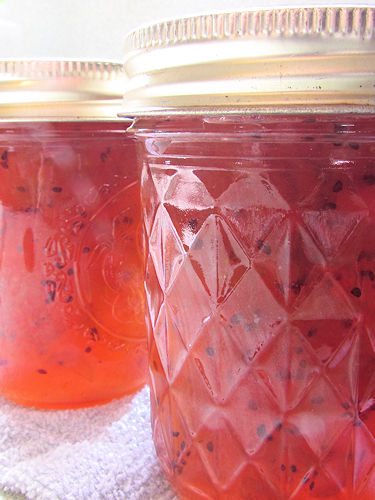
Day 354: The thought of a Thanksgiving turkey gave me just the goose I needed to start making space in my freezer. Goose? As in, "thaw this year's gooseberries and make jam!" The bushes only produced five cups of berries this year because I'd pruned them radically at the end of the 2024 season, but that was enough to make 8 half-pints and one quarter-pint of jam, with a bit left over. I've not been canning much this year. In fact, the last batch of jam I made was in February, and that was the 2024 gooseberry crop. I only have two jars from that session left, but when I went to put these away, I found another row of the 2022 batch hiding behind cranberry-orange marmalade. 2022 is still good (jam keeps well), but I'll eat it up first before getting started on these. That's my two favourites: gooseberry in the #1 spot, cranberry-orange marmalade in #2. Both of them are a lot of work, gooseberry in picking season because each berry has to be topped, tailed and cut in two before freezing, while cranberry-orange marmalade requires a lot of prep work on canning day. Still, those aren't things you're going to find in any store and, in my opinion, are well worth the extra work for as good as they are.
Monday, September 18, 2023
Canning Season
Day 340: I love having friends with fruit trees! Yesterday, a supply of pears and apples showed up on my doorstep, the pears at such a point that half of them needed to be processed immediately. The yield was only three pints, three pints to tuck away for winter nibbling. Today, I intend to work on the apples. They're harder to peel for these old, arthritic hands, but the thought of summer in jars makes the labour worthwhile.
I can't recall how long I've been canning jams, jellies and fruit. I suppose you could argue that it would be a lot less work to buy "fresh" fruit in winter, fruit which has either been in cold storage for several months or shipped across an ocean, fruit which was probably picked green and gassed to ripen it. No, that does not appeal to me. I'd rather spend a few hours in the kitchen paring, slicing, boiling jars, dripping sticky syrup on the counter and floor, steaming up every window in the house. I know this fruit personally. It's never seen a chemical, has hung on the tree in healthful sunlight and rain until it was ready to be picked. It's the real deal, warts and all, unlike some waxed, perfect and just-short-of-plastic pippin from the grocery store. It deserves to be preserved, if only for the short term.
Sunday, November 27, 2022
What's Cookin' Now?
Day 45: Oh my! What's going on in Crow's kitchen now? If you guessed cranberry-orange marmalade, you'd be right. Second only to gooseberry jam, this is one of my favourites, but marmalades are more labour-intensive, so it's been several years since I made any. Those last two or three jars in the cupboard kept insisting, "You're not supposed to archive us!" but it's always hard for me to use the very last of anything. I haven't done much canning this year, so I decided it was time to replenish the pantry. I picked up all the ingredients this morning, and have the hard part of the job done already. A while back, I discovered a slick trick for taking the peels off the citrus without getting too much of the white pulp underneath. I use a potato peeler! It cuts the exact width I prefer for my "shred" (the bits of peel which are a characteristic of marmalade), and it's easy to stack three or four to slice into fine pieces. But then there's the problem of getting the white pulp off the outside of the segments. It's harder to do when you don't have a fleshy peel to use for leverage. In any event, the peels and fruit are now simmering to tenderize, and I'll be jamming tomorrow!
Cranberry-orange Marmalade
Remove the peel from 2 oranges and 2 lemon with a potato peeler. Cut peels into tiny strips. Remove and discard the pulp from the citrus fruits. Break apart, removing seeds and any fibrous bits. Grind the fruit in a food processor, leaving it a bit chunky. Add 1 1/2 cups of water and 1/8 tsp. baking soda to the fruit and peels. Bring to a boil and simmer, covered, for 20 minutes. Add 2 pounds of fully ripe cranberries. Return the fruit to a boil and simmer for an additional 15 minutes. This can be done in advance (like, the day before).
Measure 5 cups of fruit into a large saucepan. Add 6 1/2 cups sugar and a smalll pat of butter to prevent foaming. Stir to combine. Bring to a rolling boil, and boil for one minute. Remove from heat and stir in 1 packet of Certo liquid pectin. Allow to cool for 10 minutes, stirring often to prevent floating fruit. Pour into sterilized half-pint jars (8-9), seal and process in a boiling water bath for 10 minutes.
Saturday, October 29, 2022
Jam Smarts
Day 16: Let us assume for the moment that you have the great good fortune to have gooseberries available to you. You will need four cups of them, topped, tailed and cut in half. Add a small amount of water (not enough to cover them, but close) and bring to a good boil. Cook for 15 minutes to soften the skins. Be sure you have sterilized jars and lids ready to go. Add 7.5 cups of sugar plus about two teaspoons of butter (to prevent foaming). Bring to a hard boil and maintain it for three minutes. Remove from the heat and stir in one packet of Certo liquid pectin. Return to the stove and boil for one minute. Take the pan off the stove so that the jam can cool down before jarring up. Stir frequently for ten minutes to prevent floating fruit. Decant the jam into jars, seal and process in a hot-water bath for 10 minutes (half-pints). The result will be 8-9 jars of what is easily my very favourite jam of all time. Gooseberries, my friends, are a priceless commodity, seldom grown these days because they take so much work to prepare. Voice of experience here, I got some "jam smarts" this summer, preparing small amounts every day as they ripened, then putting them in the freezer for processing into jam during cooler weather. Nine cups of gooseberries yielded 18 half-pints of jam. I'm set for winter!
Monday, March 14, 2022
Stem Ginger On The Hoof
Day 152: It's arguably cheaper to buy stem ginger at the supermarket than it is to make your own, to say nothing of the labour involved, but the "gingery-ness" of the finished product will prove worth the effort. I'm doing a lot more Chinese cooking these days and am getting a little tired of trying to cut up crystallized ginger without taking off a fingertip in an effort to get the pieces fine enough. I can't really keep fresh roots on hand for grating, so I've decided to put up a few jars in syrup, one to use immediately and the others to be canned like jam or jelly by processing in a water-bath. I suspect there's one flaw in this course of action: it's going to be hard not to eat it for an after-dinner sweet!
Monday, January 10, 2022
The Medlar Project
Day 89: The principle is sound. The practice needs perfecting. I cooked the medlar jelly too long, and it set to the consistency of taffy. That said, further experimentation yielded a solution: add a little water to each jar, reheat in a pan of hot water as if de-crystallizing honey, and allow to cool. The jelly will reset because it contains no pectin other than what was in the fruit. Next year, I want to try adapting the recipe to use commercial pectin, but this year's medlar windfall produced four half-pints and four 4-ounce jars of very tasty garnet-coloured jelly. The flavour eludes description. There is a hint of lemony tartness, a slight similarity to persimmon, perhaps a pleasantly earthy overtone suspended in an exotic and aromatic honey. It tastes...well, it tastes like medlars, deliciously so. It would be excellent as a chutney with pork, as mint jelly goes with lamb. Despite the issue of the too-firm set, I would call the experiment a success. It just needs a bit of refining.
Sunday, January 9, 2022
The Grand Experiment
Day 88: The Grand Experiment is under way, and if it tastes half as good as it smells, I will be quite pleased. A windfall of medlars yielded eight cups of liquid after being simmered gently for an hour per batch. This "juice" was then frozen to await final processing into jelly. Review of several pectinless recipes on YouTube suggested roughly one cup of sugar per cup of liquid. For the record, I decided to use seven cups of sugar. Now the boiling begins. Once the jelly has reached the "set" point (to be determined by dropping a bit of it on a chilled plate), I will jar it up. I couldn't resist sampling the sweetened juice, and I'm sure it's going to validate the time involved in bletting the fruit in a corner of my kitchen.
Friday, September 17, 2021
Filling The Larder
Day 339: A second batch of pears is done and in the pantry cupboard where they will wait to bring a little cheer into the cold, dark months of winter. These next few weeks will be occupied with more canning as I stock the larder with fruit and jam. Asian pears are ripening on the counter, gooseberries and currant juice are thawing in the fridge, and if anyone happens to have a surplus of apples, I'd welcome at least part of them with open arms. Store-bought canned fruit doesn't hold a candle to homemade, and even though canning is a lot of work, I believe it's well worth the effort. These pears are going to taste really good when snow blankets the ground.
Friday, October 9, 2020
Worth Every Prickle
Day 362: Gooseberries are not commonly seen in stores these days, nor at roadside stands. Few people grow them even for home use in pies or as jam. Given my fondness for gooseberry jam, it's hard for me to imagine that a few prickles would be a major deterrent, but on the other hand, they require a lot of meticulous preparation before they're serviceable. In the jargon of gooseberry cultivation, the process is known as "topping and tailing." Using a sharp knife, both the stem and blossom ends must be trimmed from each berry individually, a time-consuming but not altogether unpleasant task if you occupy yourself with thinking of the tart/sweet taste of the jam on a future muffin. Their general unavailability led me to plant a couple of bushes several years ago, but they did not do well in the location I chose. I decided to try Alternate Plan B: purchase new ones and bed them in huge flower pots in the Berry Pen where my blueberries flourish. Then, in an attempt to make the best of a bad deal, I also moved the old plants to the Berry Pen. The relocation and new plantings were successful and I harvested a pound and a half of tangy gooseberries this last summer. Concurrently, I planted two red-currant bushes and got enough fruit this year to make a quarter-cup of juice which I added to the gooseberries, turning the whole lot into six half-pints of one of my favourite bread-spreads. That said, potential gooseberry farmers should be aware that the plants are armed and dangerous, but to my way of thinking, worth every prickle for the yield.
Saturday, August 22, 2020
Plumming Project
Day 314: It's that time of the year again, and I'd like to give a shout out to a Parkie friend who presented me with two bags of delicious red plums, more than I could reasonably eat before they went bad. That said, I am not one to turn down free fruit, so the question became what to do with the remainder. Plum crumble? Canned plums? Frozen plums? Plum butter! Well, as they say, "It seemed like a good idea at the time," but after tenderizing them and putting them through the food mill, I realized that by the time they were cooked to the "butter" stage, I might not have enough to fill a four-ounce jar. I decided to make plum jelly instead. By that point, I was definitely winging it as far as the recipe was concerned, so I checked my pectin supply, added more sugar, put the jars on to boil, and roughly 45 minutes later, I had three half-pints canned up and cooling. There was a slight over-run which went in the fridge and was taste-tested on sourdough toast this morning. It's a little runny, but tasty.
Thursday, September 26, 2019
Home Arts
Day 348: An unexpected windfall of Asian pears from my botany partner Joe set Tuesday's course of action. I spent the morning peeling them (a process which dyed my fingers a lovely shade of orange), and then dragged out the water-bath canner and my biggest cook-pot which was necessary to accommodate sixteen cups of pear bits. I prefer to chunk them up rather than canning halves or slices; you get more in the jar, and fewer jars require less storage space. I put them up in pints rather than quarts so I can parse them out judiciously over the winter months. That said, I've never canned Asian pears before and was unsure how long to process the firmer fruit, so gave them a slightly longer boil in light syrup than I'd have given standard pears followed by twenty minutes in the water-bath. A dose of ascorbic/citric acid product will keep them from turning brown. Oh yeah, that's the kitty quilt in the background. I'm a little over half done with the machine-quilting.
Friday, October 26, 2018
Before And After
Day 13: Between one of the Morris dancers and a Parkie friend, I came by a windfall of apples and pears this week, and settled in this morning to the job of paring, coring and canning. I seldom eat the tasteless, over-processed canned fruit sold in stores, but I find it hard to keep home-canned things on my shelf. Since both the pears and apples were tart varieties, I used a medium syrup, preserving the colour with a product called "Fruit Fresh." It's essentially a mix of ascorbic and citric acids, and when added to the syrup, it prevents the fruit from browning, not that any of this will last that long. I'm already into the plums I put up two months ago. Today, I canned two pints of pears and seven of apple chunks from at least five different types of apple. These are going to taste really good when the January snow flies.
Thursday, August 23, 2018
Never Pass Up Free Food
Day 314: After my dad died, my mother and I were plunged into abject poverty, and there were many days when I was grateful to have a bowl of oatmeal at dinnertime, the only food I'd seen all day. Special occasions might have seen a grilled-cheese sandwich made with process cheese on my plate, a real treat for an 11-year old who was so thin she'd have to stand twice to cast a shadow. That said, our acreage had fruit trees and berry vines, and although sugar was too costly to expend in canning, my mom often froze the harvest. I can hear her voice even now, offering words which still guide me today: "Never pass up free food."
Kevin showed up on my doorstep last night with a bag of plums, presenting me with an internal debate. Did I want to make plum butter or jam? Did I want to freeze them? Or did I want to can them as an alternate to the figs I'd missed out on? I already have a cupboard full of various jams, jellies and preserves and don't need more, so that option was rejected. They'd need to be treated with an anti-browning agent for freezing, and a check of my canning supplies told me I was out of FruitFresh (lemon juice is not recommended for plums because it alters the flavour). That left me with canning. Okay, I'm good with that.
I let Kevin know that I'd put up three pints, and he asked, "Do you want more?" Yes! This morning, he dropped off another bag which yielded up two more pints. It seems like a lot of work for only five pints of fruit, but this winter, I know I will relish every last bite.
Thursday, August 17, 2017
Pickled
Day 308: After making seven pints of curry pickles a week ago (my mother's recipe), I realized that they weren't going to go very far if I gave a bottle to everyone who dropped hints. The next time I went to town, I bought more cucumbers, sugar and spices, and another dozen Kerr pint jars (my preferred brand). I checked with Kevin to see how much work had piled up on my desk (not much), and then took Wednesday off to can.
Pickles are a two-day process. The chunked cucumbers must be soaked in brine 24 hours before the actual canning can be done. The canning process involves every square inch of counter space within reach of the stove, and every burner is occupied by the canning kettle or some other vessel holding hot water, lids or rings, or in the boiling of the pickles preparatory to putting them in the jars. Modern stoves aren't built to accommodate a large hot-water bath canner along with the other implements necessary for the job, but somehow I manage to pull it all together in a timely manner. That's a factor: the jars must be sterilized by boiling for 20 minutes, the vegetables must be boiled in the spice liquid for 5, and the lids and rings must be scalded for 5. Big kettles and little pots must reach the boiling point in sequence so that at the last minute, everything is ready for the final stage. Once the hot pickles are in the jars and have been topped up with liquid, the rims must be wiped and the lids applied. Then they're placed in the hot-water bath and processed (boiled) for ten minutes.
Once I've lowered them into the canner, I can relax...or start cleaning up the kitchen. There's nothing left to do except remove the pickles from their bath and wait to hear the delightful sound of *plink!* *plink!* *plink!* as the jars seal. The pickles? Far and away my favourite sweet pickle, they shouldn't be opened for at least two weeks in order to develop the full flavour.
Wednesday, August 9, 2017
The Way I Figgered It
Day 300: The way I had it figgered, I could get five in a jar because they'd get squishy during the five-minute simmer required for the hot-pack method. Raw, three was the best I could do. I'd originally guessed at 60 for ten pints, but when I saw them on the tree, I realized they were a little bigger in real life than in my memory. I came home with 66 (a nearly full two-gallon pail!) and after processing, I had twelve pints of figs to tuck away for winter. That gives me one jar per week for the official three-month season.
Why go to all this work when I could have dried them much more easily? Because I love canned figs. Forty years ago, you could buy them in stores under the S&W brand name. They came in glass jars. They became harder and harder to find until finally disappearing from the shelves, and I swore that if I ever had a chance, I'd can my own. I am grateful to the friends in Olympia who allowed me to harvest enough from their tree (Desert King) to see me through the winter. My own tree (four years old, and a start from theirs) has not yet produced a fig although each year, it's putting on more leaves and branches. Maybe some day!
Sunday, October 9, 2016
Double Batch
Day 362: Of all the preserves, jams and jellies I make, my very favourite is Cranberry-Orange Marmalade. I never make enough and always run out before cranberries come on the market the following year. When I discovered that the first crop had come in at the grocery store yesterday, I decided to seize the opportunity to get ahead of the game. I bought enough fruit for a double batch, and have been in the kitchen for the last six hours to produce a final yield of 22 half-pints.
Marmalade is rather time-consuming, but I've learned a few tricks which make preparing the fruit a little easier. Peeling oranges and lemons with a potato peeler provides delightfully thin shavings of rind and avoids adding too much of the bitter white citrus pith which can throw off the taste of the jam. I prefer a "shred" style marmalade with finely sliced pieces of peel rather than chunks, and this is easily accomplished by further cutting the strips of peel with a knife or scissors. The pith remaining on each orange or lemon is discarded along with seeds and as much membrane as it is possible to remove, and then the cleaned segments are put through a grinder. The peels, ground fruit and cranberries are cooked for half an hour with a little soda and water. Then sugar is added to the cooked fruit and processing continues as for any other jam.
Friday, September 9, 2016
Pickled!
Day 332: A few days ago when a Parkie friend asked me if I would like some of her pickling cucumbers, my response was enthusiastic, "I haven't made pickles in YEARS!" She dropped off about a dozen small cukes yesterday which I brined overnight, and this morning made a half-batch of my mother's curry pickles which in my considered opinion are the best pickles in the world. Pickles are no more difficult to make than jam (perhaps even easier), but although my mother's directions say to pour into sterilized jars and seal without additional processing, modern recipes recommend placing them in a boiling-water bath for reasons of safety. I've adapted my mom's instructions to reflect that. The addition of a small amount of curry powder gives these pickle chunks a little extra zing and a flavour which can't be found in your average supermarket. For the full 6-pint recipe, follow the directions given below. For a half batch, use half as many cukes and brine according to the instructions, but when making the pickling liquid, reduce the vinegar to 1 1/2 cups and the sugar to 1 3/4 cups. Select firm, small cucumbers for your pickles. Wash them thoroughly before brining.
Make a brine of 1/2 cup NON-iodized or pickling salt and 8 cups of water. Place the cucumbers in the brine and weight them to hold them beneath the surface of the brine. For crisper pickles, separate layers of cukes with washed, raw grape leaves (optional). These will be discarded after brining. Allow the cucumbers to sit in the brine for 12 hours. Keep them in the brine until you have sterilized your canning jars by boiling them in a covered pan for 20 minutes. Near the end of the boiling time, prepare jar lids and rings and assemble your canning equipment. Have scalded lids ready to go.
You will need:
16 cups of brined cucumber chunks
2 cups of 5-6% white vinegar
2 1/2 cups of sugar
1 1/2 tsp. curry powder
1/4 cup of mustard seed
1 Tbsp. celery seed
Rinse and drain the cucumbers. Rinse a second time and cut into bite-size chunks. Combine all ingredients except the cucumbers and bring to a boil in a large saucepan. Add cukes and return to the boil. Keep at a simmer while you remove the jars from the boiling water. Ladle cukes into jars and top up with liquid to within 1/4" of the rim. Seal. Place the sealed jars into a boiling-water bath for 15 minutes. Remove and allow to cool on the counter. Pickles will be ready to eat in two weeks!
Thursday, August 11, 2016
Exclusively Evergreen
Day 303: In western Washington, non-native blackberries are regarded in two conflicting lights. Property owners consider them a scourge because they overrun everything else and create monocultures which can completely envelop small buildings or form impenetrable thickets, earning them the nickname of "the kudzu of the north." On the other hand, home canners love the rich flavour of jams and jellies made with them, as do the people who receive the preserved products as gifts. Most of us have our favourite spots to pick, e.g., places where property owners have neglected to control them and have allowed them to create monocultures with more or less easy access. Boon or burden? Hard to decide.
I've done my part this year to limit the spread of the two non-natives (at least by seed), and yesterday came across a fencerow mound which was exclusively Evergreen (as opposed to Himalayan). In my opinion, this slightly drier berry produces a tastier jam, although you may have to pick a few more to obtain the required amount of juice. I managed to fill my berry bucket in 20 minutes, nibbling as I picked only the plumpest berries. One gallon of berries produced four cups of juice when processed, exactly the amount called for in my recipe. Since I did not filter the juice to clarify it but only removed the seeds, the end result qualifies as jam rather than jelly. The final yield was nine half-pints and "leftovers" sufficient for this morning's toast.
Evergreen Blackberry (Rubus lacinatus) is recognizable by its deeply incised, lacy leaves consisting of five leaflets which persist through winter. Himalayan Blackberry (Rubus ulmifolius, formerly Rubus discolor) bears a toothed oval leaf having three to five leaflets. The two species often occur together.
Monday, August 8, 2016
Kitchen Music
Day 300: First order of the day...jam up yesterday's gleanings. Last year, the blackberry crop was the poorest I'd ever seen, severely inhibited by hot, dry weather. I'd tried four spots where picking was normally easy, but came home with less than a quart of berries. When I noticed that this year's were beginning to turn black and plump, I decided to strike at once. Since I was already planning to go to Eatonville to see the matinee showing of "Star Trek: Beyond," I loaded bucket, gloves and clippers in the car and left early. Picking wasn't prime, but I soon filled the pail. I juiced them as soon as I got home and let the mash settle overnight. After separating the remaining seeds out this morning, I had exactly four cups of juice, just enough for one batch of seedless blackberry jam. Soon, I was listening to the happy, tinny sound of "Plink! Plink! Plink!" as ten half-pints cooled on the kitchen counter. Not one to let anything edible go to waste, I spread the skimmed foam on homemade toasted sourdough bread for my breakfast. It was worth the wait!
Monday, December 28, 2015
Relaxing, Crow-Style
Removing the white pith and slicing orange and lemon peels thinly is a time-consuming project ordinarily, but this year, I discovered a shortcut which should have occurred to me years ago. I used a potato peeler! The width of the blade was perfect for creating the one-inch strips necessary for a good "shred" style marmalade, and I had only to do the imitation of a microtome I've perfected in preparing lichens for microscope slides in order to achieve thread-like bits of rind. The slivers of peel are cooked with a touch of baking soda until they are tender, and then the fruit is added and cooking continues for ten minutes to soften any remaining membrane. From that point, canning is the same as for most jam...boil, add pectin, cool slightly and pour into jars. I prefer to process my jams and jellies in a water bath to ensure a good seal. Unlike most jams and jellies, marmalade takes a week or two to set, but oh, it's worth the wait to have it homemade!