365Caws is now in its 16th year of publication. If I am unable to post daily, I hope readers who love the natural world and fiberarts will seize those days to read the older material. Remember that this has been my journey as well, so you may find errors in my identifications of plants. I have tried to correct them as I discover them. Likewise, I have refined fiberarts techniques and have adjusted recipes, so search by tags to find the most current information. And thank you for following me!
Friday, February 9, 2024
Cream Puffs
Day 119: When Ed came up to deliver Max, the countermarche loom, he also brought a sizeable number of foodstuffs I consider luxury items: fruit, fresh veg, pecans and a small bottle of whipping cream to put in his tea. He left the things we didn't eat with me, and I have been delighting in broccoli and cauliflower in cheese sauce, apples, oranges and salami. The whipping cream presented a puzzle. I was certainly not going to waste a drop of it because it's probably been fifty years since I had any of it in the house, but what was the best use? Then it hit me: cream puffs.
Now when I was in high school, "Home Economics" was a mandatory subject. I despised it almost as passionately as I despised History. It didn't help that the teacher didn't like me because I refused to wear a girdle and nylons and, consequently, my grades were very poor. Possibly the only benefit I got from that class was that I learned to make cream puffs, never mind that I couldn't boil water without burning it, but I have probably only made them half a dozen times in the half century which followed. I'm pleased to say that I haven't lost my touch for lack of practice, and Ed's whipping cream is almost gone.
Tuesday, March 21, 2023
Tea And Crumpets
Tuesday, May 24, 2022
The Cart, The Horse
Day 223: Sometimes the relative positions of the proverbial Cart and Horse are not easily within our control. I bought an Instant Pot and my initial experiment involved making jasmine rice, a task apparently beyond the skills of the Aroma rice cooker for some reason, and I was so pleased with the results from the IP that I decided to move to a significantly higher level of Pot use: yogurt. I happened to have some Greek yogurt in the fridge to use as a starter, and after reviewing dozens of YouTube videos (most of which prided themselves on being "no-boil" methods requiring ultra-pasteurized milk), I elected to use a "boil" method similar to that in the instructions for my old yogurt-maker. The process was very simple: bring standard whole milk to 180 degrees on "sauté," cool it to 110, add the starter culture and let the Pot do the rest. Eight hours from the time I set the IP to "Yogurt," I had...yes, yogurt. It seemed a bit loose, and in any event, I wanted Greek-style yogurt, so I poured it into a jelly bag and put it in the fridge overnight. In the morning, I had...yogurt cream cheese! Two hours probably would have been sufficient to leave it the consistency of Greek yogurt. Nine hours produced a bagful of the most delicious yogurt cheese imaginable (and salt-free!). This was the Cart, coming well before the Horse of bagels which I just harnessed and brought out of the oven stable. Little backwards there, but in the end, a very tasty lunch, and I can tell you this: I will never buy commercial cream cheese again.
Wednesday, May 11, 2022
Pita Pockets
Day 210: The pandemic has left people with a lot more time on their hands, and many of us have turned to new hobbies or picked up old ones again for the first time in many years. I can only do needlework for a limited number of hours per day, so I've reverted to cooking as an alternate. I've always enjoyed baking, but not so much preparing meals. Friends have often heard me say that if it takes more than one pan and five minutes prep time, I'm not going to bother making it. The exception to that rule is ethnic dishes. I like the challenge presented by trying to recreate some of my restaurant favourites, as you will no doubt recall from earlier posts about cooking Chinese. That said, my favourite sandwich is gyros, and let's settle one thing right here at the outset: the word "gyros" is singular, and it is pronounced YEE-ros. It means "to turn" and gives us the English words "gyrate," "gyroscope" and others, but note that the hard G is an Anglicization. I repeat, the word for the rotisseried meat is "gyros," said YEE-ros, and don't argue with me. It has also come to mean the whole sandwich as popularized by Greek-American restaurants.
This week has had a decidedly Greek flavour. I made spanakopita a few days ago to have something to eat while the gyros was/were in preparation. Then I made a baked version of the meat and tzadziki sauce, both of which needed to rest in the fridge for at least 12 hours. But key to the whole meal was pita, the pocket bread which makes the sandwich. I hadn't made pita in twenty years, and hoped I hadn't lost my touch. I use a recipe in Bernard Clayton's "Complete Book of Breads," but not the one listed under "pita" in the index. Rather, I use the "Arab Bread" version which is baked in a very hot (500 degree) oven. The bread takes roughly 2 1/2 hours from start to finish. The secret is in rolling them out with sufficient flour to keep the dough from sticking to the board or the pin. If it sticks rather than stretching, the characteristic air pocket will not develop properly. If you prefer your pita with a little browning, you can cook them on a griddle or in a cast-iron skillet if you like. Mine puffed to perfection in the oven.
Tuesday, March 15, 2022
Gingery Goodness
Day 153: An old recipe for jugged hare comes to mind: "Fyrst, catch ye an hare..." Get yourself some fresh ginger, enough to make two cups when cut into small chunks. Peel it, ignoring the arthritic objections from your old hands. Cut it up. Freeze it overnight. In the morning, dump it into a pan of water to cover it by about an inch and boil it for half an hour. Drain it. Add fresh boiling water and cook it again for about two hours. Drain it, reserving this second batch of liquid. Combine 2 1/2 cups of the liquid with 3 cups of sugar. Sugar? Oh crap, I'm out of sugar. How did that happen? And I was just at the grocery store yesterday! Okay, combine 2 1/2 cups of the ginger liquid with 2 1/4 cups of granulated sugar and 3/4 cups of brown sugar. Bring it to a boil, and then simmer it for about 40 minutes until it makes a syrupy drizzle on a chilled plate. Add the ginger. Bring it back to the boil and simmer for another 40 minutes. While all this is happening, sterilize four one-cup jars and accordant lids and rings. When the ginger is done cooking, decant it into the jars, seal them and process them in a boiling-water bath for 15 minutes. You'll have syrup left over, but that's good in tea, cookies, cake, Chinese food, or if you have any energy left at all, you could add some apples or pears and turn it into jelly/jam. Have at it. Me, I'm going to go sit down.
Monday, March 14, 2022
Stem Ginger On The Hoof
Day 152: It's arguably cheaper to buy stem ginger at the supermarket than it is to make your own, to say nothing of the labour involved, but the "gingery-ness" of the finished product will prove worth the effort. I'm doing a lot more Chinese cooking these days and am getting a little tired of trying to cut up crystallized ginger without taking off a fingertip in an effort to get the pieces fine enough. I can't really keep fresh roots on hand for grating, so I've decided to put up a few jars in syrup, one to use immediately and the others to be canned like jam or jelly by processing in a water-bath. I suspect there's one flaw in this course of action: it's going to be hard not to eat it for an after-dinner sweet!
Thursday, March 10, 2022
Connections
Day 148: One of the items in this photo is quite different from the others, but even so, there is a very strong connection between them. Can you guess what it is? I made another batch of snowskin mooncakes yesterday (one is shown center right), and this time, I used a double-boiler to cook the custard filling. The process was much easier and trustworthy than using a pan on the stovetop. The custard thickened quickly without any danger of burning. Having made the egg-yolk custard, I was then challenged to use the leftover egg whites, and I remembered having a bag of flaked coconut in the fridge. Call them "macaroons" or call them "meringues," they require only a few ingredients: egg whites, sugar, a pinch of salt and a dash of vanilla, and are a crispy, fragile sweet-treat which can be made in just a few minutes. You might say yesterday's cookery was a win-win situation, if not quite fusion cuisine, definitely drawn from disparate cultures.
Sidebar: my double-boiler is older than I am, its reservoir caked with mineral deposits from the hard water in the area where my mother was a young wife. She used it to make "fisheye pudding," a tapioca made with pea-sized "pearls" of starch rather than the fine-grained "minute" tapioca you see in today's supermarkets.
Sunday, February 20, 2022
Best-Laid Flans
Day 130: With apologies to Rabbie, "The best-laid flans...gang aft a-gley." Not this one! After making Snowskin Mooncakes which required roughly one tablespoon of sweetened condensed milk, I was in a bit of a quandary with respect to how to use the remaining 99.5% in the open can. Fudge was an obvious answer, but uninspired, so I began browsing YouTube once again. Now I am an old hand at making flan, so when I saw a recipe from Preppy Kitchen, I almost skipped over it thinking that it would probably mean a trip to the grocery store for cream, but I decided to watch it anyway. About halfway through, I said,"Hang on a mo'...sweetened condensed milk and evaporated milk? No cream? I have everything I need for this!" I put it together late yesterday afternoon, chilled it overnight and did the taste-test for breakfast-dessert. Put up against my usual recipe, you might notice a slightly less creamy flavour, but that's a fair trade-off for being able to keep all the ingredients on hand. I will repeat the recipe here in case you want to try it, but would also suggest that you look up Preppy Kitchen. The presentations are quite entertaining, and his recipes are always accurate.
Place 3/4 cup of sugar in a shallow pan (I used a small frying pan). Add 1/4 cup water and mix briefly. Place over medium-high heat and cook without stirring until sugar is nicely browned (hard-crack stage). Pour the caramel into an 8- or 9-inch pan and set aside to cool until the caramel hardens.
Preheat the oven to 325 degrees. Adding one at a time, beat six eggs until smooth. Add one 15-ounce can of sweetened condensed milk, one 12-ounce can of evaporated milk and one Tbsp. vanilla. Beat until thoroughly incorporated. Pour into your chosen pan.
To bake, you will need a second pan somewhat larger than the pan for the custard. Place the pan containing the custard in the larger pan, and then add boiling water to the larger pan until it's about halfway up the sides of the custard pan. Put in the oven and bake for 45-60 minutes, or until a knife inserted in the center of the custard (but not into the caramel on the bottom) comes out clean. NB: If your ingredients are refrigerated, baking time may have to be extended even longer. Because my sweetened condensed milk had been in the fridge, I had to bake the custard for an additional half hour. Remove from oven and cool on countertop for 15-20 minutes. Cover with plastic wrap pressed down against the surface and chill for at least 4 hours. To remove from pan, run a knife around the edge of the custard, set the pan in warm water for a couple of minutes and then invert onto a plate. The caramel will have turned into the sticky syrup which makes this Latin dessert such a decadent treat.
Friday, February 18, 2022
Snowskin Mooncakes
Day 128: Never mind how long it took to collect all the ingredients, never mind the hours spent watching YouTube videos until I finally found a recipe which addressed all the whys, wherefores and pitfalls. The fact is, this project began roughly eight hours ago with a countertop full of little bowls with carefully measured amounts of various flours, oils, salt, sugar and so on, and a Crow blithely oblivious to the amount of work ahead. That said, everything went smoothly and according to the instructions, and despite the fact that my kitchen looks like the aftermath of a Holi festival, the dishes are washed and my first batch of Snowskin Mooncakes is complete. One small mishap occurred when I pressed too firmly while molding the first one. I chalked it up to a learning experience and ate the evidence, all but that last bite you see in the foreground. These mooncakes do not require baking. The dough is cooked before it is molded around the filling (in this case, a thick custard). The word "sticky" has achieved a new status in my vocabulary because both the rice-flour skin and the custard centers are worked by hand before chilling. Even cold, both have a consistency which could put Gorilla Glue out of business. However, once dusted with cooked glutinous rice flour, these treats can be molded and handled without sticking to anything. Although the flavour and texture of rice pastry might not appeal to some Western palates, I think these are delicious! But damnation, they're a lot of work!
Monday, February 14, 2022
Oh, Rye!
Day 124: My "stock-and-trade" breads are Birdseed Sourdough and Cinnamon Swirl, made roughly at a ratio of 12:1. Being sweet, Cinnamon Swirl is a treat as breakfast toast, but as they say, you'd even get tired of eating ice cream if you ate it every day. Occasionally, I'll make a loaf of whole wheat, and even more rarely, pitas to stuff with turkey, cranberry sauce and alfalfa sprouts for summertime sandwiches. I haven't made rye bread in donkey's years, but I've been craving a favourite spread of chopped black olives and cream cheese, and nothing suits that flavour combination better than a good caraway rye. Two Bread Days in one week have left the house smelling utterly divine!
Crow's Rye (single baguette roughly 10" x 5")
1.5 tsp. dry yeast
1/4 cup warm water
1/8 cup brown sugar
1/8 cup molasses
1.5 tsp. salt
1 Tbsp. shortening
175 ml. hot water
1.25 cups dark rye flour
1.5 Tbsp. caraway seed
2 cups sifted bread flour (which you probably won't use completely)
Soften the yeast in 1/4 cup warm water (not hot) for 10 minutes. Combine brown sugar, molasses, salt and shortening with 175 ml. hot water and stir until shortening is melted. Allow to cool to lukewarm. Stir in rye flour and caraway seeds. Mix well and add softened yeast. Add one cup of bread flour and stir to form a soft dough. Cover and let rest for 10 minutes. Knead for 10-12 minutes on a well-floured board, adding more flour as necessary, but do not force the dough to take more flour than it wants to accept (this is important with any bread). Place in a greased bowl and turn the dough to grease it all 'round, then cover and allow to raise in a warm place for 2 hours. Punch down and let rest for 10 minutes. Form into a baguette and place on a cookie sheet greased and dusted lightly with corn meal. Fold a piece of aluminum foil several times and form it into an oval ring 1" high around the dough to keep it from spreading. Cover and allow to raise another 1 1/2 hours. Bake at 375 degrees for 35-40 minutes or until the loaf sounds hollow when rapped on the bottom. After baking, brush with butter for a softer crust. For the spread, combine chopped black olives and cream cheese. It's absolutely scrumptious!
Sunday, February 6, 2022
Sprout Farm
Day 116: Insofar as growing produce is concerned, I am a notorious failure. I can grow beautiful flowers and don't do too badly with berries, but vegetable science eludes me. However, as with most rules, there is an exception: alfalfa sprouts. I've been hankering for Chinese food, and of course because of the pandemic, I won't go in a restaurant or even order take-out, so the obvious solution is to make my own. YouTube has been remarkably instructive in this regard, although I began my search for recipes with a small degree of experience in my background, hence the presence of sprouter trays in the back of a kitchen cupboard. It's been at least fifteen years (probably twenty) since I used them, and while I could have made do with a Mason jar and a piece of screen wire, the trays are much easier to use. The seeds are spread on the perforated tray with sufficient water in the lower level to just moisten them. The water should be changed out every day to prevent molding, but within five or six days, your alfalfa sprouts should be ready to use. They can go on salads, in spring rolls or stir-fries. Sometimes, I just pinch up a few and eat them straight.
Friday, February 4, 2022
I'll Take A Bao
Bao (steamed buns) sounded fairly daunting, but I wanted to try it and I hoped my familiarity with various types of dough would give me a leg up. As it was, the pastry turned out drier than anticipated, probably due to the fact that I was using bread flour rather than all-purpose. I added a little more water to compensate. The amount of yeast suggested in the ingredients list had me a little worried, but as it turned out, a teaspoonful was plenty, despite other YouTube versions calling for as much as a tablespoon plus other leavening agents. For my filling, I did not follow Mandy's recipe exactly. I used pork sausage for two reasons: it's what I had on hand, and it's what I usually use to stuff wontons. Fillings for bao can be as creative as you'd like, and they do not have to include meat if you're vegetarian. Use sprouts, bok choy, carrots, peas, water chestnuts and spice them to your individual taste. My steamer would only accommodate three buns on each of two levels, so I cooked them in two batches. These are BIG bao! Two are easily enough for a dinner, and they can be frozen and re-steamed. Oh, I probably should add that I practiced pleating bao using a circle of fabric until I was confident I could make a presentable spiral. Honestly, that's the hardest part of making this Chinese treat.
Saturday, January 22, 2022
Mill-it!
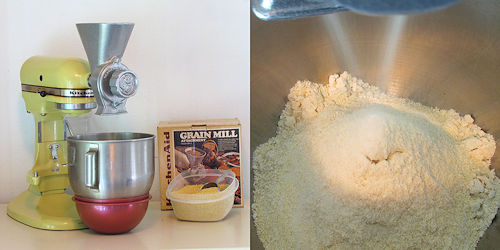
Day 101: It's been a while since I found out that Bob's Red Mill produced a millet flour, and I have to admit I've gotten a little spoiled by having it at my fingertips, ready-made. I used to buy millet in bulk, and although I sometimes used the whole seed in crackers, my primary use for it is as flour, notably substituting it for a portion of the bread flour called for in my favourite sourdough loaf. With Bob's Red Mill in easy reach, the last of my whole seed migrated to the back of the refrigerator freezer and only came to the forefront in response to a sub-vocal question about the contents of the container. "Oh!" said I. "I should grind that and use it up." Thus you see today's project: turning four cups of whole millet into flour. It should only take an hour or so, allowing time for the grain mill to cool down between batches.
Wednesday, September 15, 2021
The Perfect Scotch Pie
Day 337: The recipe is not mine, but it is so delicious that I will give a shout out to John Kirkwood, "a retired cook from the northeast of England in the UK," as he says in the introduction to his YouTube videos, and if you like Scotch Pies, his method couldn't be simpler. I tend to avoid cooking if it involves more than one pan and five minutes of prep time, and I can assure you that weighing the ingredients takes longer than making them. Admittedly, rolling out the crusts and assembling the four pies (three shown here) requires about fifteen minutes, but both the filling and the hot-water pastry can be made a day ahead. The traditional filling is lamb and onion and is what I used for mine, but that could easily be changed up to suit American tastes by using burger or even chicken chunks and mixed veg. Top off your Scotch pie with a bit of simple cornstarch gravy made from stock, and this one is a hands-down win!
Thursday, November 5, 2020
Take A Leek
Day 23: Take a leek...no, take three small leeks, or one large one and...wait, let's start this over. I recently fell heir to three small leeks from a local organic farm and because my previous attempts at making cock-a-leekie soup were almost inedible, I wanted to use them in a different dish. Once again turning to YouTube, I discovered a Greek recipe which I thought I could tweak to suit the ingredients I had on hand. It actually necessitated quite a bit of alteration, so herewith I present to you Crow's Leek-Bacon-Cheddar Crustless Quiche which, incidentally, is quite delicious. Now, to those leeks.
Slice and chop roughly half a cup of cleaned leek. Begin sauteing it over medium heat in 4 Tbsp. of olive oil because it's going to take about 15-20 minutes to cook through. While this is going on, assemble your other ingredients. You will need:
6 large eggs
1/2 cup grated cheddar cheese
3 Tbsp. flour
1 tsp. baking powder
1/2 cup crisped bacon, crumbled
3/4 cup milk
salt and pepper
With a whisk, whip the eggs until they are well-blended. Sift the flour with the baking powder and add it to the eggs, whisking them together thoroughly. The baking powder is optional, but it makes your quiche light and airy. Add the milk, whisking again, and adding salt and pepper as you see fit. Now stir in the cheese, bacon and sauted leeks. Spray an 8-inch baking tin with PAM or similar product, pour in the mixture and bake at 400 degrees for 25-30 minutes or until a toothpick inserted in the center comes out clean. If you have leftovers, they can be refrigerated and reheated in the microwave, but trust me, you're going to want to eat the whole thing.
Friday, November 16, 2018
Fruitcake Season
Day 34: It's fruitcake season, and I mention that, expecting one of two responses. The camps are strongly divided into those who love it and those who hate it and, quite honestly, if I had only been exposed to the commercially-produced varieties, I'd probably be singing a different tune. Homemade is always better, whether it's jams and jellies, biscuits, buns or bread, and fruitcake is no exception. Mine is never the same twice, although the basic recipe is for a "dark" version made with grape juice. The fruits and nuts I use depend on availability and budget. This year's cakes feature only two types of raisin (regular and golden) but have an extra measure of pecans in addition to the candied peels which give a good fruitcake its character. Therein lay an obstacle which nearly made me abandon the project. The only glacé fruit I could find was diced far more finely than I wanted, and never mind that it just came on the market recently when it should have been on the shelves by mid-October when any fruitcake-builder should be baking. After chasing around to every grocery chain within 50 miles, I realized that I was going to have to make do. The larger S&W glacé mix was simply not available, and all of the "house" brands looked as if they had come from the same source. With all the ingredients finally in hand, I baked this morning, two and a half hours for the small loaves, three and a half for the large. They've had their first dose of rum, and I'll add more weekly until Christmas when they'll be ready to eat.
Wednesday, July 25, 2018
The Joy Of Gardening
Day 285: Mmmmmm, such wonderful rewards! This is the second batch of blueberry muffins I've turned out from my three bushes. The two mid-season types accounted for the bulk of the harvest. Oddly, the self-fertile dwarf plant only put on about two dozen berries. I've also picked three nice Oregon Spring tomatoes and a handful or two of Sungolds. "As you sow, so shall you reap!" When you garden with love, you get good returns.
Tuesday, September 12, 2017
Blue Elderberries
Day 334: "It seemed like a good idea at the time." Those words always chime in my head when I see blue elderberries.
When I was growing up, the red-fruited Elderberry was the only one you'd see in the cooler, damper climate of Snohomish County. It wasn't until I moved to southwest Washington that I saw blue Elderberry in abundance. My mother had always told me that the fruits of red Elderberry were poisonous, and while that is not exactly true (they must be cooked before eating), it kept me from nibbling on the ones in our neighbourhood. She also said (correctly) that black or blue Elderberries could be used for pie and jam. As a young housewife, I was tempted by the abundance of dusty blue berries within a short walk of our prairie property, and one afternoon set out with my husband to collect a five-gallon bucketful. Our mission was soon accomplished and we returned to the house for the next phase. That's when it all went south.
Y'see, for all of the fact that they grow in heavy clusters, each one of these berries is only about 5 mm. and consists largely of skin wrapped around hundreds of crunchy little seeds. After crushing the full five gallons and pressing (I might say "squeezing the hell out of") the mash through a jelly bag, the juice extracted would not have filled a quart jar. Perhaps this was the wrong way to approach the project; maybe I should have put them in a pot with some water and boiled them, but I was new to jam and jelly production then, and was following a "live off the land" recipe which I suspect had been written by someone who'd never actually tried to do it themselves. In the end, I chose the only reasonable option. I threw mash and juice onto the compost heap and put the cookbook in the darkest corner of my library.
Older and wiser now, I choose to leave blue Elderberries on the bush for the birdies. "Once bitten, twice shy" is another phrase which comes to mind.
Sunday, October 9, 2016
Double Batch
Day 362: Of all the preserves, jams and jellies I make, my very favourite is Cranberry-Orange Marmalade. I never make enough and always run out before cranberries come on the market the following year. When I discovered that the first crop had come in at the grocery store yesterday, I decided to seize the opportunity to get ahead of the game. I bought enough fruit for a double batch, and have been in the kitchen for the last six hours to produce a final yield of 22 half-pints.
Marmalade is rather time-consuming, but I've learned a few tricks which make preparing the fruit a little easier. Peeling oranges and lemons with a potato peeler provides delightfully thin shavings of rind and avoids adding too much of the bitter white citrus pith which can throw off the taste of the jam. I prefer a "shred" style marmalade with finely sliced pieces of peel rather than chunks, and this is easily accomplished by further cutting the strips of peel with a knife or scissors. The pith remaining on each orange or lemon is discarded along with seeds and as much membrane as it is possible to remove, and then the cleaned segments are put through a grinder. The peels, ground fruit and cranberries are cooked for half an hour with a little soda and water. Then sugar is added to the cooked fruit and processing continues as for any other jam.
Monday, August 8, 2016
Kitchen Music
Day 300: First order of the day...jam up yesterday's gleanings. Last year, the blackberry crop was the poorest I'd ever seen, severely inhibited by hot, dry weather. I'd tried four spots where picking was normally easy, but came home with less than a quart of berries. When I noticed that this year's were beginning to turn black and plump, I decided to strike at once. Since I was already planning to go to Eatonville to see the matinee showing of "Star Trek: Beyond," I loaded bucket, gloves and clippers in the car and left early. Picking wasn't prime, but I soon filled the pail. I juiced them as soon as I got home and let the mash settle overnight. After separating the remaining seeds out this morning, I had exactly four cups of juice, just enough for one batch of seedless blackberry jam. Soon, I was listening to the happy, tinny sound of "Plink! Plink! Plink!" as ten half-pints cooled on the kitchen counter. Not one to let anything edible go to waste, I spread the skimmed foam on homemade toasted sourdough bread for my breakfast. It was worth the wait!